 Add to Chrome
 Add to Firefox
 Add to Edge
Beyond Local Accuracy: A Protocol-Level Identifiability Audit for Controlled LLM Reasoning Evaluation
Aug 13, 2026
LLM benchmark scores can be precise even when the observation protocol does not identify the behavioral property they are intended to measure. In a controlled, solver-grounded setting, we formalize a protocol-level identifiability audit over a finite behavioral policy class: given policies H, observation support O, and estimand $τ$, we test whether O separates every pair with different $τ$. The audit requires zero model calls and resolves our diagnostic case: base-only observation collapses seven frozen deterministic policies into one equivalence class; full support yields seven classes and no cross-estimand collisions; every leave-one-out support retains a constructive collision witness. Empirically, both constrained-generation variants have pair-validity 1.0, yet base accuracy and selective-response fidelity diverge - 0.620 versus 0.324 across six balanced oracle-transition directions (cluster-bootstrap 95% CI [0.600, 0.642] vs. [0.304, 0.345]) - and the gap recurs on a second deterministic source (0.646 vs. 0.331). The audit also synthesizes a minimum identifying support $O^*$ for the frozen policy class: two cells instead of the full 36-cell tensor. This case shows how evaluation-design validity can be checked structurally before model inference and why base correctness does not determine intervention-response fidelity.

Group-specific discriminant analysis reveals statistically validated sex differences in lateralization of brain functional network
Apr 08, 2024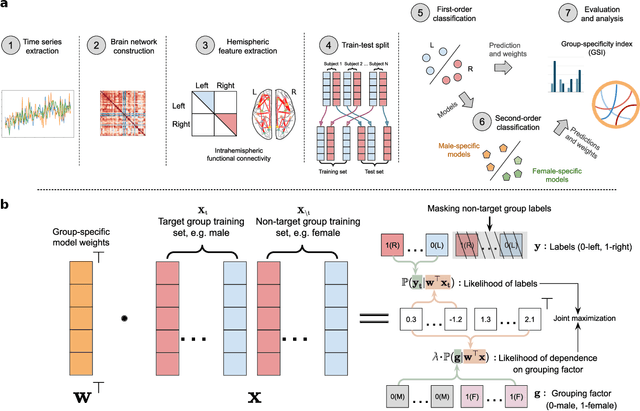

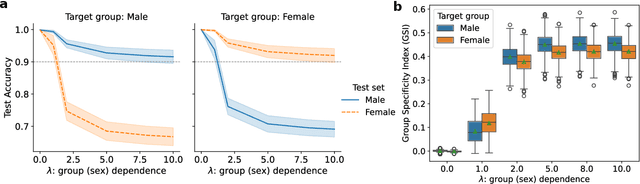

Lateralization is a fundamental feature of the human brain, where sex differences have been observed. Conventional studies in neuroscience on sex-specific lateralization are typically conducted on univariate statistical comparisons between male and female groups. However, these analyses often lack effective validation of group specificity. Here, we formulate modeling sex differences in lateralization of functional networks as a dual-classification problem, consisting of first-order classification for left vs. right functional networks and second-order classification for male vs. female models. To capture sex-specific patterns, we develop the Group-Specific Discriminant Analysis (GSDA) for first-order classification. The evaluation on two public neuroimaging datasets demonstrates the efficacy of GSDA in learning sex-specific models from functional networks, achieving a significant improvement in group specificity over baseline methods. The major sex differences are in the strength of lateralization and the interactions within and between lobes. The GSDA-based method is generic in nature and can be adapted to other group-specific analyses such as handedness-specific or disease-specific analyses.