 Add to Chrome
 Add to Firefox
 Add to Edge
High-Resolution Artwork Outpainting with Global Blueprint Guidance and Layout Control
Jul 07, 2026
Image outpainting extends an image beyond its original borders, requiring seamless style integration and globally coherent scene completion. Building on the success of diffusion models, recent methods have achieved substantial improvements in visual quality. In practice, however, high-resolution outpainting is commonly performed via progressive expansion around a fixed source image, particularly in artwork scenarios. Despite this progress, existing approaches still suffer from three key limitations: (i) the absence of a reliable global planning mechanism, which leads to structural instability and error accumulation at high resolutions; (ii) limited spatial controllability beyond text prompts, making it difficult to place objects at user-specified locations; and (iii) high inference latency caused by inherently sequential patch generation. To address these issues, we propose a global blueprint-guided two-stage diffusion framework for layout-controllable high-resolution outpainting with efficient parallel synthesis. In Stage 1, we generate a low-resolution global blueprint using a layout adapter that injects bounding-box conditions into a Stable Diffusion inpainting backbone, producing a globally consistent structural plan while extracting global guidance features. In Stage 2, we synthesize high-resolution local patches in parallel by injecting the blueprint-derived global guidance and initializing each patch from the blueprint using the low-frequency preservation property of forward diffusion. This design eliminates sequential dependency while maintaining global coherence. Extensive experiments on large-scale artwork datasets demonstrate improved visual fidelity, stronger semantic consistency, and substantially reduced inference time compared to prior baselines, while uniquely supporting explicit layout control for artwork outpainting.

Is user feedback always informative? Retrieval Latent Defending for Semi-Supervised Domain Adaptation without Source Data
Jul 22, 2024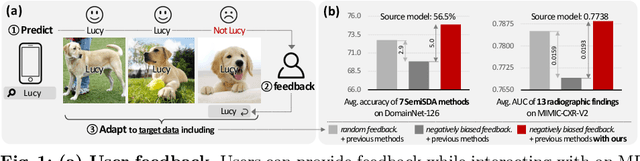


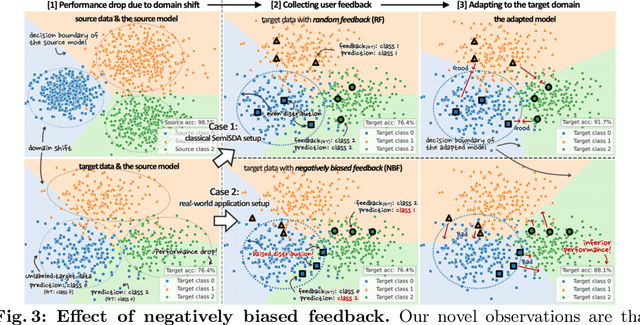
This paper aims to adapt the source model to the target environment, leveraging small user feedback (i.e., labeled target data) readily available in real-world applications. We find that existing semi-supervised domain adaptation (SemiSDA) methods often suffer from poorly improved adaptation performance when directly utilizing such feedback data, as shown in Figure 1. We analyze this phenomenon via a novel concept called Negatively Biased Feedback (NBF), which stems from the observation that user feedback is more likely for data points where the model produces incorrect predictions. To leverage this feedback while avoiding the issue, we propose a scalable adapting approach, Retrieval Latent Defending. This approach helps existing SemiSDA methods to adapt the model with a balanced supervised signal by utilizing latent defending samples throughout the adaptation process. We demonstrate the problem caused by NBF and the efficacy of our approach across various benchmarks, including image classification, semantic segmentation, and a real-world medical imaging application. Our extensive experiments reveal that integrating our approach with multiple state-of-the-art SemiSDA methods leads to significant performance improvements.
Enhancing Breast Cancer Risk Prediction by Incorporating Prior Images
Mar 28, 2023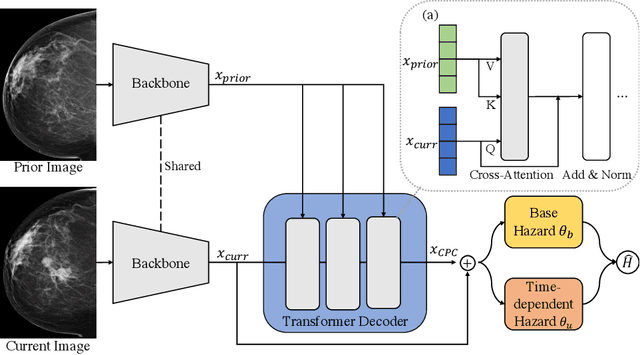
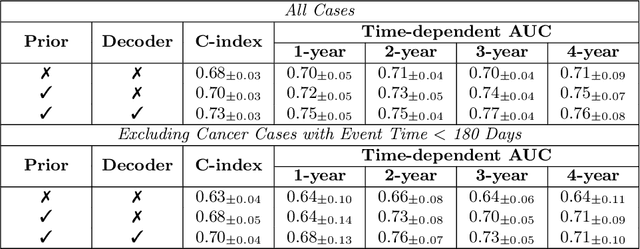
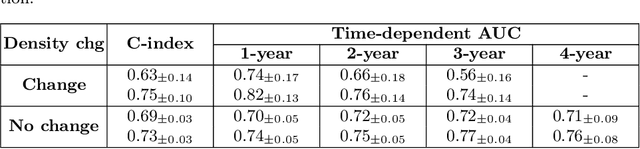
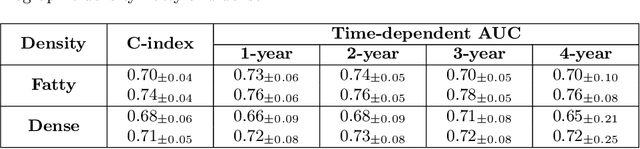
Recently, deep learning models have shown the potential to predict breast cancer risk and enable targeted screening strategies, but current models do not consider the change in the breast over time. In this paper, we present a new method, PRIME+, for breast cancer risk prediction that leverages prior mammograms using a transformer decoder, outperforming a state-of-the-art risk prediction method that only uses mammograms from a single time point. We validate our approach on a dataset with 16,113 exams and further demonstrate that it effectively captures patterns of changes from prior mammograms, such as changes in breast density, resulting in improved short-term and long-term breast cancer risk prediction. Experimental results show that our model achieves a statistically significant improvement in performance over the state-of-the-art based model, with a C-index increase from 0.68 to 0.73 (p < 0.05) on held-out test sets.
Learning to Adapt to Unseen Abnormal Activities under Weak Supervision
Mar 25, 2022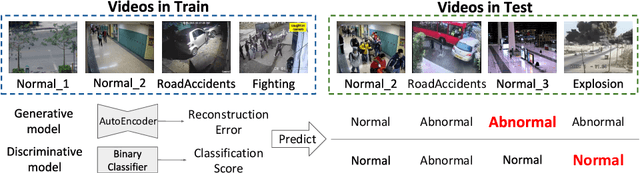

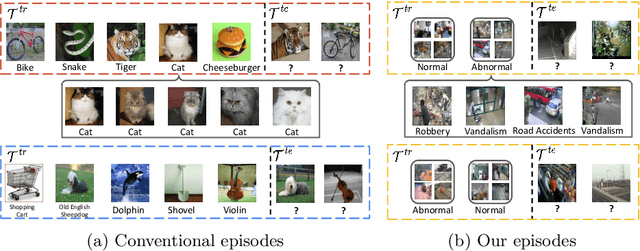
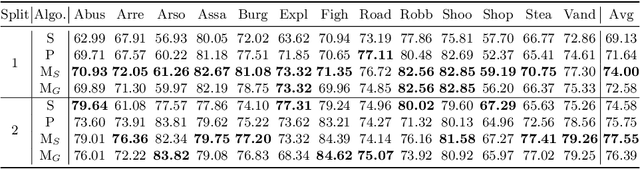
We present a meta-learning framework for weakly supervised anomaly detection in videos, where the detector learns to adapt to unseen types of abnormal activities effectively when only video-level annotations of binary labels are available. Our work is motivated by the fact that existing methods suffer from poor generalization to diverse unseen examples. We claim that an anomaly detector equipped with a meta-learning scheme alleviates the limitation by leading the model to an initialization point for better optimization. We evaluate the performance of our framework on two challenging datasets, UCF-Crime and ShanghaiTech. The experimental results demonstrate that our algorithm boosts the capability to localize unseen abnormal events in a weakly supervised setting. Besides the technical contributions, we perform the annotation of missing labels in the UCF-Crime dataset and make our task evaluated effectively.