 Add to Chrome
 Add to Firefox
 Add to Edge
StrAD: A Streaming Method and Benchmark for Audio Description Generation for Long-form Videos
Aug 12, 2026
Visual content is the dominant medium of communication, yet without audio descriptions (ADs), it remains inaccessible to blind and low-vision people. ADs narrate context-relevant visual events during natural audio pauses. Manually creating ADs is expensive, limiting coverage to a small fraction of available content. Most existing automatic AD generation methods frame the task as video clip captioning, requiring ground-truth timestamps and additional context cues such as character databases. Current benchmarks reinforce this framing, consisting of short video segments paired with automatic or task-mismatched annotations. We introduce StrAD, a benchmark for long-form AD generation on full-length videos spanning diverse genres such as movies, documentaries, short films, performances, and video games. We reformulate AD generation as streaming dense video captioning. Our approach processes full-length videos with a sliding window, inserting ADs into existing transcripts without ground-truth timestamps, and supports both fine-tuned models and zero-shot prompting of vision-language models. On the segment-level task with given timestamps, our fine-tuned StrAD-FT sets the state of the art on CMD-AD with 36.3 CIDEr (+10.0 over Shot-by-shot), establishes a reference point on StrAD (51.0 CIDEr), and remains competitive on MAD-Eval at 24.9 CIDEr. On the full-video streaming task, StrAD-FT reaches a SODA score of 2.4 against 1.1 for our zero-shot baseline StrAD-Zero, though both exhibit limitations in temporal localization and narrative coherence. While prior work has tackled full-video AD generation in an offline, multi-stage fashion, ours is the first streaming approach, generating ADs on the fly without ground-truth timestamps. StrAD makes progress on full-video AD generation measurable, a prerequisite for scaling accessibility.

Florenz: Scaling Laws for Systematic Generalization in Vision-Language Models
Mar 12, 2025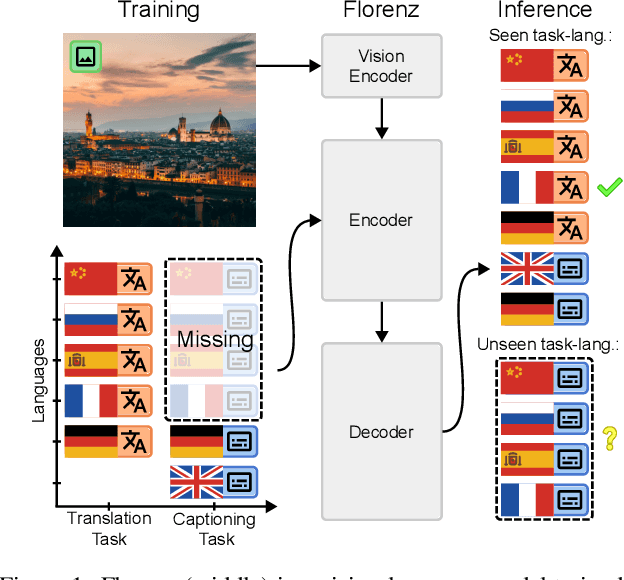
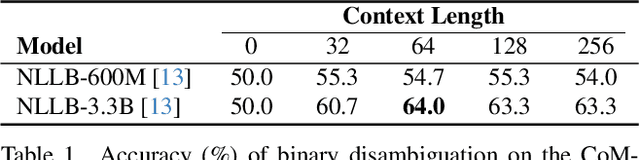
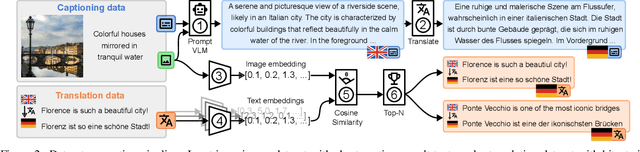
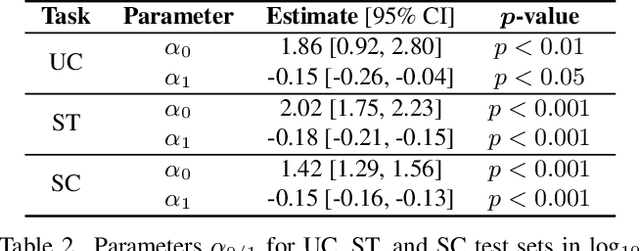
Cross-lingual transfer enables vision-language models (VLMs) to perform vision tasks in various languages with training data only in one language. Current approaches rely on large pre-trained multilingual language models. However, they face the curse of multilinguality, sacrificing downstream task performance for multilingual capabilities, struggling with lexical ambiguities, and falling behind recent advances. In this work, we study the scaling laws of systematic generalization with monolingual VLMs for multilingual tasks, focusing on the impact of model size and seen training samples. We propose Florenz, a monolingual encoder-decoder VLM with 0.4B to 11.2B parameters combining the pre-trained VLM Florence-2 and the large language model Gemma-2. Florenz is trained with varying compute budgets on a synthetic dataset that features intentionally incomplete language coverage for image captioning, thus, testing generalization from the fully covered translation task. We show that not only does indirectly learning unseen task-language pairs adhere to a scaling law, but also that with our data generation pipeline and the proposed Florenz model family, image captioning abilities can emerge in a specific language even when only data for the translation task is available. Fine-tuning on a mix of downstream datasets yields competitive performance and demonstrates promising scaling trends in multimodal machine translation (Multi30K, CoMMuTE), lexical disambiguation (CoMMuTE), and image captioning (Multi30K, XM3600, COCO Karpathy).
HyenaPixel: Global Image Context with Convolutions
Feb 29, 2024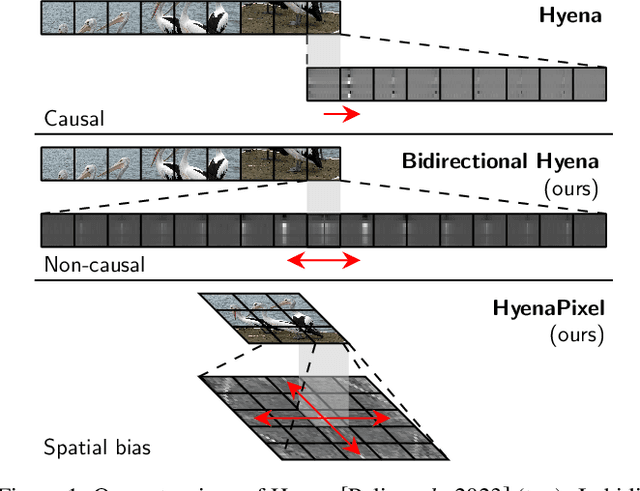
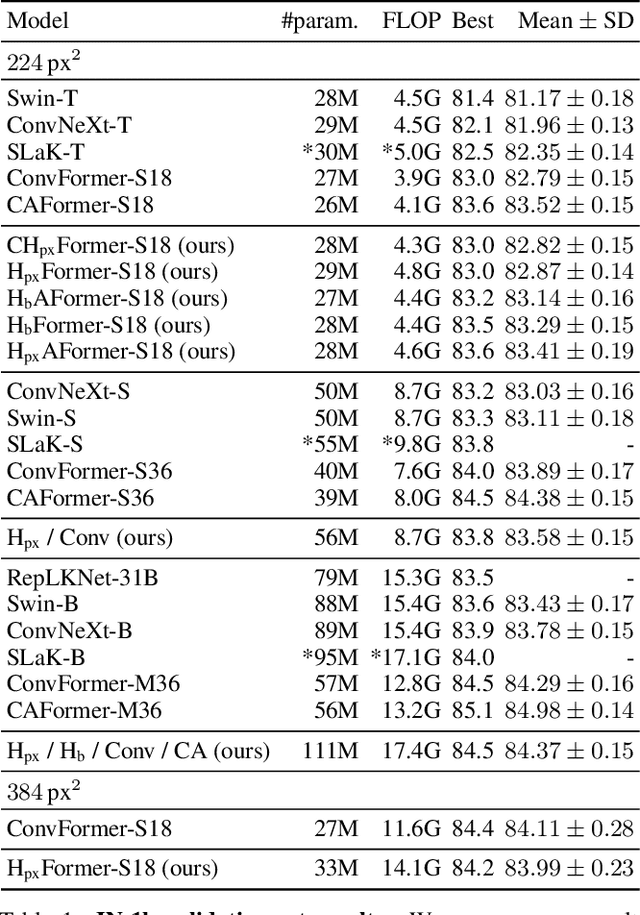
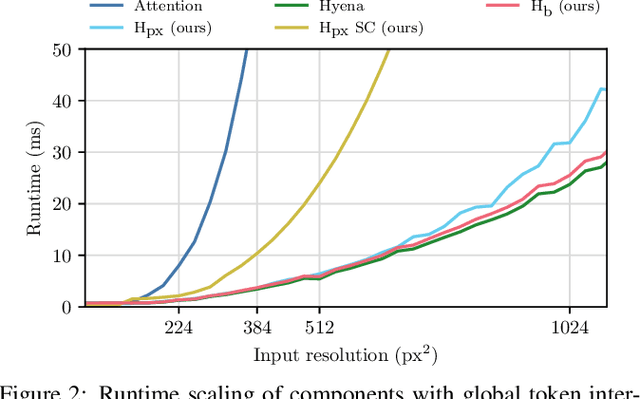
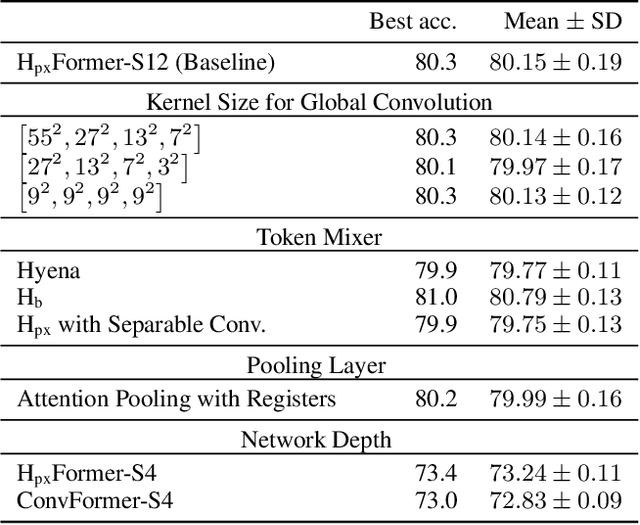
In vision tasks, a larger effective receptive field (ERF) is associated with better performance. While attention natively supports global context, convolution requires multiple stacked layers and a hierarchical structure for large context. In this work, we extend Hyena, a convolution-based attention replacement, from causal sequences to the non-causal two-dimensional image space. We scale the Hyena convolution kernels beyond the feature map size up to 191$\times$191 to maximize the ERF while maintaining sub-quadratic complexity in the number of pixels. We integrate our two-dimensional Hyena, HyenaPixel, and bidirectional Hyena into the MetaFormer framework. For image categorization, HyenaPixel and bidirectional Hyena achieve a competitive ImageNet-1k top-1 accuracy of 83.0% and 83.5%, respectively, while outperforming other large-kernel networks. Combining HyenaPixel with attention further increases accuracy to 83.6%. We attribute the success of attention to the lack of spatial bias in later stages and support this finding with bidirectional Hyena.