 Add to Chrome
 Add to Firefox
 Add to Edge
ID-Sim: An Identity-Focused Similarity Metric
Apr 06, 2026
Humans have remarkable selective sensitivity to identities -- easily distinguishing between highly similar identities, even across significantly different contexts such as diverse viewpoints or lighting. Vision models have struggled to match this capability, and progress toward identity-focused tasks such as personalized image generation is slowed by a lack of identity-focused evaluation metrics. To help facilitate progress, we propose ID-Sim, a feed-forward metric designed to faithfully reflect human selective sensitivity. To build ID-Sim, we curate a high-quality training set of images spanning diverse real-world domains, augmented with generative synthetic data that provides controlled, fine-grained identity and contextual variations. We evaluate our metric on a new unified evaluation benchmark for assessing consistency with human annotations across identity-focused recognition, retrieval, and generative tasks.

TaxaAdapter: Vision Taxonomy Models are Key to Fine-grained Image Generation over the Tree of Life
Mar 27, 2026Accurately generating images across the Tree of Life is difficult: there are over 10M distinct species on Earth, many of which differ only by subtle visual traits. Despite the remarkable progress in text-to-image synthesis, existing models often fail to capture the fine-grained visual cues that define species identity, even when their outputs appear photo-realistic. To this end, we propose TaxaAdapter, a simple and lightweight approach that incorporates Vision Taxonomy Models (VTMs) such as BioCLIP to guide fine-grained species generation. Our method injects VTM embeddings into a frozen text-to-image diffusion model, improving species-level fidelity while preserving flexible text control over attributes such as pose, style, and background. Extensive experiments demonstrate that TaxaAdapter consistently improves morphology fidelity and species-identity accuracy over strong baselines, with a cleaner architecture and training recipe. To better evaluate these improvements, we also introduce a multimodal Large Language Model-based metric that summarizes trait-level descriptions from generated and real images, providing a more interpretable measure of morphological consistency. Beyond this, we observe that TaxaAdapter exhibits strong generalization capabilities, enabling species synthesis in challenging regimes such as few-shot species with only a handful of training images and even species unseen during training. Overall, our results highlight that VTMs are a key ingredient for scalable, fine-grained species generation.
Finer-Personalization Rank: Fine-Grained Retrieval Examines Identity Preservation for Personalized Generation
Dec 22, 2025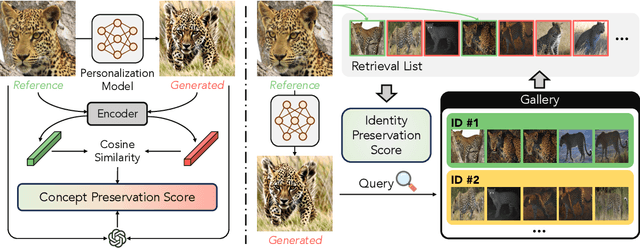
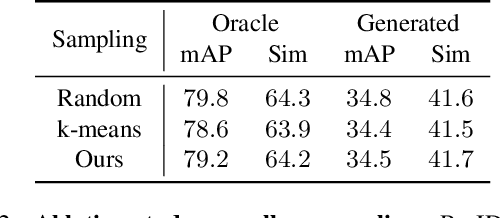
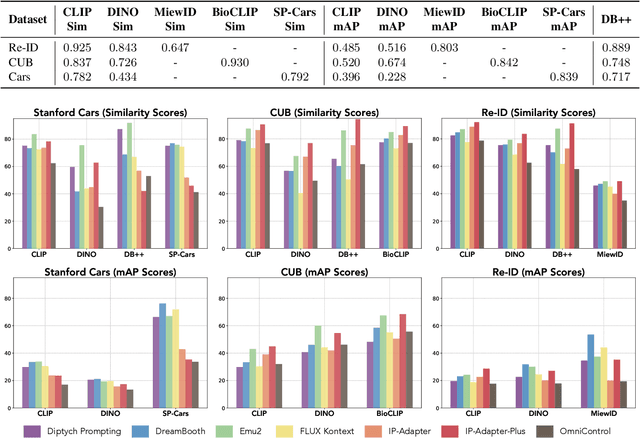

The rise of personalized generative models raises a central question: how should we evaluate identity preservation? Given a reference image (e.g., one's pet), we expect the generated image to retain precise details attached to the subject's identity. However, current generative evaluation metrics emphasize the overall semantic similarity between the reference and the output, and overlook these fine-grained discriminative details. We introduce Finer-Personalization Rank, an evaluation protocol tailored to identity preservation. Instead of pairwise similarity, Finer-Personalization Rank adopts a ranking view: it treats each generated image as a query against an identity-labeled gallery consisting of visually similar real images. Retrieval metrics (e.g., mean average precision) measure performance, where higher scores indicate that identity-specific details (e.g., a distinctive head spot) are preserved. We assess identity at multiple granularities -- from fine-grained categories (e.g., bird species, car models) to individual instances (e.g., re-identification). Across CUB, Stanford Cars, and animal Re-ID benchmarks, Finer-Personalization Rank more faithfully reflects identity retention than semantic-only metrics and reveals substantial identity drift in several popular personalization methods. These results position the gallery-based protocol as a principled and practical evaluation for personalized generation.
INQUIRE-Search: A Framework for Interactive Discovery in Large-Scale Biodiversity Databases
Nov 19, 2025
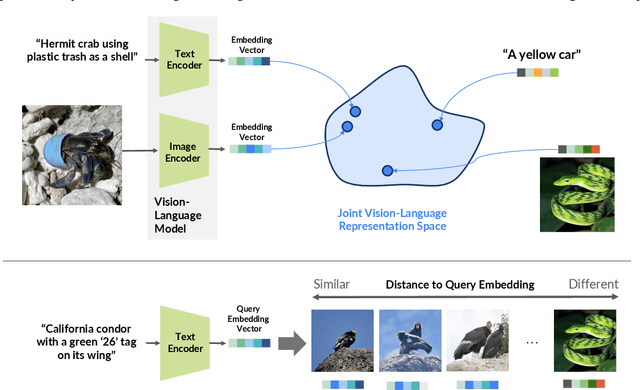
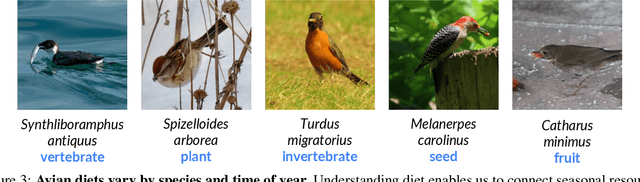
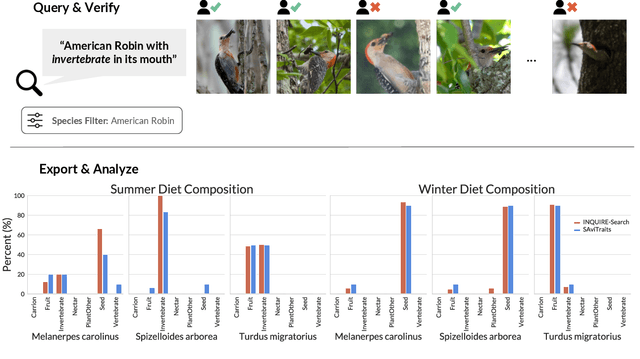
Large community science platforms such as iNaturalist contain hundreds of millions of biodiversity images that often capture ecological context on behaviors, interactions, phenology, and habitat. Yet most ecological workflows rely on metadata filtering or manual inspection, leaving this secondary information inaccessible at scale. We introduce INQUIRE-Search, an open-source system that enables scientists to rapidly and interactively search within an ecological image database for specific concepts using natural language, verify and export relevant observations, and utilize this discovered data for novel scientific analysis. Compared to traditional methods, INQUIRE-Search takes a fraction of the time, opening up new possibilities for scientific questions that can be explored. Through five case studies, we show the diversity of scientific applications that a tool like INQUIRE-Search can support, from seasonal variation in behavior across species to forest regrowth after wildfires. These examples demonstrate a new paradigm for interactive, efficient, and scalable scientific discovery that can begin to unlock previously inaccessible scientific value in large-scale biodiversity datasets. Finally, we emphasize using such AI-enabled discovery tools for science call for experts to reframe the priorities of the scientific process and develop novel methods for experiment design, data collection, survey effort, and uncertainty analysis.
Personalized Representation from Personalized Generation
Dec 20, 2024Modern vision models excel at general purpose downstream tasks. It is unclear, however, how they may be used for personalized vision tasks, which are both fine-grained and data-scarce. Recent works have successfully applied synthetic data to general-purpose representation learning, while advances in T2I diffusion models have enabled the generation of personalized images from just a few real examples. Here, we explore a potential connection between these ideas, and formalize the challenge of using personalized synthetic data to learn personalized representations, which encode knowledge about an object of interest and may be flexibly applied to any downstream task relating to the target object. We introduce an evaluation suite for this challenge, including reformulations of two existing datasets and a novel dataset explicitly constructed for this purpose, and propose a contrastive learning approach that makes creative use of image generators. We show that our method improves personalized representation learning for diverse downstream tasks, from recognition to segmentation, and analyze characteristics of image generation approaches that are key to this gain.
Categorical Depth Distribution Network for Monocular 3D Object Detection
Mar 01, 2021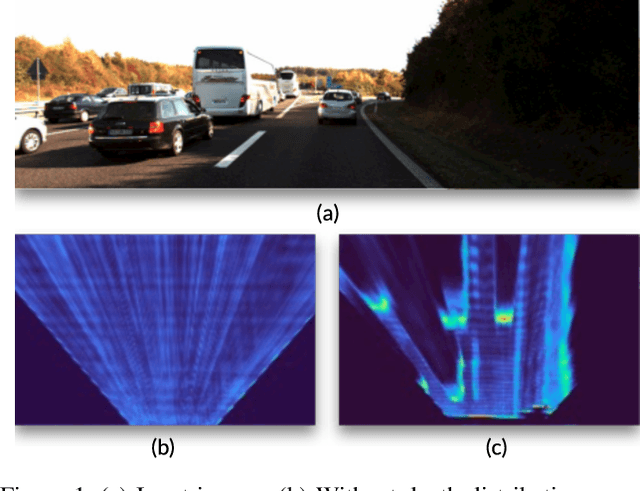
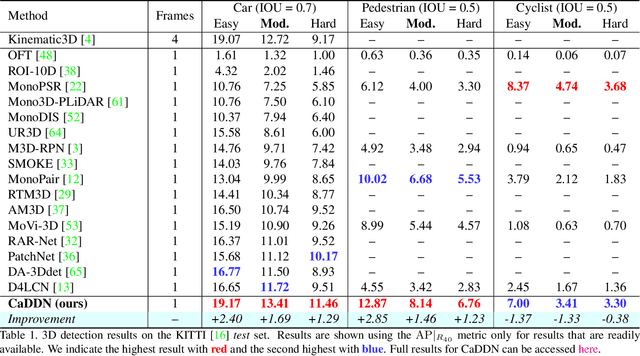
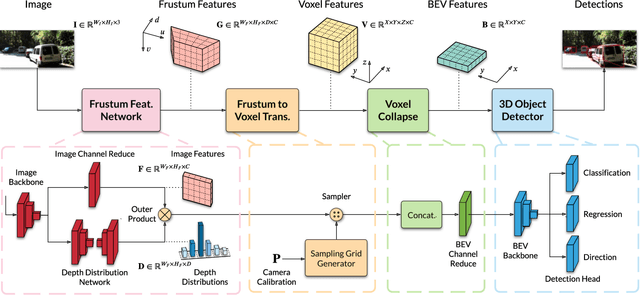
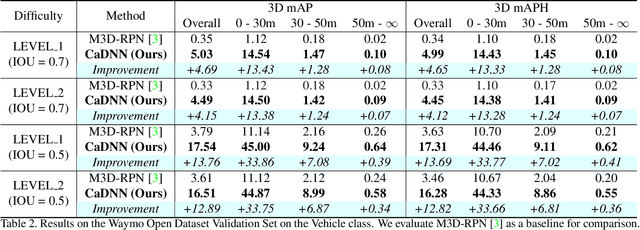
Monocular 3D object detection is a key problem for autonomous vehicles, as it provides a solution with simple configuration compared to typical multi-sensor systems. The main challenge in monocular 3D detection lies in accurately predicting object depth, which must be inferred from object and scene cues due to the lack of direct range measurement. Many methods attempt to directly estimate depth to assist in 3D detection, but show limited performance as a result of depth inaccuracy. Our proposed solution, Categorical Depth Distribution Network (CaDDN), uses a predicted categorical depth distribution for each pixel to project rich contextual feature information to the appropriate depth interval in 3D space. We then use the computationally efficient bird's-eye-view projection and single-stage detector to produce the final output bounding boxes. We design CaDDN as a fully differentiable end-to-end approach for joint depth estimation and object detection. We validate our approach on the KITTI 3D object detection benchmark, where we rank 1st among published monocular methods. We also provide the first monocular 3D detection results on the newly released Waymo Open Dataset. The source code for CaDDN will be made publicly available before publication.