 Add to Chrome
 Add to Firefox
 Add to Edge
Millimeter-Wave Dual-Polarized Omnidirectional Reference Antennas for Total Array Gain Evaluation
Jul 13, 2026
The present manuscript introduces a compact millimeter-wave dual-polarized reference antenna module designed for performance comparison of handset antenna arrays in multipath environments. Both vertically- and horizontally-polarized fields are covered with sufficiently wide impedance bandwidths and low gain variation along the horizontal plane. When integrated into a compact dual-polarized antenna module, the mutual coupling between the antennas is well controlled to ensure minimal distortion in the radiation patterns. Measurements confirm that the proposed antenna module achieves the designed low gain variation and almost identical realized gains for the two polarizations.

Permittivity Characterization of Human Skin Based on a Quasi-optical System at Sub-THz
May 20, 2024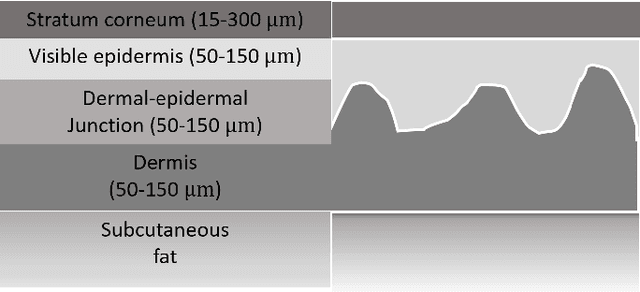
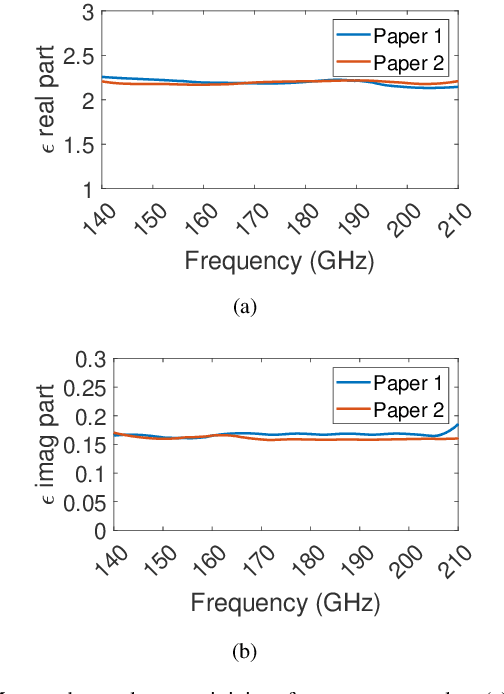
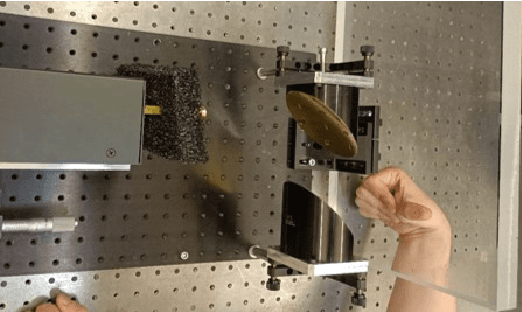
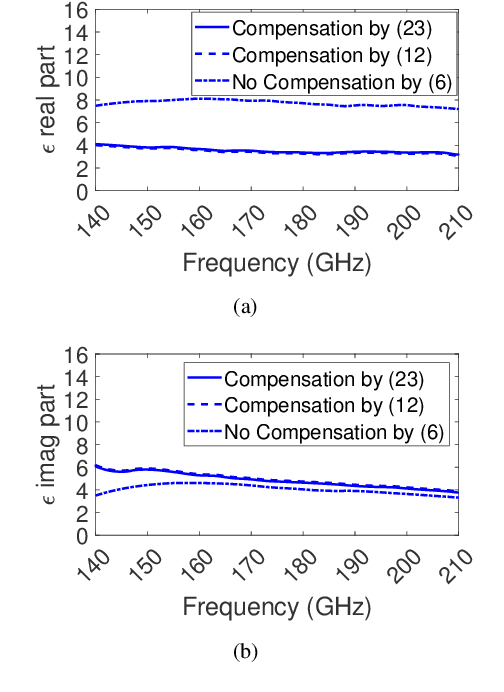
This paper introduces a novel approach to experimentally characterize effective human skin permittivity at sub-Terahertz (sub-THz) frequencies, specifically from $140$~to $210$~GHz, utilizing a quasi-optical measurement system. To ensure accurate measurement of the reflection coefficients of human skin, a planar, rigid, and thick reference plate with a low-loss dielectric is utilized to flatten the human skin surface. A permittivity characterization method is proposed to reduce permittivity estimation deviations resulting from the pressure effects on the phase displacements of skins under the measurements but also to ensure repeatability of the measurement. In practical permittivity characterizations, the complex permittivities of the finger, palm, and arm of seven volunteers show small standard deviations for the repeated measurements, respectively, while those show significant variations across different regions of the skins and for different persons. The proposed measurement system holds significant potential for future skin permittivity estimation in sub-THz bands, facilitating further studies on human-electromagnetic-wave interactions based on the measured permittivity values.
Complex Permittivity Characterization of Low-Loss Dielectric Slabs at Sub-THz
May 09, 2024This manuscript presents a novel method for characterizing the permittivities of low-loss dielectric slabs in sub-terahertz (sub-THz) frequencies, specifically above 100 GHz using a quasi-optical system. The algorithm is introduced with detailed derivations, and the measurement sensitivity is analyzed through simulations. Subsequently, the method's validity is established via simulations, demonstrating high accuracy (error 0.1% for the loss tangent) for a 30 mm thick plate material and relatively lower accuracy (error <5% for the loss tangent) for a 6 mm thick plate material. Notably, this accuracy surpasses that of the approach presented in [1] when the same window width is used to extract signals. Furthermore, a comparison between the permittivities of plexiglass with a 30 mm thickness characterized by the proposed method and the approach in [1] reveals a maximum difference in the dielectric constant of 0.011 and in loss tangent of 0.00071 from 140 to 220 GHz. Finally, the relative complex permittivities of plexiglass at 142.86 GHz obtained by both methods are compared with the reference values provided in [2], exhibiting differences of 0.06 in the dielectric constant.