 Add to Chrome
 Add to Firefox
 Add to Edge
MolDeTox: Evaluating Language Model's Stepwise Fragment Editing for Molecular Detoxification
May 12, 2026
Large Language Models (LLMs) and Vision Language Models (VLMs) have recently shown promising capabilities in various scientific domain. In particular, these advances have opened new opportunities in drug discovery, where the ability to understand and modify molecular structures is critical for optimizing drug properties such as efficacy and toxicity. However, existing models and benchmarks often overlook toxicity-related challenges, focusing primarily on general property optimization without adequately addressing safety concerns. In addition, even existing toxicity repair benchmarks suffer from limited data diversity, low structural validity of generated molecules, and heavy reliance on proxy models for toxicity assessment. To address these limitations, we propose MolDeTox, a novel benchmark for molecular detoxification, designed to enable fine-grained and reliable evaluation of toxicity-aware molecular optimization across stepwise tasks. We evaluate a wide range of general-purpose LLMs and VLMs under diverse settings, and demonstrate that understanding and generating molecules at the fragment-level improves structural validity and enhances the quality of generated molecules. Moreover, through detailed task-level performance analysis, MolDeTox provides an interpretable benchmark that enables a deeper understanding of the detoxification process. Our dataset is available at : https://huggingface.co/datasets/MolDeTox/MolDeTox

ToxReason: A Benchmark for Mechanistic Chemical Toxicity Reasoning via Adverse Outcome Pathway
Apr 07, 2026Recent advances in large language models (LLMs) have enabled molecular reasoning for property prediction. However, toxicity arises from complex biological mechanisms beyond chemical structure, necessitating mechanistic reasoning for reliable prediction. Despite its importance, current benchmarks fail to systematically evaluate this capability. LLMs can generate fluent but biologically unfaithful explanations, making it difficult to assess whether predicted toxicities are grounded invalid mechanisms. To bridge this gap, we introduce ToxReason, a benchmark grounded in the Adverse Outcome Pathway (AOP) that evaluates organ-level toxicity reasoning across multiple organs. ToxReason integrates experimental drug-target interaction evidence with toxicity labels, requiring models to infer both toxic outcomes and their underlying mechanisms from Molecular Initiating Event (MIE) to Adverse Outcome (AO). Using ToxReason, we evaluate toxicity prediction performance and reasoning quality across diverse LLMs. We find that strong predictive performance does not necessarily imply reliable reasoning. Furthermore, we show that reasoning-aware training improves mechanistic reasoning and, consequently, toxicity prediction performance. Together, these results underscore the necessity of integrating reasoning into both evaluation and training for trustworthy toxicity modeling.
ATTNSOM: Learning Cross-Isoform Attention for Cytochrome P450 Site-of-Metabolism
Jan 28, 2026Identifying metabolic sites where cytochrome P450 enzymes metabolize small-molecule drugs is essential for drug discovery. Although existing computational approaches have been proposed for site-of-metabolism prediction, they typically ignore cytochrome P450 isoform identity or model isoforms independently, thereby failing to fully capture inherent cross-isoform metabolic patterns. In addition, prior evaluations often rely on top-k metrics, where false positive atoms may be included among the top predictions, underscoring the need for complementary metrics that more directly assess binary atom-level discrimination under severe class imbalance. We propose ATTNSOM, an atom-level site-of-metabolism prediction framework that integrates intrinsic molecular reactivity with cross-isoform relationships. The model combines a shared graph encoder, molecule-conditioned atom representations, and a cross-attention mechanism to capture correlated metabolic patterns across cytochrome P450 isoforms. The model is evaluated on two benchmark datasets annotated with site-of-metabolism labels at atom resolution. Across these benchmarks, the model achieves consistently strong top-k performance across multiple cytochrome P450 isoforms. Relative to ablated variants, the model yields higher Matthews correlation coefficient, indicating improved discrimination of true metabolic sites. These results support the importance of explicitly modeling cross-isoform relationships for site-of-metabolism prediction. The code and datasets are available at https://github.com/dmis-lab/ATTNSOM.
CRADLE-VAE: Enhancing Single-Cell Gene Perturbation Modeling with Counterfactual Reasoning-based Artifact Disentanglement
Sep 10, 2024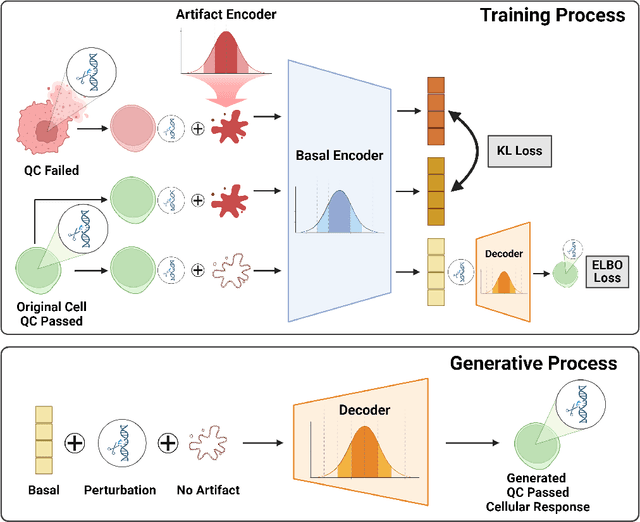
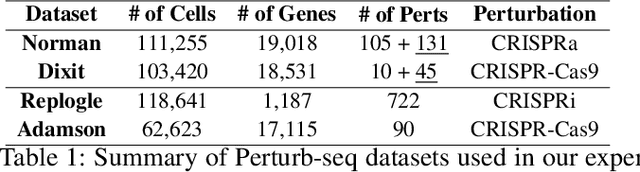
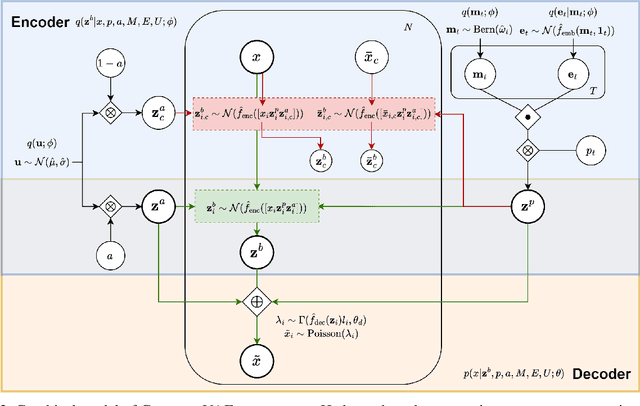
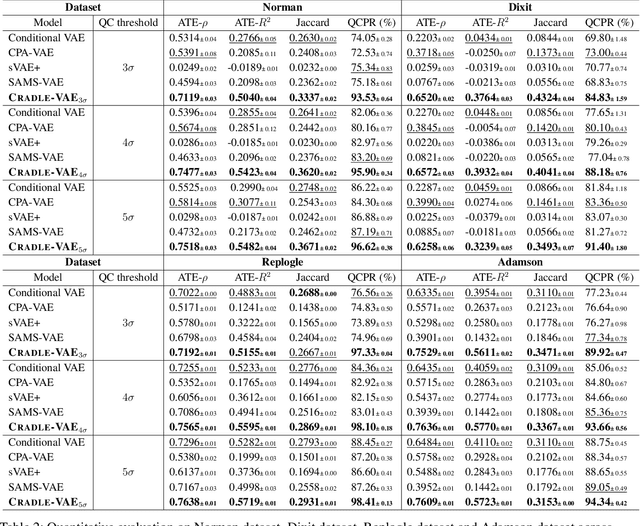
Predicting cellular responses to various perturbations is a critical focus in drug discovery and personalized therapeutics, with deep learning models playing a significant role in this endeavor. Single-cell datasets contain technical artifacts that may hinder the predictability of such models, which poses quality control issues highly regarded in this area. To address this, we propose CRADLE-VAE, a causal generative framework tailored for single-cell gene perturbation modeling, enhanced with counterfactual reasoning-based artifact disentanglement. Throughout training, CRADLE-VAE models the underlying latent distribution of technical artifacts and perturbation effects present in single-cell datasets. It employs counterfactual reasoning to effectively disentangle such artifacts by modulating the latent basal spaces and learns robust features for generating cellular response data with improved quality. Experimental results demonstrate that this approach improves not only treatment effect estimation performance but also generative quality as well. The CRADLE-VAE codebase is publicly available at https://github.com/dmis-lab/CRADLE-VAE.
MolPLA: A Molecular Pretraining Framework for Learning Cores, R-Groups and their Linker Joints
Jan 30, 2024Molecular core structures and R-groups are essential concepts in drug development. Integration of these concepts with conventional graph pre-training approaches can promote deeper understanding in molecules. We propose MolPLA, a novel pre-training framework that employs masked graph contrastive learning in understanding the underlying decomposable parts inmolecules that implicate their core structure and peripheral R-groups. Furthermore, we formulate an additional framework that grants MolPLA the ability to help chemists find replaceable R-groups in lead optimization scenarios. Experimental results on molecular property prediction show that MolPLA exhibits predictability comparable to current state-of-the-art models. Qualitative analysis implicate that MolPLA is capable of distinguishing core and R-group sub-structures, identifying decomposable regions in molecules and contributing to lead optimization scenarios by rationally suggesting R-group replacements given various query core templates. The code implementation for MolPLA and its pre-trained model checkpoint is available at https://github.com/dmis-lab/MolPLA