 Add to Chrome
 Add to Firefox
 Add to Edge
The Push-Forward Transform for Continuous and Robust Comparison of Dynamic Shapes
Aug 03, 2026
We introduce a mathematical framework for shape comparison based on mapping functions from the shape domain to a common reference domain. This Push-Forward Transform enables invariant and robust comparison of shapes, preserving intrinsic geometric information. Quantitatively comparing shapes and their temporal evolution is a fundamental challenge in image analysis. Meaningful shape comparison requires representations that are invariant to transformations that do not alter shape itself, such as translation, rotation, reflection, re-parametrization, and uniform scaling, while remaining sensitive to intrinsic geometric variation. Existing approaches often rely on sensitive parameterizations, landmark correspondence, or learned representations that are difficult to interpret and reproduce. We show that the Push-Forward Transform (PF-T) applied to Signed Distance Functions (SDFs) yields a continuous representation that captures both boundary and interior geometry. We derive an interpretable morphometric that quantifies shape similarity and reveals features such as skeletal topology and rotational symmetries. The push-forward transform applies consistently to two- and three-dimensional shapes, extends to time-evolving geometries, and supports the joint analysis of shape and additional scalar fields defined over shapes, such as intensity or molecular signals. We present the mathematical formulation, describe an efficient algorithm, and benchmark the approach on 2D, 3D, and temporal data sets.

Ensuring Topological Data-Structure Preservation under Autoencoder Compression due to Latent Space Regularization in Gauss--Legendre nodes
Sep 21, 2023


We formulate a data independent latent space regularisation constraint for general unsupervised autoencoders. The regularisation rests on sampling the autoencoder Jacobian in Legendre nodes, being the centre of the Gauss-Legendre quadrature. Revisiting this classic enables to prove that regularised autoencoders ensure a one-to-one re-embedding of the initial data manifold to its latent representation. Demonstrations show that prior proposed regularisation strategies, such as contractive autoencoding, cause topological defects already for simple examples, and so do convolutional based (variational) autoencoders. In contrast, topological preservation is ensured already by standard multilayer perceptron neural networks when being regularised due to our contribution. This observation extends through the classic FashionMNIST dataset up to real world encoding problems for MRI brain scans, suggesting that, across disciplines, reliable low dimensional representations of complex high-dimensional datasets can be delivered due to this regularisation technique.
Learning Partial Differential Equations by Spectral Approximates of General Sobolev Spaces
Jan 12, 2023

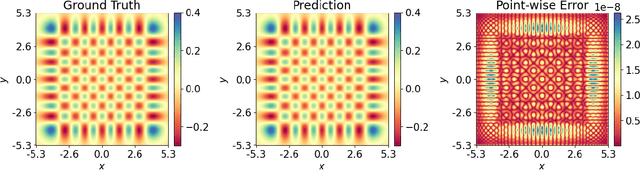

We introduce a novel spectral, finite-dimensional approximation of general Sobolev spaces in terms of Chebyshev polynomials. Based on this polynomial surrogate model (PSM), we realise a variational formulation, solving a vast class of linear and non-linear partial differential equations (PDEs). The PSMs are as flexible as the physics-informed neural nets (PINNs) and provide an alternative for addressing inverse PDE problems, such as PDE-parameter inference. In contrast to PINNs, the PSMs result in a convex optimisation problem for a vast class of PDEs, including all linear ones, in which case the PSM-approximate is efficiently computable due to the exponential convergence rate of the underlying variational gradient descent. As a practical consequence prominent PDE problems were resolved by the PSMs without High Performance Computing (HPC) on a local machine. This gain in efficiency is complemented by an increase of approximation power, outperforming PINN alternatives in both accuracy and runtime. Beyond the empirical evidence we give here, the translation of classic PDE theory in terms of the Sobolev space approximates suggests the PSMs to be universally applicable to well-posed, regular forward and inverse PDE problems.