 Add to Chrome
 Add to Firefox
 Add to Edge
Toward a Unified Semantic Loss Model for Deep JSCC-based Transmission of EO Imagery
Jan 28, 2026
Modern Earth Observation (EO) systems increasingly rely on high-resolution imagery to support critical applications such as environmental monitoring, disaster response, and land-use analysis. Although these applications benefit from detailed visual data, the resulting data volumes impose significant challenges on satellite communication systems constrained by limited bandwidth, power, and dynamic link conditions. To address these limitations, this paper investigates Deep Joint Source-Channel Coding (DJSCC) as an effective source-channel paradigm for the transmission of EO imagery. We focus on two complementary aspects of semantic loss in DJSCC-based systems. First, a reconstruction-centric framework is evaluated by analyzing the semantic degradation of reconstructed images under varying compression ratios and channel signal-to-noise ratios (SNR). Second, a task-oriented framework is developed by integrating DJSCC with lightweight, application-specific models (e.g., EfficientViT), with performance measured using downstream task accuracy rather than pixel-level fidelity. Based on extensive empirical analysis, we propose a unified semantic loss framework that captures both reconstruction-centric and task-oriented performance within a single model. This framework characterizes the implicit relationship between JSCC compression, channel SNR, and semantic quality, offering actionable insights for the design of robust and efficient EO imagery transmission under resource-constrained satellite links.

A Semantic-Loss Function Modeling Framework With Task-Oriented Machine Learning Perspectives
Mar 12, 2025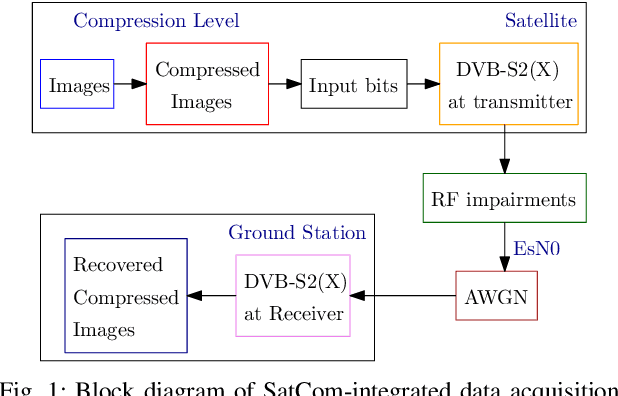
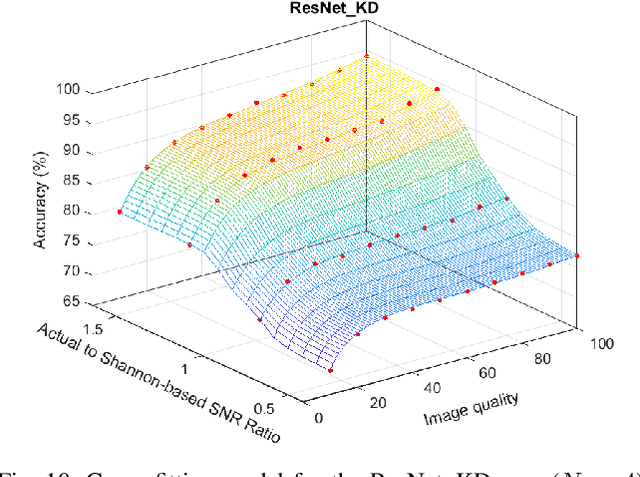
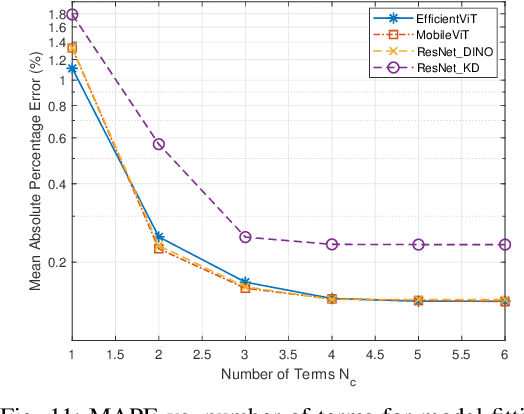
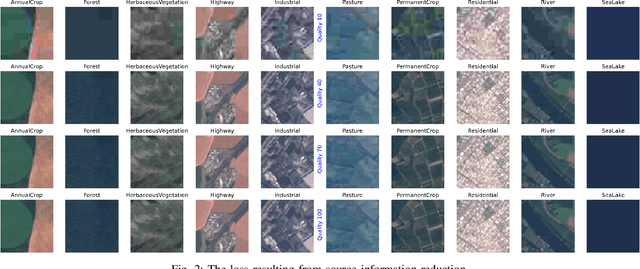
The integration of machine learning (ML) has significantly enhanced the capabilities of Earth Observation (EO) systems by enabling the extraction of actionable insights from complex datasets. However, the performance of data-driven EO applications is heavily influenced by the data collection and transmission processes, where limited satellite bandwidth and latency constraints can hinder the full transmission of original data to the receivers. To address this issue, adopting the concepts of Semantic Communication (SC) offers a promising solution by prioritizing the transmission of essential data semantics over raw information. Implementing SC for EO systems requires a thorough understanding of the impact of data processing and communication channel conditions on semantic loss at the processing center. This work proposes a novel data-fitting framework to empirically model the semantic loss using real-world EO datasets and domain-specific insights. The framework quantifies two primary types of semantic loss: (1) source coding loss, assessed via a data quality indicator measuring the impact of processing on raw source data, and (2) transmission loss, evaluated by comparing practical transmission performance against the Shannon limit. Semantic losses are estimated by evaluating the accuracy of EO applications using four task-oriented ML models, EfficientViT, MobileViT, ResNet50-DINO, and ResNet8-KD, on lossy image datasets under varying channel conditions and compression ratios. These results underpin a framework for efficient semantic-loss modeling in bandwidth-constrained EO scenarios, enabling more reliable and effective operations.