 Add to Chrome
 Add to Firefox
 Add to Edge
M-ErasureBench: A Comprehensive Multimodal Evaluation Benchmark for Concept Erasure in Diffusion Models
Dec 28, 2025
Text-to-image diffusion models may generate harmful or copyrighted content, motivating research on concept erasure. However, existing approaches primarily focus on erasing concepts from text prompts, overlooking other input modalities that are increasingly critical in real-world applications such as image editing and personalized generation. These modalities can become attack surfaces, where erased concepts re-emerge despite defenses. To bridge this gap, we introduce M-ErasureBench, a novel multimodal evaluation framework that systematically benchmarks concept erasure methods across three input modalities: text prompts, learned embeddings, and inverted latents. For the latter two, we evaluate both white-box and black-box access, yielding five evaluation scenarios. Our analysis shows that existing methods achieve strong erasure performance against text prompts but largely fail under learned embeddings and inverted latents, with Concept Reproduction Rate (CRR) exceeding 90% in the white-box setting. To address these vulnerabilities, we propose IRECE (Inference-time Robustness Enhancement for Concept Erasure), a plug-and-play module that localizes target concepts via cross-attention and perturbs the associated latents during denoising. Experiments demonstrate that IRECE consistently restores robustness, reducing CRR by up to 40% under the most challenging white-box latent inversion scenario, while preserving visual quality. To the best of our knowledge, M-ErasureBench provides the first comprehensive benchmark of concept erasure beyond text prompts. Together with IRECE, our benchmark offers practical safeguards for building more reliable protective generative models.

DiffQRCoder: Diffusion-based Aesthetic QR Code Generation with Scanning Robustness Guided Iterative Refinement
Sep 10, 2024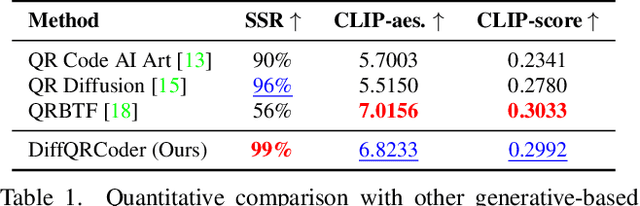
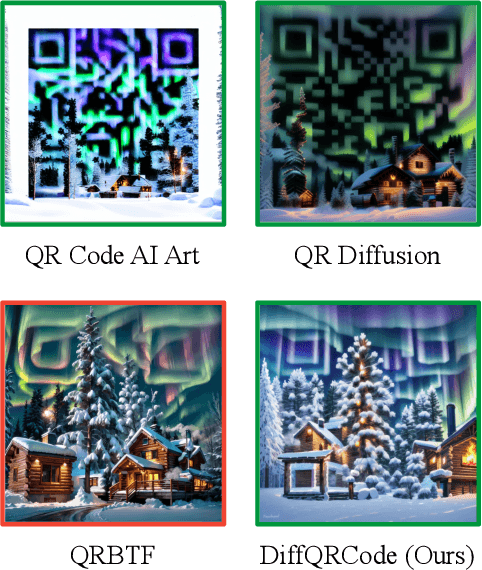
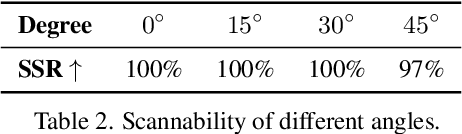
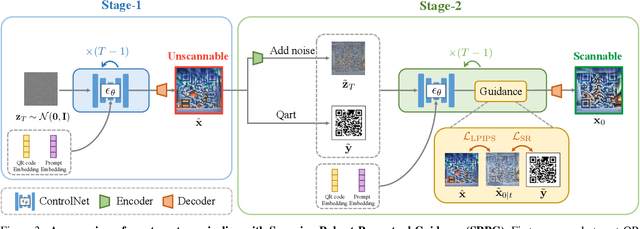
With the success of Diffusion Models for image generation, the technologies also have revolutionized the aesthetic Quick Response (QR) code generation. Despite significant improvements in visual attractiveness for the beautified codes, their scannabilities are usually sacrificed and thus hinder their practical uses in real-world scenarios. To address this issue, we propose a novel Diffusion-based QR Code generator (DiffQRCoder) to effectively craft both scannable and visually pleasing QR codes. The proposed approach introduces Scanning-Robust Perceptual Guidance (SRPG), a new diffusion guidance for Diffusion Models to guarantee the generated aesthetic codes to obey the ground-truth QR codes while maintaining their attractiveness during the denoising process. Additionally, we present another post-processing technique, Scanning Robust Manifold Projected Gradient Descent (SR-MPGD), to further enhance their scanning robustness through iterative latent space optimization. With extensive experiments, the results demonstrate that our approach not only outperforms other compared methods in Scanning Success Rate (SSR) with better or comparable CLIP aesthetic score (CLIP-aes.) but also significantly improves the SSR of the ControlNet-only approach from 60% to 99%. The subjective evaluation indicates that our approach achieves promising visual attractiveness to users as well. Finally, even with different scanning angles and the most rigorous error tolerance settings, our approach robustly achieves over 95% SSR, demonstrating its capability for real-world applications.