 Add to Chrome
 Add to Firefox
 Add to Edge
Advancing Multimodal Fusion on Heterogeneous Medical Data with Hybrid Geometry Attention
Jul 21, 2026
Multimodal fusion learning (MFL) has shown great potential in the medical domain, where we are faced with disparate data modalities such as imaging, clinical records, and omics. However, existing MFL strategies face several major challenges. First, they struggle to capture complex cross-modal interactions effectively, which in turn limits performance improvements. Second, they incur high computational costs, restricting their applicability in resource-constrained healthcare AI applications. Finally, they are often designed and evaluated for narrow, fixed modality configurations (e.g., imaging-only, or specific pairs such as image and omics), which limits evidence of their adaptability and generalizability to broader collections of heterogeneous medical modalities. To address these challenges, we propose a novel MFL framework - Cascaded Unified Representation Learning for Efficient Fusion Network (CURE) - a lightweight and scalable framework that progressively integrates various modalities through a novel efficient Hybrid Geometry Aware Fusion layer (HyFuse), where each HyFuse layer is sequentially learned for each modality, making the framework adaptable and generalizable. Within HyFuse, an efficient residual convolution module captures rich multi-scale features to ensure cost-effective learning, while a hybrid-space aware attention mixer learns coarse-to-fine structural cues to better preserve cross-modal relationships. Complementary learnable late-fusion and shared information refinement modules are then employed to learn robust modality-order-invariant shared representations, which in turn yields consistent performance improvements. Extensive evaluations on 16 public datasets show that CURE outperforms leading multimodal fusion methods, boosting performance by up to 3.97% and lowering computational costs by up to 87.8%, ensuring more effective and reliable predictions.

Effective and Robust Multimodal Medical Image Analysis
Feb 17, 2026Multimodal Fusion Learning (MFL), leveraging disparate data from various imaging modalities (e.g., MRI, CT, SPECT), has shown great potential for addressing medical problems such as skin cancer and brain tumor prediction. However, existing MFL methods face three key limitations: a) they often specialize in specific modalities, and overlook effective shared complementary information across diverse modalities, hence limiting their generalizability for multi-disease analysis; b) they rely on computationally expensive models, restricting their applicability in resource-limited settings; and c) they lack robustness against adversarial attacks, compromising reliability in medical AI applications. To address these limitations, we propose a novel Multi-Attention Integration Learning (MAIL) network, incorporating two key components: a) an efficient residual learning attention block for capturing refined modality-specific multi-scale patterns and b) an efficient multimodal cross-attention module for learning enriched complementary shared representations across diverse modalities. Furthermore, to ensure adversarial robustness, we extend MAIL network to design Robust-MAIL by incorporating random projection filters and modulated attention noise. Extensive evaluations on 20 public datasets show that both MAIL and Robust-MAIL outperform existing methods, achieving performance gains of up to 9.34% while reducing computational costs by up to 78.3%. These results highlight the superiority of our approaches, ensuring more reliable predictions than top competitors. Code: https://github.com/misti1203/MAIL-Robust-MAIL.
Multimodal Fusion Learning with Dual Attention for Medical Imaging
Dec 02, 2024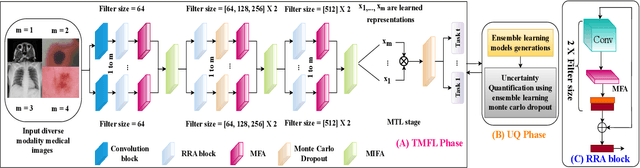
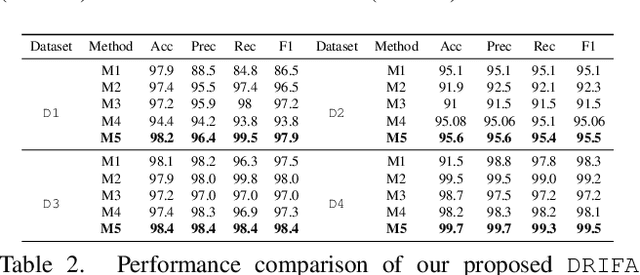
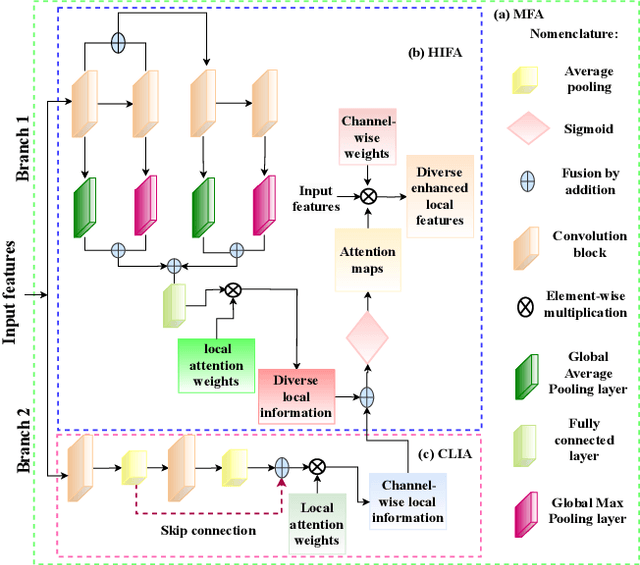
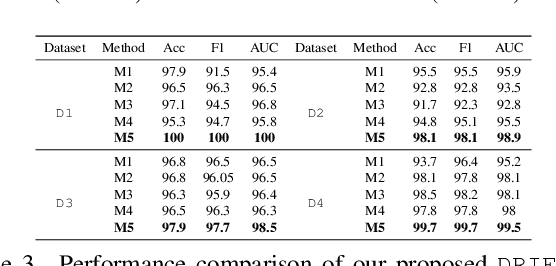
Multimodal fusion learning has shown significant promise in classifying various diseases such as skin cancer and brain tumors. However, existing methods face three key limitations. First, they often lack generalizability to other diagnosis tasks due to their focus on a particular disease. Second, they do not fully leverage multiple health records from diverse modalities to learn robust complementary information. And finally, they typically rely on a single attention mechanism, missing the benefits of multiple attention strategies within and across various modalities. To address these issues, this paper proposes a dual robust information fusion attention mechanism (DRIFA) that leverages two attention modules, i.e. multi-branch fusion attention module and the multimodal information fusion attention module. DRIFA can be integrated with any deep neural network, forming a multimodal fusion learning framework denoted as DRIFA-Net. We show that the multi-branch fusion attention of DRIFA learns enhanced representations for each modality, such as dermoscopy, pap smear, MRI, and CT-scan, whereas multimodal information fusion attention module learns more refined multimodal shared representations, improving the network's generalization across multiple tasks and enhancing overall performance. Additionally, to estimate the uncertainty of DRIFA-Net predictions, we have employed an ensemble Monte Carlo dropout strategy. Extensive experiments on five publicly available datasets with diverse modalities demonstrate that our approach consistently outperforms state-of-the-art methods. The code is available at https://github.com/misti1203/DRIFA-Net.
* 10 pages