 Add to Chrome
 Add to Firefox
 Add to Edge
HistoWAS: A Pathomics Framework for Large-Scale Feature-Wide Association Studies of Tissue Topology and Patient Outcomes
Dec 23, 2025
High-throughput "pathomic" analysis of Whole Slide Images (WSIs) offers new opportunities to study tissue characteristics and for biomarker discovery. However, the clinical relevance of the tissue characteristics at the micro- and macro-environment level is limited by the lack of tools that facilitate the measurement of the spatial interaction of individual structure characteristics and their association with clinical parameters. To address these challenges, we introduce HistoWAS (Histology-Wide Association Study), a computational framework designed to link tissue spatial organization to clinical outcomes. Specifically, HistoWAS implements (1) a feature space that augments conventional metrics with 30 topological and spatial features, adapted from Geographic Information Systems (GIS) point pattern analysis, to quantify tissue micro-architecture; and (2) an association study engine, inspired by Phenome-Wide Association Studies (PheWAS), that performs mass univariate regression for each feature with statistical correction. As a proof of concept, we applied HistoWAS to analyze a total of 102 features (72 conventional object-level features and our 30 spatial features) using 385 PAS-stained WSIs from 206 participants in the Kidney Precision Medicine Project (KPMP). The code and data have been released to https://github.com/hrlblab/histoWAS.

Meta-Model Framework for Surrogate-Based Parameter Estimation in Dynamical Systems
Jun 21, 2019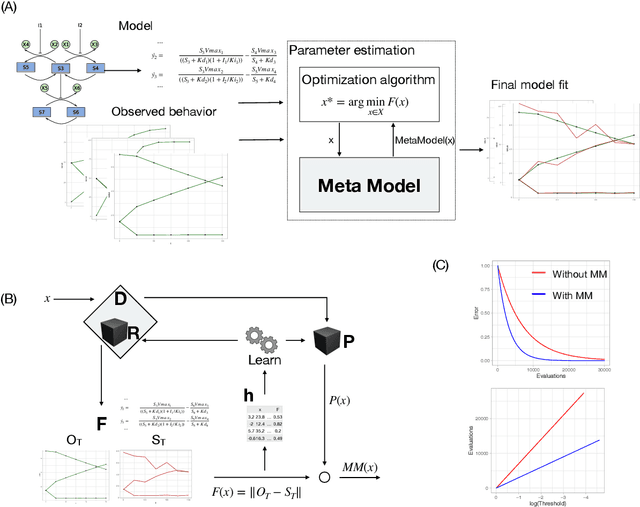
The central task in modeling complex dynamical systems is parameter estimation. This task involves numerous evaluations of a computationally expensive objective function. Surrogate-based optimization introduces a computationally efficient predictive model that approximates the value of the objective function. The standard approach involves learning a surrogate from training examples that correspond to past evaluations of the objective function. Current surrogate-based optimization methods use static, predefined substitution strategies that decide when to use the surrogate and when the true objective. We introduce a meta-model framework where the substitution strategy is dynamically adapted to the solution space of the given optimization problem. The meta model encapsulates the objective function, the surrogate model and the model of the substitution strategy, as well as components for learning them. The framework can be seamlessly coupled with an arbitrary optimization algorithm without any modification: it replaces the objective function and autonomously decides how to evaluate a given candidate solution. We test the utility of the framework on three tasks of estimating parameters of real-world models of dynamical systems. The results show that the meta model significantly improves the efficiency of optimization, reducing the total number of evaluations of the objective function up to an average of 77%.