 Add to Chrome
 Add to Firefox
 Add to Edge
SMT-AD: a scalable quantum-inspired anomaly detection approach
Apr 07, 2026
Quantum-inspired tensor networks algorithms have shown to be effective and efficient models for machine learning tasks, including anomaly detection. Here, we propose a highly parallelizable quantum-inspired approach which we call SMT-AD from Superposition of Multiresolution Tensors for Anomaly Detection. It is based upon the superposition of bond-dimension-1 matrix product operators to transform the input data with Fourier-assisted feature embedding, where the number of learnable parameters grows linearly with feature size, embedding resolutions, and the number of additional components in the matrix product operators structure. We demonstrate successful anomaly detection when applied to standard datasets, including credit card transactions, and find that, even with minimal configurations, it achieves competitive performance against established anomaly detection baselines. Furthermore, it provides a straightforward way to reduce the weight of the model and even improve the performance by highlighting the most relevant input features.

Fine-tuning Large Language Model (LLM) Artificial Intelligence Chatbots in Ophthalmology and LLM-based evaluation using GPT-4
Feb 15, 2024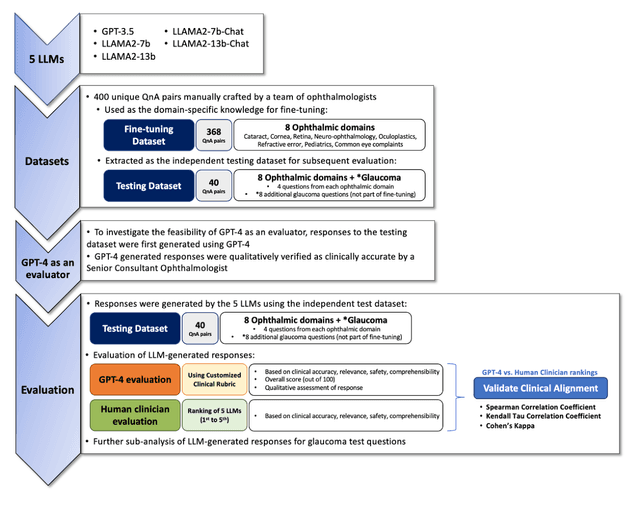


Purpose: To assess the alignment of GPT-4-based evaluation to human clinician experts, for the evaluation of responses to ophthalmology-related patient queries generated by fine-tuned LLM chatbots. Methods: 400 ophthalmology questions and paired answers were created by ophthalmologists to represent commonly asked patient questions, divided into fine-tuning (368; 92%), and testing (40; 8%). We find-tuned 5 different LLMs, including LLAMA2-7b, LLAMA2-7b-Chat, LLAMA2-13b, and LLAMA2-13b-Chat. For the testing dataset, additional 8 glaucoma QnA pairs were included. 200 responses to the testing dataset were generated by 5 fine-tuned LLMs for evaluation. A customized clinical evaluation rubric was used to guide GPT-4 evaluation, grounded on clinical accuracy, relevance, patient safety, and ease of understanding. GPT-4 evaluation was then compared against ranking by 5 clinicians for clinical alignment. Results: Among all fine-tuned LLMs, GPT-3.5 scored the highest (87.1%), followed by LLAMA2-13b (80.9%), LLAMA2-13b-chat (75.5%), LLAMA2-7b-Chat (70%) and LLAMA2-7b (68.8%) based on the GPT-4 evaluation. GPT-4 evaluation demonstrated significant agreement with human clinician rankings, with Spearman and Kendall Tau correlation coefficients of 0.90 and 0.80 respectively; while correlation based on Cohen Kappa was more modest at 0.50. Notably, qualitative analysis and the glaucoma sub-analysis revealed clinical inaccuracies in the LLM-generated responses, which were appropriately identified by the GPT-4 evaluation. Conclusion: The notable clinical alignment of GPT-4 evaluation highlighted its potential to streamline the clinical evaluation of LLM chatbot responses to healthcare-related queries. By complementing the existing clinician-dependent manual grading, this efficient and automated evaluation could assist the validation of future developments in LLM applications for healthcare.