 Add to Chrome
 Add to Firefox
 Add to Edge
Network Level Evaluation of Hangup Susceptibility of HRGCs using Deep Learning and Sensing Techniques: A Goal Towards Safer Future
Dec 14, 2025
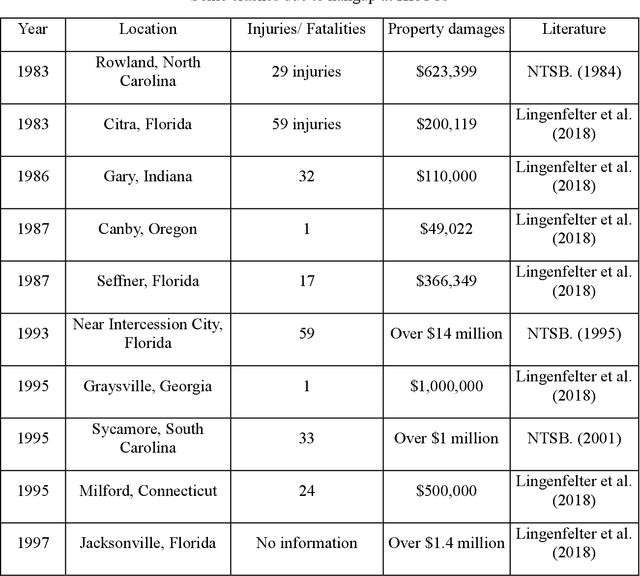
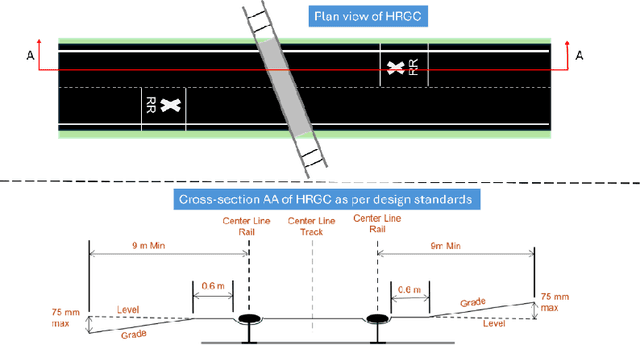

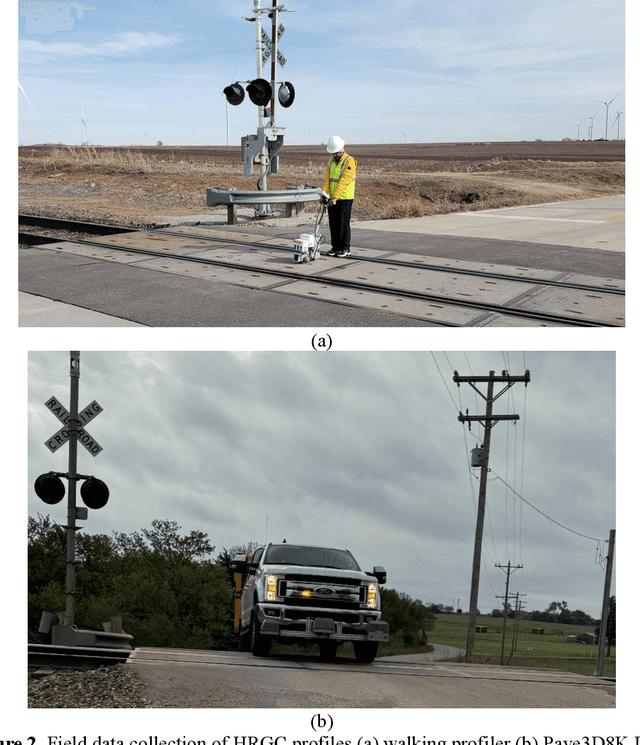
Steep profiled Highway Railway Grade Crossings (HRGCs) pose safety hazards to vehicles with low ground clearance, which may become stranded on the tracks, creating risks of train vehicle collisions. This research develops a framework for network level evaluation of hangup susceptibility of HRGCs. Profile data from different crossings in Oklahoma were collected using both a walking profiler and the Pave3D8K Laser Imaging System. A hybrid deep learning model, combining Long Short Term Memory (LSTM) and Transformer architectures, was developed to reconstruct accurate HRGC profiles from Pave3D8K Laser Imaging System data. Vehicle dimension data from around 350 specialty vehicles were collected at various locations across Oklahoma to enable up to date statistical design dimensions. Hangup susceptibility was analyzed using three vehicle dimension scenarios (a) median dimension (median wheelbase and ground clearance), (b) 75 25 percentile dimension (75 percentile wheelbase, 25 percentile ground clearance), and (c) worst case dimension (maximum wheelbase and minimum ground clearance). Results indicate 36, 62, and 67 crossings at the highest hangup risk levels under these scenarios, respectively. An ArcGIS database and a software interface were developed to support transportation agencies in mitigating crossing hazards. This framework advances safety evaluation by integrating next generation sensing, deep learning, and infrastructure datasets into practical decision support tools.

SAMJAM: Zero-Shot Video Scene Graph Generation for Egocentric Kitchen Videos
Apr 10, 2025Video Scene Graph Generation (VidSGG) is an important topic in understanding dynamic kitchen environments. Current models for VidSGG require extensive training to produce scene graphs. Recently, Vision Language Models (VLM) and Vision Foundation Models (VFM) have demonstrated impressive zero-shot capabilities in a variety of tasks. However, VLMs like Gemini struggle with the dynamics for VidSGG, failing to maintain stable object identities across frames. To overcome this limitation, we propose SAMJAM, a zero-shot pipeline that combines SAM2's temporal tracking with Gemini's semantic understanding. SAM2 also improves upon Gemini's object grounding by producing more accurate bounding boxes. In our method, we first prompt Gemini to generate a frame-level scene graph. Then, we employ a matching algorithm to map each object in the scene graph with a SAM2-generated or SAM2-propagated mask, producing a temporally-consistent scene graph in dynamic environments. Finally, we repeat this process again in each of the following frames. We empirically demonstrate that SAMJAM outperforms Gemini by 8.33% in mean recall on the EPIC-KITCHENS and EPIC-KITCHENS-100 datasets.