 Add to Chrome
 Add to Firefox
 Add to Edge
Confusion-Aware Rubric Optimization for LLM-based Automated Grading
Feb 28, 2026
Accurate and unambiguous guidelines are critical for large language model (LLM) based graders, yet manually crafting these prompts is often sub-optimal as LLMs can misinterpret expert guidelines or lack necessary domain specificity. Consequently, the field has moved toward automated prompt optimization to refine grading guidelines without the burden of manual trial and error. However, existing frameworks typically aggregate independent and unstructured error samples into a single update step, resulting in "rule dilution" where conflicting constraints weaken the model's grading logic. To address these limitations, we introduce Confusion-Aware Rubric Optimization (CARO), a novel framework that enhances accuracy and computational efficiency by structurally separating error signals. CARO leverages the confusion matrix to decompose monolithic error signals into distinct modes, allowing for the diagnosis and repair of specific misclassification patterns individually. By synthesizing targeted "fixing patches" for dominant error modes and employing a diversity-aware selection mechanism, the framework prevents guidance conflict and eliminates the need for resource-heavy nested refinement loops. Empirical evaluations on teacher education and STEM datasets demonstrate that CARO significantly outperforms existing SOTA methods. These results suggest that replacing mixed-error aggregation with surgical, mode-specific repair yields robust improvements in automated assessment scalability and precision.

Optimizing In-Context Demonstrations for LLM-based Automated Grading
Feb 28, 2026Automated assessment of open-ended student responses is a critical capability for scaling personalized feedback in education. While large language models (LLMs) have shown promise in grading tasks via in-context learning (ICL), their reliability is heavily dependent on the selection of few-shot exemplars and the construction of high-quality rationales. Standard retrieval methods typically select examples based on semantic similarity, which often fails to capture subtle decision boundaries required for rubric adherence. Furthermore, manually crafting the expert rationales needed to guide these models can be a significant bottleneck. To address these limitations, we introduce GUIDE (Grading Using Iteratively Designed Exemplars), a framework that reframes exemplar selection and refinement in automated grading as a boundary-focused optimization problem. GUIDE operates on a continuous loop of selection and refinement, employing novel contrastive operators to identify "boundary pairs" that are semantically similar but possess different grades. We enhance exemplars by generating discriminative rationales that explicitly articulate why a response receives a specific score to the exclusion of adjacent grades. Extensive experiments across datasets in physics, chemistry, and pedagogical content knowledge demonstrate that GUIDE significantly outperforms standard retrieval baselines. By focusing the model's attention on the precise edges of rubric, our approach shows exceptionally robust gains on borderline cases and improved rubric adherence. GUIDE paves the way for trusted, scalable assessment systems that align closely with human pedagogical standards.
How Uncertain Is the Grade? A Benchmark of Uncertainty Metrics for LLM-Based Automatic Assessment
Feb 17, 2026The rapid rise of large language models (LLMs) is reshaping the landscape of automatic assessment in education. While these systems demonstrate substantial advantages in adaptability to diverse question types and flexibility in output formats, they also introduce new challenges related to output uncertainty, stemming from the inherently probabilistic nature of LLMs. Output uncertainty is an inescapable challenge in automatic assessment, as assessment results often play a critical role in informing subsequent pedagogical actions, such as providing feedback to students or guiding instructional decisions. Unreliable or poorly calibrated uncertainty estimates can lead to unstable downstream interventions, potentially disrupting students' learning processes and resulting in unintended negative consequences. To systematically understand this challenge and inform future research, we benchmark a broad range of uncertainty quantification methods in the context of LLM-based automatic assessment. Although the effectiveness of these methods has been demonstrated in many tasks across other domains, their applicability and reliability in educational settings, particularly for automatic grading, remain underexplored. Through comprehensive analyses of uncertainty behaviors across multiple assessment datasets, LLM families, and generation control settings, we characterize the uncertainty patterns exhibited by LLMs in grading scenarios. Based on these findings, we evaluate the strengths and limitations of different uncertainty metrics and analyze the influence of key factors, including model families, assessment tasks, and decoding strategies, on uncertainty estimates. Our study provides actionable insights into the characteristics of uncertainty in LLM-based automatic assessment and lays the groundwork for developing more reliable and effective uncertainty-aware grading systems in the future.
Enhancing LLM-Based Short Answer Grading with Retrieval-Augmented Generation
Apr 07, 2025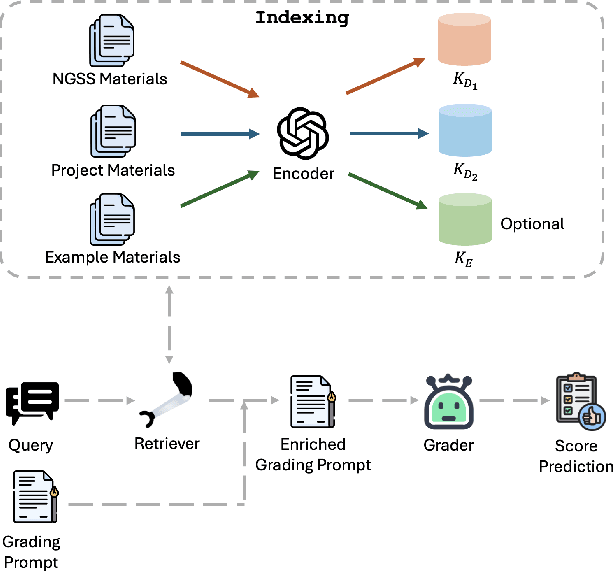
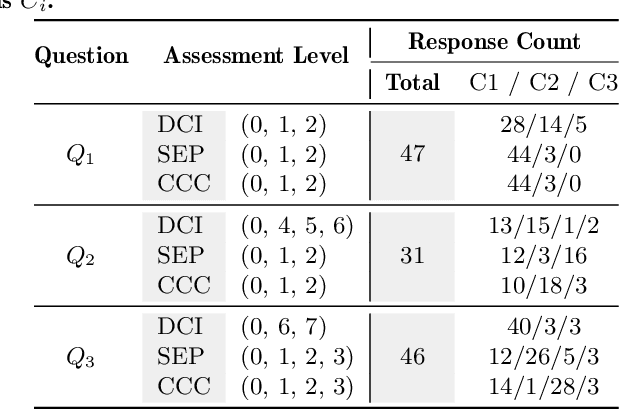
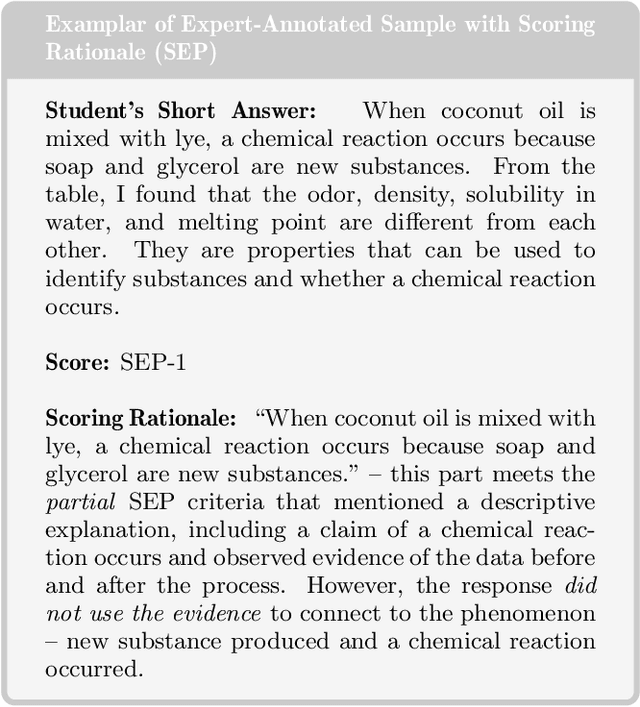
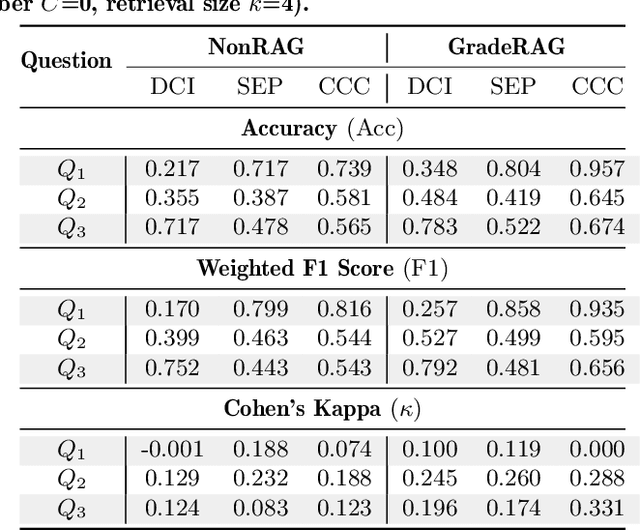
Short answer assessment is a vital component of science education, allowing evaluation of students' complex three-dimensional understanding. Large language models (LLMs) that possess human-like ability in linguistic tasks are increasingly popular in assisting human graders to reduce their workload. However, LLMs' limitations in domain knowledge restrict their understanding in task-specific requirements and hinder their ability to achieve satisfactory performance. Retrieval-augmented generation (RAG) emerges as a promising solution by enabling LLMs to access relevant domain-specific knowledge during assessment. In this work, we propose an adaptive RAG framework for automated grading that dynamically retrieves and incorporates domain-specific knowledge based on the question and student answer context. Our approach combines semantic search and curated educational sources to retrieve valuable reference materials. Experimental results in a science education dataset demonstrate that our system achieves an improvement in grading accuracy compared to baseline LLM approaches. The findings suggest that RAG-enhanced grading systems can serve as reliable support with efficient performance gains.
Pseudo AI Bias
Oct 14, 2022

Pseudo Artificial Intelligence bias (PAIB) is broadly disseminated in the literature, which can result in unnecessary AI fear in society, exacerbate the enduring inequities and disparities in access to and sharing the benefits of AI applications, and waste social capital invested in AI research. This study systematically reviews publications in the literature to present three types of PAIBs identified due to: a) misunderstandings, b) pseudo mechanical bias, and c) over-expectations. We discussed the consequences of and solutions to PAIBs, including certifying users for AI applications to mitigate AI fears, providing customized user guidance for AI applications, and developing systematic approaches to monitor bias. We concluded that PAIB due to misunderstandings, pseudo mechanical bias, and over-expectations of algorithmic predictions is socially harmful.