 Add to Chrome
 Add to Firefox
 Add to Edge
A Multi-Stage Validation Framework for Trustworthy Large-scale Clinical Information Extraction using Large Language Models
Apr 07, 2026
Large language models (LLMs) show promise for extracting clinically meaningful information from unstructured health records, yet their translation into real-world settings is constrained by the lack of scalable and trustworthy validation approaches. Conventional evaluation methods rely heavily on annotation-intensive reference standards or incomplete structured data, limiting feasibility at population scale. We propose a multi-stage validation framework for LLM-based clinical information extraction that enables rigorous assessment under weak supervision. The framework integrates prompt calibration, rule-based plausibility filtering, semantic grounding assessment, targeted confirmatory evaluation using an independent higher-capacity judge LLM, selective expert review, and external predictive validity analysis to quantify uncertainty and characterize error modes without exhaustive manual annotation. We applied this framework to extraction of substance use disorder (SUD) diagnoses across 11 substance categories from 919,783 clinical notes. Rule-based filtering and semantic grounding removed 14.59% of LLM-positive extractions that were unsupported, irrelevant, or structurally implausible. For high-uncertainty cases, the judge LLM's assessments showed substantial agreement with subject matter expert review (Gwet's AC1=0.80). Using judge-evaluated outputs as references, the primary LLM achieved an F1 score of 0.80 under relaxed matching criteria. LLM-extracted SUD diagnoses also predicted subsequent engagement in SUD specialty care more accurately than structured-data baselines (AUC=0.80). These findings demonstrate that scalable, trustworthy deployment of LLM-based clinical information extraction is feasible without annotation-intensive evaluation.

Domain Shift Analysis in Chest Radiographs Classification in a Veterans Healthcare Administration Population
Jul 30, 2024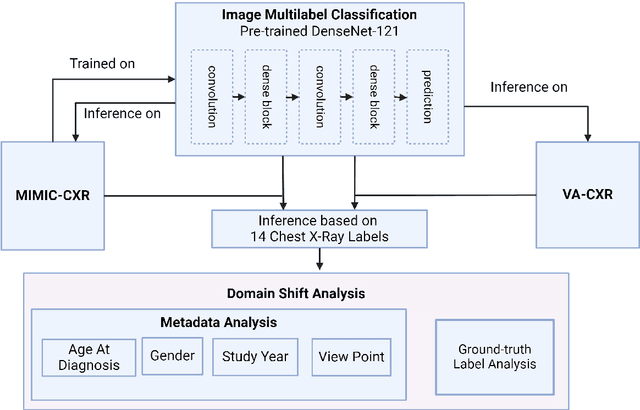
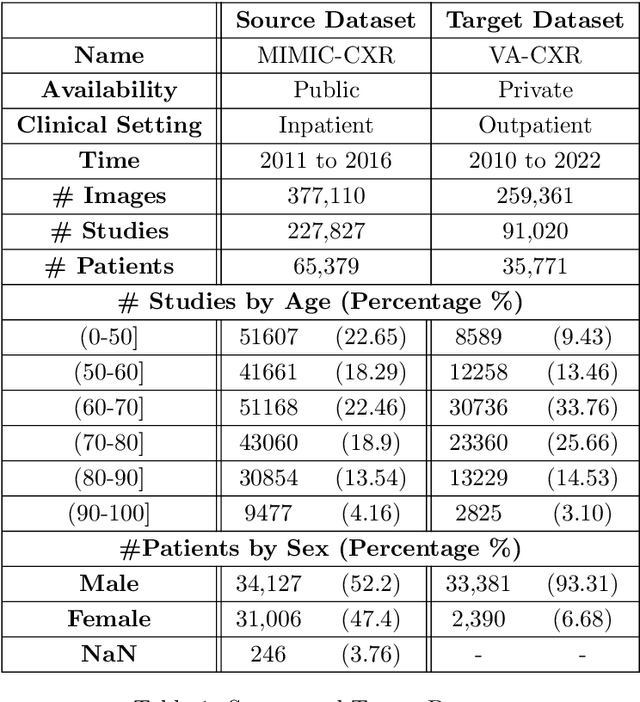
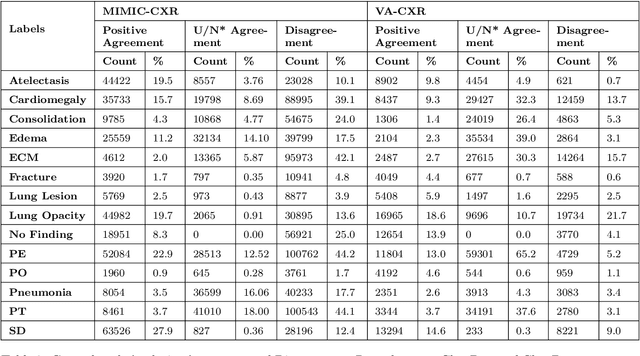
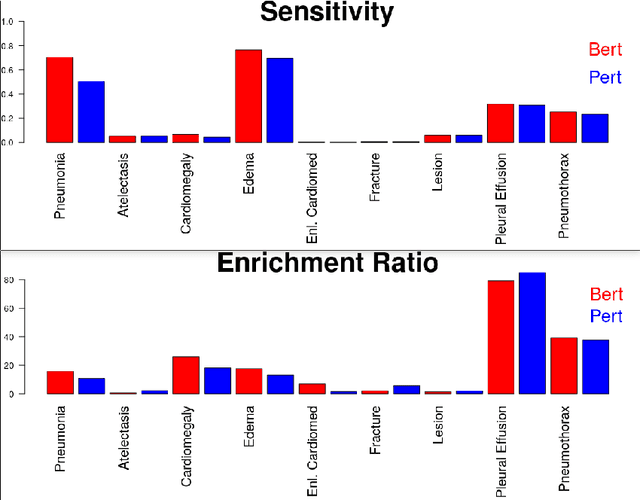
Objectives: This study aims to assess the impact of domain shift on chest X-ray classification accuracy and to analyze the influence of ground truth label quality and demographic factors such as age group, sex, and study year. Materials and Methods: We used a DenseNet121 model pretrained MIMIC-CXR dataset for deep learning-based multilabel classification using ground truth labels from radiology reports extracted using the CheXpert and CheXbert Labeler. We compared the performance of the 14 chest X-ray labels on the MIMIC-CXR and Veterans Healthcare Administration chest X-ray dataset (VA-CXR). The VA-CXR dataset comprises over 259k chest X-ray images spanning between the years 2010 and 2022. Results: The validation of ground truth and the assessment of multi-label classification performance across various NLP extraction tools revealed that the VA-CXR dataset exhibited lower disagreement rates than the MIMIC-CXR datasets. Additionally, there were notable differences in AUC scores between models utilizing CheXpert and CheXbert. When evaluating multi-label classification performance across different datasets, minimal domain shift was observed in unseen datasets, except for the label "Enlarged Cardiomediastinum." The study year's subgroup analyses exhibited the most significant variations in multi-label classification model performance. These findings underscore the importance of considering domain shifts in chest X-ray classification tasks, particularly concerning study years. Conclusion: Our study reveals the significant impact of domain shift and demographic factors on chest X-ray classification, emphasizing the need for improved transfer learning and equitable model development. Addressing these challenges is crucial for advancing medical imaging and enhancing patient care.
VISION: Toward a Standardized Process for Radiology Image Management at the National Level
Apr 29, 2024The compilation and analysis of radiological images poses numerous challenges for researchers. The sheer volume of data as well as the computational needs of algorithms capable of operating on images are extensive. Additionally, the assembly of these images alone is difficult, as these exams may differ widely in terms of clinical context, structured annotation available for model training, modality, and patient identifiers. In this paper, we describe our experiences and challenges in establishing a trusted collection of radiology images linked to the United States Department of Veterans Affairs (VA) electronic health record database. We also discuss implications in making this repository research-ready for medical investigators. Key insights include uncovering the specific procedures required for transferring images from a clinical to a research-ready environment, as well as roadblocks and bottlenecks in this process that may hinder future efforts at automation.