 Add to Chrome
 Add to Firefox
 Add to Edge
A Multi-Stage Validation Framework for Trustworthy Large-scale Clinical Information Extraction using Large Language Models
Apr 07, 2026
Large language models (LLMs) show promise for extracting clinically meaningful information from unstructured health records, yet their translation into real-world settings is constrained by the lack of scalable and trustworthy validation approaches. Conventional evaluation methods rely heavily on annotation-intensive reference standards or incomplete structured data, limiting feasibility at population scale. We propose a multi-stage validation framework for LLM-based clinical information extraction that enables rigorous assessment under weak supervision. The framework integrates prompt calibration, rule-based plausibility filtering, semantic grounding assessment, targeted confirmatory evaluation using an independent higher-capacity judge LLM, selective expert review, and external predictive validity analysis to quantify uncertainty and characterize error modes without exhaustive manual annotation. We applied this framework to extraction of substance use disorder (SUD) diagnoses across 11 substance categories from 919,783 clinical notes. Rule-based filtering and semantic grounding removed 14.59% of LLM-positive extractions that were unsupported, irrelevant, or structurally implausible. For high-uncertainty cases, the judge LLM's assessments showed substantial agreement with subject matter expert review (Gwet's AC1=0.80). Using judge-evaluated outputs as references, the primary LLM achieved an F1 score of 0.80 under relaxed matching criteria. LLM-extracted SUD diagnoses also predicted subsequent engagement in SUD specialty care more accurately than structured-data baselines (AUC=0.80). These findings demonstrate that scalable, trustworthy deployment of LLM-based clinical information extraction is feasible without annotation-intensive evaluation.

VISION: Toward a Standardized Process for Radiology Image Management at the National Level
Apr 29, 2024The compilation and analysis of radiological images poses numerous challenges for researchers. The sheer volume of data as well as the computational needs of algorithms capable of operating on images are extensive. Additionally, the assembly of these images alone is difficult, as these exams may differ widely in terms of clinical context, structured annotation available for model training, modality, and patient identifiers. In this paper, we describe our experiences and challenges in establishing a trusted collection of radiology images linked to the United States Department of Veterans Affairs (VA) electronic health record database. We also discuss implications in making this repository research-ready for medical investigators. Key insights include uncovering the specific procedures required for transferring images from a clinical to a research-ready environment, as well as roadblocks and bottlenecks in this process that may hinder future efforts at automation.
Leveraging Large Language Models to Extract Information on Substance Use Disorder Severity from Clinical Notes: A Zero-shot Learning Approach
Mar 18, 2024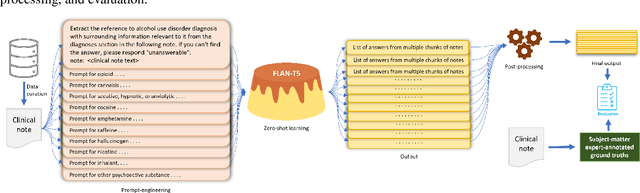
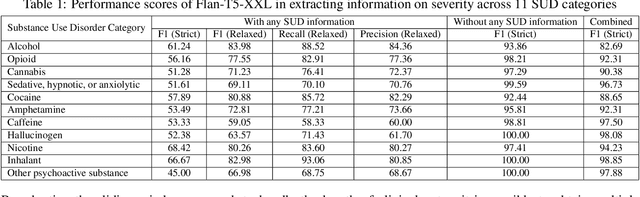
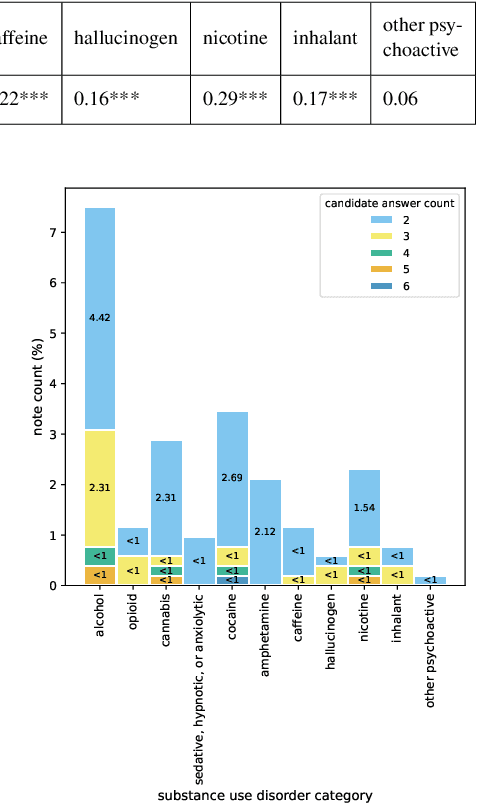
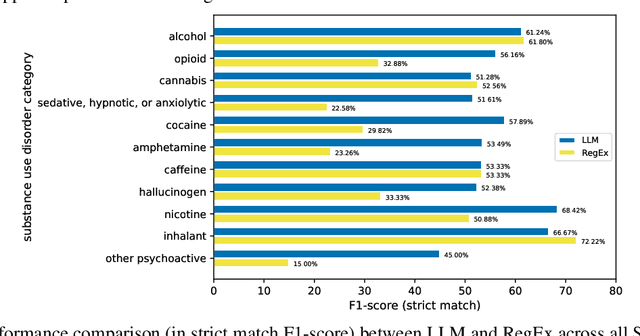
Substance use disorder (SUD) poses a major concern due to its detrimental effects on health and society. SUD identification and treatment depend on a variety of factors such as severity, co-determinants (e.g., withdrawal symptoms), and social determinants of health. Existing diagnostic coding systems used by American insurance providers, like the International Classification of Diseases (ICD-10), lack granularity for certain diagnoses, but clinicians will add this granularity (as that found within the Diagnostic and Statistical Manual of Mental Disorders classification or DSM-5) as supplemental unstructured text in clinical notes. Traditional natural language processing (NLP) methods face limitations in accurately parsing such diverse clinical language. Large Language Models (LLMs) offer promise in overcoming these challenges by adapting to diverse language patterns. This study investigates the application of LLMs for extracting severity-related information for various SUD diagnoses from clinical notes. We propose a workflow employing zero-shot learning of LLMs with carefully crafted prompts and post-processing techniques. Through experimentation with Flan-T5, an open-source LLM, we demonstrate its superior recall compared to the rule-based approach. Focusing on 11 categories of SUD diagnoses, we show the effectiveness of LLMs in extracting severity information, contributing to improved risk assessment and treatment planning for SUD patients.