 Add to Chrome
 Add to Firefox
 Add to Edge
AIMO Interpretability Challenge
Jul 15, 2026
We propose the AIMO Interpretability Challenge, a competition on distinguishing robust from spurious reasoning in frontier mathematical language models based on the models' internal mechanisms. The challenge is motivated by a central limitation of standard reasoning benchmarks: strong final-answer accuracy does not reveal whether a model relies on stable reasoning mechanisms or exploits brittle reasoning shortcuts. Building on AI Mathematical Olympiad (AIMO) problems and submissions, together with resources from the Fields Model Initiative, the competition will provide (1) newly-published olympiad-level math reasoning problems and their symbolic representations, allowing generation of novel functional variants, (2) access to frontier reasoning models, and (3) assessments of models' adversarial robustness on these problems. Participants will use these resources, along with our computing infrastructure support, to develop methods for identifying which models solve problems robustly. Our competition will also create a new, open robustness benchmark and baseline systems, aiming to provide a lasting foundation for standard benchmarking in mathematical reasoning and interpretability. Scientifically, the competition connects interpretability and generalization research around a central question in AI research: can we determine if, and to what extent, the decision-making of frontier AI models is generalizable and thus, reliable?

Unravelling the Mechanisms of Manipulating Numbers in Language Models
Oct 30, 2025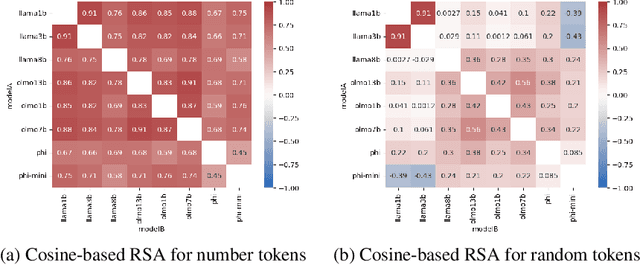
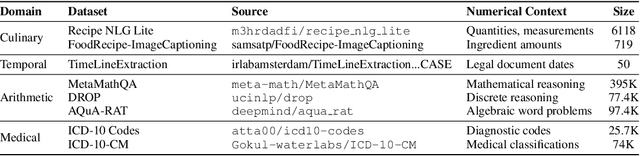
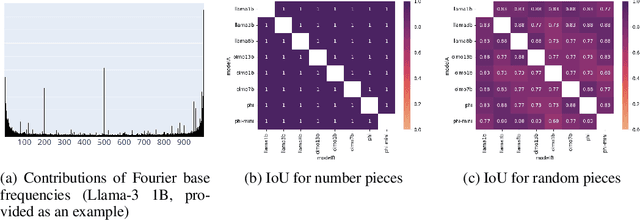
Recent work has shown that different large language models (LLMs) converge to similar and accurate input embedding representations for numbers. These findings conflict with the documented propensity of LLMs to produce erroneous outputs when dealing with numeric information. In this work, we aim to explain this conflict by exploring how language models manipulate numbers and quantify the lower bounds of accuracy of these mechanisms. We find that despite surfacing errors, different language models learn interchangeable representations of numbers that are systematic, highly accurate and universal across their hidden states and the types of input contexts. This allows us to create universal probes for each LLM and to trace information -- including the causes of output errors -- to specific layers. Our results lay a fundamental understanding of how pre-trained LLMs manipulate numbers and outline the potential of more accurate probing techniques in addressed refinements of LLMs' architectures.
Pre-trained Language Models Learn Remarkably Accurate Representations of Numbers
Jun 10, 2025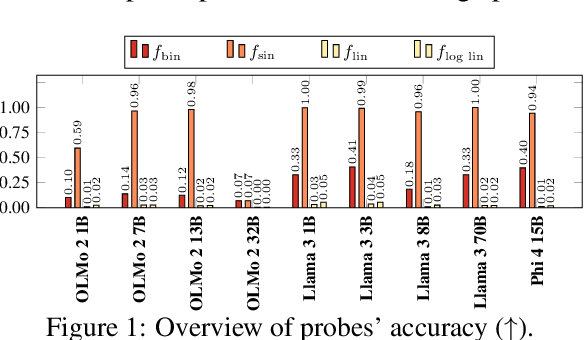
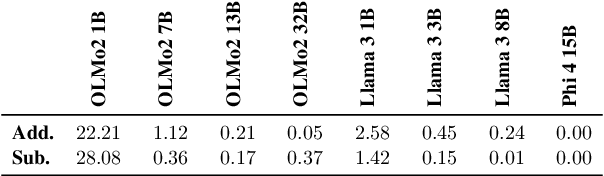
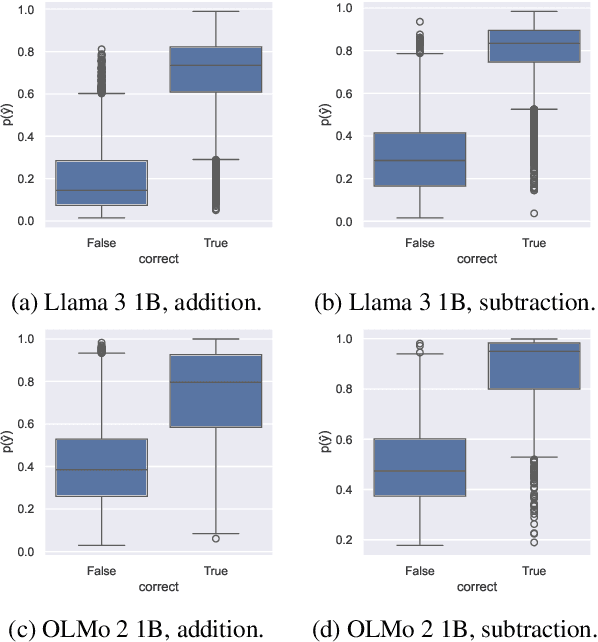
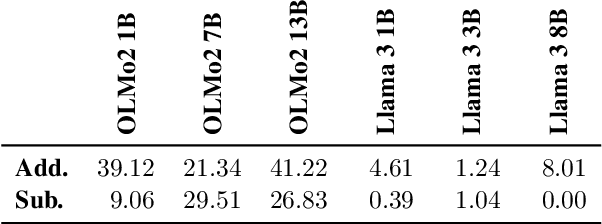
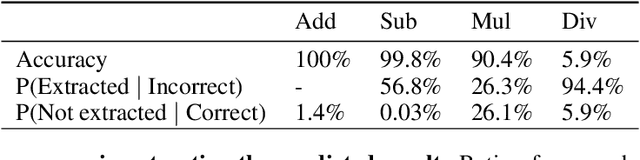
Pretrained language models (LMs) are prone to arithmetic errors. Existing work showed limited success in probing numeric values from models' representations, indicating that these errors can be attributed to the inherent unreliability of distributionally learned embeddings in representing exact quantities. However, we observe that previous probing methods are inadequate for the emergent structure of learned number embeddings with sinusoidal patterns. In response, we propose a novel probing technique that decodes numeric values from input embeddings with near-perfect accuracy across a range of open-source LMs. This proves that after the sole pre-training, LMs represent numbers with remarkable precision. Finally, we find that the embeddings' preciseness judged by our probe's accuracy explains a large portion of LM's errors in elementary arithmetic, and show that aligning the embeddings with the pattern discovered by our probe can mitigate these errors.