 Add to Chrome
 Add to Firefox
 Add to Edge
Column Generation for the Micro-Transit Zoning Problem
Mar 08, 2026
Along with the rapid development of new urban mobility options like ride-sharing over the past decade, on-demand micro-transit services stand out as a middle ground, bridging the gap between fixed-line mass transit and single-request ride-hailing, balancing ridership maximization and travel time minimization. Micro-transit adoption can have significant social impact. It improves urban sustainability, through lower energy consumption and reduced emissions, while enhancing equitable mobility access for disadvantaged communities, thanks to its lower vehicle miles per passenger, flexible schedules, and affordable pricing. However, effective operation of micro-transit services requires planning geo-fenced zones in advance, which involves solving a challenging combinatorial optimization problem. Existing approaches enumerate candidate zones first and selects a fixed number of optimal zones in the second step. In this paper, we generalize the Micro-Transit Zoning Problem (MZP) to allow a global budget rather than imposing a size limit for candidate zones. We also design a Column Generation (CG) framework to solve the problem and several pricing heuristics to accelerate computation. Extensive numerical experiments across major U.S. cities demonstrate that our approach produces higher-quality solutions more efficiently and scales better in the generalized setting.

Online Decision-Making Under Uncertainty for Vehicle-to-Building Systems
Jan 07, 2026Vehicle-to-building (V2B) systems integrate physical infrastructures, such as smart buildings and electric vehicles (EVs) connected to chargers at the building, with digital control mechanisms to manage energy use. By utilizing EVs as flexible energy reservoirs, buildings can dynamically charge and discharge them to optimize energy use and cut costs under time-variable pricing and demand charge policies. This setup leads to the V2B optimization problem, where buildings coordinate EV charging and discharging to minimize total electricity costs while meeting users' charging requirements. However, the V2B optimization problem is challenging because of: (1) fluctuating electricity pricing, which includes both energy charges ($/kWh) and demand charges ($/kW); (2) long planning horizons (typically over 30 days); (3) heterogeneous chargers with varying charging rates, controllability, and directionality (i.e., unidirectional or bidirectional); and (4) user-specific battery levels at departure to ensure user requirements are met. In contrast to existing approaches that often model this setting as a single-shot combinatorial optimization problem, we highlight critical limitations in prior work and instead model the V2B optimization problem as a Markov decision process (MDP), i.e., a stochastic control process. Solving the resulting MDP is challenging due to the large state and action spaces. To address the challenges of the large state space, we leverage online search, and we counter the action space by using domain-specific heuristics to prune unpromising actions. We validate our approach in collaboration with Nissan Advanced Technology Center - Silicon Valley. Using data from their EV testbed, we show that the proposed framework significantly outperforms state-of-the-art methods.
* 17 pages, 2 figures, 10 tables. Published in the Proceedings of the 16th ACM/IEEE International Conference on Cyber-Physical Systems (ICCPS '25), May 06--09, 2025, Irvine, CA, USA
CONSENT: A Negotiation Framework for Leveraging User Flexibility in Vehicle-to-Building Charging under Uncertainty
Jan 04, 2026The growth of Electric Vehicles (EVs) creates a conflict in vehicle-to-building (V2B) settings between building operators, who face high energy costs from uncoordinated charging, and drivers, who prioritize convenience and a full charge. To resolve this, we propose a negotiation-based framework that, by design, guarantees voluntary participation, strategy-proofness, and budget feasibility. It transforms EV charging into a strategic resource by offering drivers a range of incentive-backed options for modest flexibility in their departure time or requested state of charge (SoC). Our framework is calibrated with user survey data and validated using real operational data from a commercial building and an EV manufacturer. Simulations show that our negotiation protocol creates a mutually beneficial outcome: lowering the building operator's costs by over 3.5\% compared to an optimized, non-negotiating smart charging policy, while simultaneously reducing user charging expenses by 22\% below the utility's retail energy rate. By aligning operator and EV user objectives, our framework provides a strategic bridge between energy and mobility systems, transforming EV charging from a source of operational friction into a platform for collaboration and shared savings.
Reinforcement Learning-based Approach for Vehicle-to-Building Charging with Heterogeneous Agents and Long Term Rewards
Feb 24, 2025Strategic aggregation of electric vehicle batteries as energy reservoirs can optimize power grid demand, benefiting smart and connected communities, especially large office buildings that offer workplace charging. This involves optimizing charging and discharging to reduce peak energy costs and net peak demand, monitored over extended periods (e.g., a month), which involves making sequential decisions under uncertainty and delayed and sparse rewards, a continuous action space, and the complexity of ensuring generalization across diverse conditions. Existing algorithmic approaches, e.g., heuristic-based strategies, fall short in addressing real-time decision-making under dynamic conditions, and traditional reinforcement learning (RL) models struggle with large state-action spaces, multi-agent settings, and the need for long-term reward optimization. To address these challenges, we introduce a novel RL framework that combines the Deep Deterministic Policy Gradient approach (DDPG) with action masking and efficient MILP-driven policy guidance. Our approach balances the exploration of continuous action spaces to meet user charging demands. Using real-world data from a major electric vehicle manufacturer, we show that our approach comprehensively outperforms many well-established baselines and several scalable heuristic approaches, achieving significant cost savings while meeting all charging requirements. Our results show that the proposed approach is one of the first scalable and general approaches to solving the V2B energy management challenge.
Forecasting and Mitigating Disruptions in Public Bus Transit Services
Mar 06, 2024

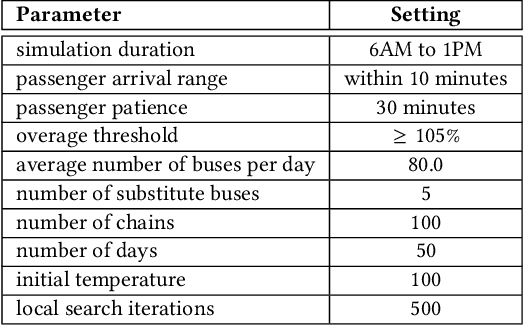
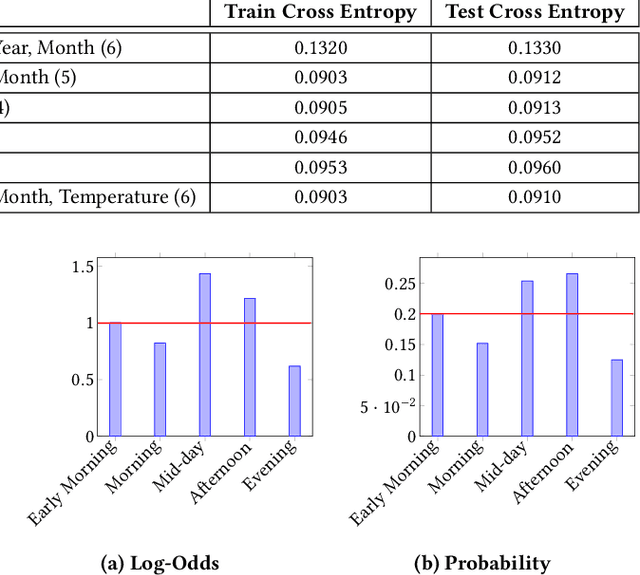
Public transportation systems often suffer from unexpected fluctuations in demand and disruptions, such as mechanical failures and medical emergencies. These fluctuations and disruptions lead to delays and overcrowding, which are detrimental to the passengers' experience and to the overall performance of the transit service. To proactively mitigate such events, many transit agencies station substitute (reserve) vehicles throughout their service areas, which they can dispatch to augment or replace vehicles on routes that suffer overcrowding or disruption. However, determining the optimal locations where substitute vehicles should be stationed is a challenging problem due to the inherent randomness of disruptions and due to the combinatorial nature of selecting locations across a city. In collaboration with the transit agency of Nashville, TN, we address this problem by introducing data-driven statistical and machine-learning models for forecasting disruptions and an effective randomized local-search algorithm for selecting locations where substitute vehicles are to be stationed. Our research demonstrates promising results in proactive disruption management, offering a practical and easily implementable solution for transit agencies to enhance the reliability of their services. Our results resonate beyond mere operational efficiency: by advancing proactive strategies, our approach fosters more resilient and accessible public transportation, contributing to equitable urban mobility and ultimately benefiting the communities that rely on public transportation the most.
On Designing Day Ahead and Same Day Ridership Level Prediction Models for City-Scale Transit Networks Using Noisy APC Data
Oct 10, 2022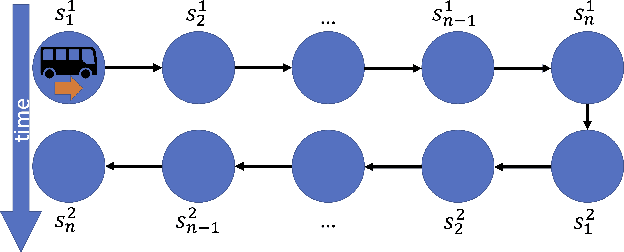
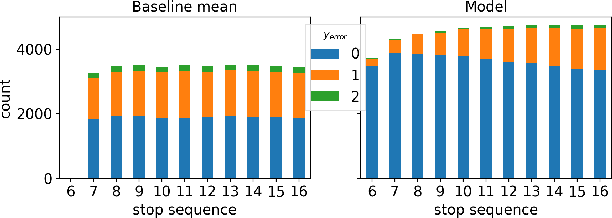
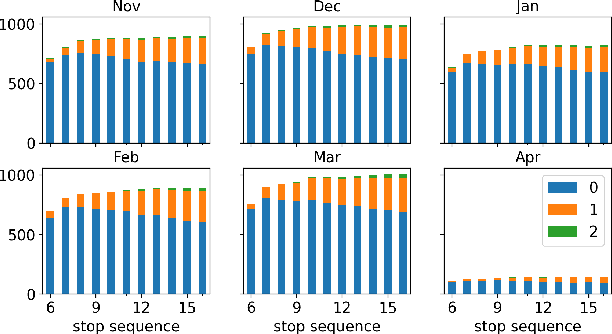
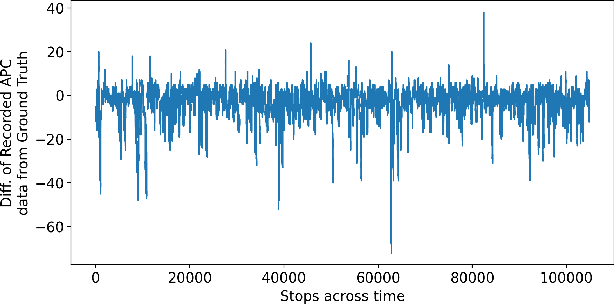
The ability to accurately predict public transit ridership demand benefits passengers and transit agencies. Agencies will be able to reallocate buses to handle under or over-utilized bus routes, improving resource utilization, and passengers will be able to adjust and plan their schedules to avoid overcrowded buses and maintain a certain level of comfort. However, accurately predicting occupancy is a non-trivial task. Various reasons such as heterogeneity, evolving ridership patterns, exogenous events like weather, and other stochastic variables, make the task much more challenging. With the progress of big data, transit authorities now have access to real-time passenger occupancy information for their vehicles. The amount of data generated is staggering. While there is no shortage in data, it must still be cleaned, processed, augmented, and merged before any useful information can be generated. In this paper, we propose the use and fusion of data from multiple sources, cleaned, processed, and merged together, for use in training machine learning models to predict transit ridership. We use data that spans a 2-year period (2020-2022) incorporating transit, weather, traffic, and calendar data. The resulting data, which equates to 17 million observations, is used to train separate models for the trip and stop level prediction. We evaluate our approach on real-world transit data provided by the public transit agency of Nashville, TN. We demonstrate that the trip level model based on Xgboost and the stop level model based on LSTM outperform the baseline statistical model across the entire transit service day.