 Add to Chrome
 Add to Firefox
 Add to Edge
Scaling the Memory of Balanced Adam
May 11, 2026
Recent evidence suggests that Adam performs robustly when its momentum parameters are tied, $β_1=β_2$, reducing the optimizer to a single remaining parameter. However, the value of this parameter is still poorly understood. We argue that, in balanced Adam, $β$ should not be treated as a dimensionless constant: it defines a statistical memory horizon $H_β=(1-β)^{-1}$. In terms of the effective learning horizon $T_{\mathrm{ES}}$, estimated from the validation trajectory, we study the refresh count $R_β=(1-β)T_{\mathrm{ES}}$, which measures how many times Adam renews its internal statistics during the useful phase of training. Across 11 vision and language experiments, we find that choosing $β$ so that $R_β\approx1000$ selects different beta values depending on the training scale, yet improves robustness over the best fixed-beta baseline. Compared with the strongest fixed choice $β=0.94377$, the refresh rule improves worst-case robustness, reducing the global maximum validation gap by $33.4\%$, while bringing all 11 runs within $1\%$ of their validation oracle. These results suggest that the remaining hyperparameter of balanced Adam is better understood as a memory-scale variable than as a fixed constant. This provides a simple budget-aware perspective on optimizer scaling and opens a path toward treating Adam's momentum as part of the learning dynamics rather than as a static default.

OUIDecay: Adaptive Layer-wise Weight Decay for CNNs Using Online Activation Patterns
May 11, 2026Weight decay remains one of the most widely used regularization mechanisms for training convolutional neural networks, yet it is still commonly applied as a fixed coefficient shared by all layers throughout training. This uniform treatment ignores that different layers may follow different structural dynamics and therefore may require different regularization strengths. In this work, we propose OUIDecay, an adaptive layer-wise and time-dependent weight decay scheduler for CNNs driven by the Overfitting-Underfitting Indicator (OUI), an activation-based metric previously shown to provide early information about regularization quality. OUIDecay uses a lightweight batch-based formulation of OUI to monitor the structural behavior of each layer online and periodically rescales its weight decay relative to the other layers in the network. Unlike gradient-based adaptive decay methods, our approach relies on functional information extracted from activation patterns and does not require validation data. Experiments on EfficientNet-B0 with Stanford Cars, ResNet50 with Food101, DenseNet121 with CIFAR100, and MobileNetV2 with CIFAR10 show that OUIDecay achieves the best mean best-validation-loss in 7 out of 8 evaluated settings. These results indicate that activation-driven weight decay adaptation is a practical and effective alternative to fixed decay and gradient-based adaptive decay, while keeping the method lightweight and suitable for online use.
FedSQ: Optimized Weight Averaging via Fixed Gating
Apr 03, 2026Federated learning (FL) enables collaborative training across organizations without sharing raw data, but it is hindered by statistical heterogeneity (non-i.i.d.\ client data) and by instability of naive weight averaging under client drift. In many cross-silo deployments, FL is warm-started from a strong pretrained backbone (e.g., ImageNet-1K) and then adapted to local domains. Motivated by recent evidence that ReLU-like gating regimes (structural knowledge) stabilize earlier than the remaining parameter values (quantitative knowledge), we propose FedSQ (Federated Structural-Quantitative learning), a transfer-initialized neural federated procedure based on a DualCopy, piecewise-linear view of deep networks. FedSQ freezes a structural copy of the pretrained model to induce fixed binary gating masks during federated fine-tuning, while only a quantitative copy is optimized locally and aggregated across rounds. Fixing the gating reduces learning to within-regime affine refinements, which stabilizes aggregation under heterogeneous partitions. Experiments on two convolutional neural network backbones under i.i.d.\ and Dirichlet splits show that FedSQ improves robustness and can reduce rounds-to-best validation performance relative to standard baselines while preserving accuracy in the transfer setting.
λ-GELU: Learning Gating Hardness for Controlled ReLU-ization in Deep Networks
Mar 23, 2026Gaussian Error Linear Unit (GELU) is a widely used smooth alternative to Rectifier Linear Unit (ReLU), yet many deployment, compression, and analysis toolchains are most naturally expressed for piecewise-linear (ReLU-type) networks. We study a hardness-parameterized formulation of GELU, f(x;λ)=xΦ(λ x), where Φ is the Gaussian CDF and λ \in [1, infty) controls gate sharpness, with the goal of turning smooth gated training into a controlled path toward ReLU-compatible models. Learning λ is non-trivial: naive updates yield unstable dynamics and effective gradient attenuation, so we introduce a constrained reparameterization and an optimizer-aware update scheme. Empirically, across a diverse set of model--dataset pairs spanning MLPs, CNNs, and Transformers, we observe structured layerwise hardness profiles and assess their robustness under different initializations. We further study a deterministic ReLU-ization strategy in which the learned gates are progressively hardened toward a principled target, enabling a post-training substitution of λ-GELU by ReLU with reduced disruption. Overall, λ-GELU provides a minimal and interpretable knob to profile and control gating hardness, bridging smooth training with ReLU-centric downstream pipelines.
When Learning Rates Go Wrong: Early Structural Signals in PPO Actor-Critic
Mar 10, 2026Deep Reinforcement Learning systems are highly sensitive to the learning rate (LR), and selecting stable and performant training runs often requires extensive hyperparameter search. In Proximal Policy Optimization (PPO) actor--critic methods, small LR values lead to slow convergence, whereas large LR values may induce instability or collapse. We analyse this phenomenon from the behavior of the hidden neurons in the network using the Overfitting-Underfitting Indicator (OUI), a metric that quantifies the balance of binary activation patterns over a fixed probe batch. We introduce an efficient batch-based formulation of OUI and derive a theoretical connection between LR and activation sign changes, clarifying how a correct evolution of the neuron's inner structure depends on the step size. Empirically, across three discrete-control environments and multiple seeds, we show that OUI measured at only 10\% of training already discriminates between LR regimes. We observe a consistent asymmetry: critic networks achieving highest return operate in an intermediate OUI band (avoiding saturation), whereas actor networks achieving highest return exhibit comparatively high OUI values. We then compare OUI-based screening rules against early return, clip-based, divergence-based, and flip-based criteria under matched recall over successful runs. In this setting, OUI provides the strongest early screening signal: OUI alone achieves the best precision at broader recall, while combining early return with OUI yields the highest precision in best-performing screening regimes, enabling aggressive pruning of unpromising runs without requiring full training.
Regime Change Hypothesis: Foundations for Decoupled Dynamics in Neural Network Training
Feb 09, 2026Despite the empirical success of DNN, their internal training dynamics remain difficult to characterize. In ReLU-based models, the activation pattern induced by a given input determines the piecewise-linear region in which the network behaves affinely. Motivated by this geometry, we investigate whether training exhibits a two-timescale behavior: an early stage with substantial changes in activation patterns and a later stage where weight updates predominantly refine the model within largely stable activation regimes. We first prove a local stability property: outside measure-zero sets of parameters and inputs, sufficiently small parameter perturbations preserve the activation pattern of a fixed input, implying locally affine behavior within activation regions. We then empirically track per-iteration changes in weights and activation patterns across fully-connected and convolutional architectures, as well as Transformer-based models, where activation patterns are recorded in the ReLU feed-forward (MLP/FFN) submodules, using fixed validation subsets. Across the evaluated settings, activation-pattern changes decay 3 times earlier than weight-update magnitudes, showing that late-stage training often proceeds within relatively stable activation regimes. These findings provide a concrete, architecture-agnostic instrument for monitoring training dynamics and motivate further study of decoupled optimization strategies for piecewise-linear networks. For reproducibility, code and experiment configurations will be released upon acceptance.
Why Adam Works Better with $β_1 = β_2$: The Missing Gradient Scale Invariance Principle
Jan 29, 2026Adam has been at the core of large-scale training for almost a decade, yet a simple empirical fact remains unaccounted for: both validation scores and the qualitative behaviour of the training runs improve when the momentum parameters satisfy $β_{1}=β_{2}$. Some recent studies have reported this pattern, but there is still no explanation for why this choice helps. We show that this choice is closely tied to a structural property that we refer to as \textit{gradient scale invariance}. We formalize this notion and prove that Adam becomes gradient scale invariant of first order if and only if $β_{1}=β_{2}$. This perspective places the balanced regime of Adam in direct alignment with the design principles underlying several recent optimizers that explicitly enforce scale-robust updates. The theory is supported by experiments across vision and language tasks, and across different architectural families, in which rescaling the gradient has a markedly smoother effect on the update when $β_{1}=β_{2}$. Overall, our results offer a coherent explanation for an open question in the behavior of Adam and provide a simple principle that helps guide the design of future optimizers.
Sinusoidal Initialization, Time for a New Start
May 19, 2025Initialization plays a critical role in Deep Neural Network training, directly influencing convergence, stability, and generalization. Common approaches such as Glorot and He initializations rely on randomness, which can produce uneven weight distributions across layer connections. In this paper, we introduce the Sinusoidal initialization, a novel deterministic method that employs sinusoidal functions to construct structured weight matrices expressly to improve the spread and balance of weights throughout the network while simultaneously fostering a more uniform, well-conditioned distribution of neuron activation states from the very first forward pass. Because Sinusoidal initialization begins with weights and activations that are already evenly and efficiently utilized, it delivers consistently faster convergence, greater training stability, and higher final accuracy across a wide range of models, including convolutional neural networks, vision transformers, and large language models. On average, our experiments show an increase of 4.8 % in final validation accuracy and 20.9 % in convergence speed. By replacing randomness with structure, this initialization provides a stronger and more reliable foundation for Deep Learning systems.
OUI Need to Talk About Weight Decay: A New Perspective on Overfitting Detection
Apr 24, 2025
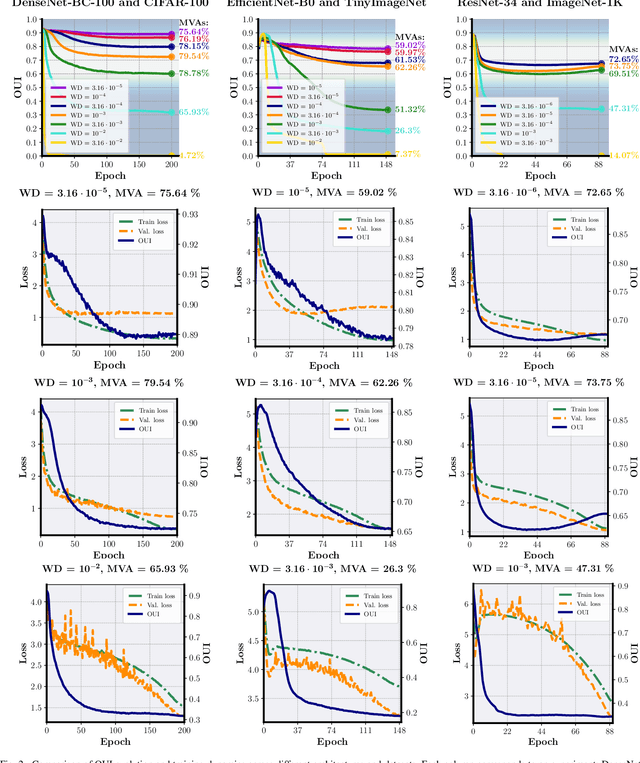
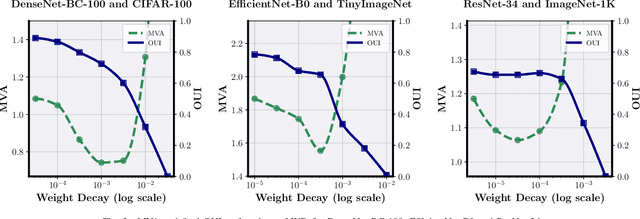
We introduce the Overfitting-Underfitting Indicator (OUI), a novel tool for monitoring the training dynamics of Deep Neural Networks (DNNs) and identifying optimal regularization hyperparameters. Specifically, we validate that OUI can effectively guide the selection of the Weight Decay (WD) hyperparameter by indicating whether a model is overfitting or underfitting during training without requiring validation data. Through experiments on DenseNet-BC-100 with CIFAR- 100, EfficientNet-B0 with TinyImageNet and ResNet-34 with ImageNet-1K, we show that maintaining OUI within a prescribed interval correlates strongly with improved generalization and validation scores. Notably, OUI converges significantly faster than traditional metrics such as loss or accuracy, enabling practitioners to identify optimal WD (hyperparameter) values within the early stages of training. By leveraging OUI as a reliable indicator, we can determine early in training whether the chosen WD value leads the model to underfit the training data, overfit, or strike a well-balanced trade-off that maximizes validation scores. This enables more precise WD tuning for optimal performance on the tested datasets and DNNs. All code for reproducing these experiments is available at https://github.com/AlbertoFdezHdez/OUI.
GreenLightningAI: An Efficient AI System with Decoupled Structural and Quantitative Knowledge
Dec 15, 2023The number and complexity of artificial intelligence (AI) applications is growing relentlessly. As a result, even with the many algorithmic and mathematical advances experienced over past decades as well as the impressive energy efficiency and computational capacity of current hardware accelerators, training the most powerful and popular deep neural networks comes at very high economic and environmental costs. Recognising that additional optimisations of conventional neural network training is very difficult, this work takes a radically different approach by proposing GreenLightningAI, a new AI system design consisting of a linear model that is capable of emulating the behaviour of deep neural networks by subsetting the model for each particular sample. The new AI system stores the information required to select the system subset for a given sample (referred to as structural information) separately from the linear model parameters (referred to as quantitative knowledge). In this paper we present a proof of concept, showing that the structural information stabilises far earlier than the quantitative knowledge. Additionally, we show experimentally that the structural information can be kept unmodified when re-training the AI system with new samples while still achieving a validation accuracy similar to that obtained when re-training a neural network with similar size. Since the proposed AI system is based on a linear model, multiple copies of the model, trained with different datasets, can be easily combined. This enables faster and greener (re)-training algorithms, including incremental re-training and federated incremental re-training.