 Add to Chrome
 Add to Firefox
 Add to Edge
NumColor: Precise Numeric Color Control in Text-to-Image Generation
Mar 13, 2026
Text-to-image diffusion models excel at generating images from natural language descriptions, yet fail to interpret numerical colors such as hex codes (#FF5733) and RGB values (rgb(255,87,51)). This limitation stems from subword tokenization, which fragments color codes into semantically meaningless tokens that text encoders cannot map to coherent color representations. We present NumColor, that enables precise numerical color control across multiple diffusion architectures. NumColor comprises two components: a Color Token Aggregator that detects color specifications regardless of tokenization, and a ColorBook containing 6,707 learnable embeddings that map colors to embedding space of text encoder in perceptually uniform CIE Lab space. We introduce two auxiliary losses, directional alignment and interpolation consistency, to enforce geometric correspondence between Lab and embedding spaces, enabling smooth color interpolation. To train the ColorBook, we construct NumColor-Data, a synthetic dataset of 500K rendered images with unambiguous color-to-pixel correspondence, eliminating the annotation ambiguity inherent in photographic datasets. Although trained solely on FLUX, NumColor transfers zero-shot to SD3, SD3.5, PixArt-α, and PixArt-Σ without model-specific adaptation. NumColor improves numerical color accuracy by 4-9x across five models, while simultaneously improving color harmony scores by 10-30x on GenColorBench benchmark.

LumiCtrl : Learning Illuminant Prompts for Lighting Control in Personalized Text-to-Image Models
Dec 19, 2025Current text-to-image (T2I) models have demonstrated remarkable progress in creative image generation, yet they still lack precise control over scene illuminants, which is a crucial factor for content designers aiming to manipulate the mood, atmosphere, and visual aesthetics of generated images. In this paper, we present an illuminant personalization method named LumiCtrl that learns an illuminant prompt given a single image of an object. LumiCtrl consists of three basic components: given an image of the object, our method applies (a) physics-based illuminant augmentation along the Planckian locus to create fine-tuning variants under standard illuminants; (b) edge-guided prompt disentanglement using a frozen ControlNet to ensure prompts focus on illumination rather than structure; and (c) a masked reconstruction loss that focuses learning on the foreground object while allowing the background to adapt contextually, enabling what we call contextual light adaptation. We qualitatively and quantitatively compare LumiCtrl against other T2I customization methods. The results show that our method achieves significantly better illuminant fidelity, aesthetic quality, and scene coherence compared to existing personalization baselines. A human preference study further confirms strong user preference for LumiCtrl outputs. The code and data will be released upon publication.
GenColorBench: A Color Evaluation Benchmark for Text-to-Image Generation Models
Oct 23, 2025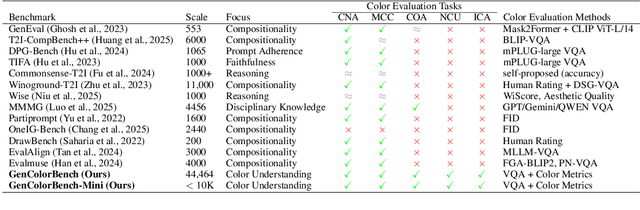
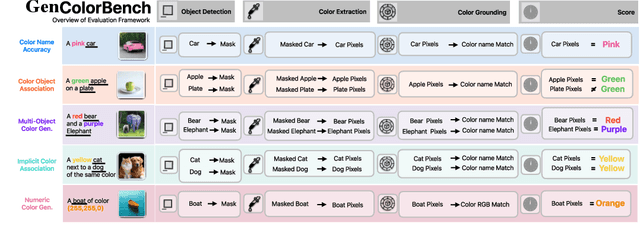
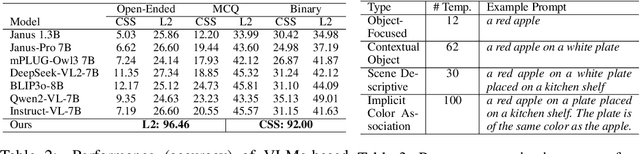
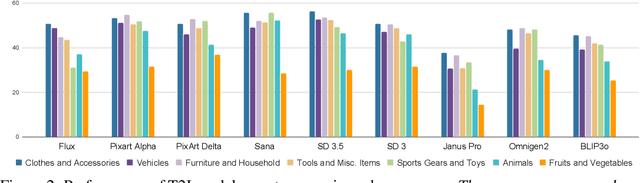
Recent years have seen impressive advances in text-to-image generation, with image generative or unified models producing high-quality images from text. Yet these models still struggle with fine-grained color controllability, often failing to accurately match colors specified in text prompts. While existing benchmarks evaluate compositional reasoning and prompt adherence, none systematically assess color precision. Color is fundamental to human visual perception and communication, critical for applications from art to design workflows requiring brand consistency. However, current benchmarks either neglect color or rely on coarse assessments, missing key capabilities such as interpreting RGB values or aligning with human expectations. To this end, we propose GenColorBench, the first comprehensive benchmark for text-to-image color generation, grounded in color systems like ISCC-NBS and CSS3/X11, including numerical colors which are absent elsewhere. With 44K color-focused prompts covering 400+ colors, it reveals models' true capabilities via perceptual and automated assessments. Evaluations of popular text-to-image models using GenColorBench show performance variations, highlighting which color conventions models understand best and identifying failure modes. Our GenColorBench assessments will guide improvements in precise color generation. The benchmark will be made public upon acceptance.
Deep Spectral Reflectance and Illuminant Estimation from Self-Interreflections
Dec 09, 2018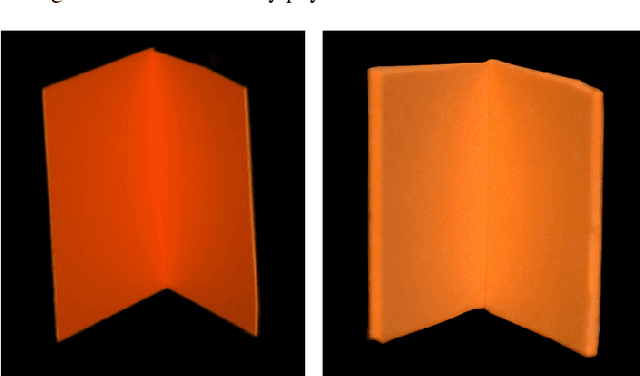
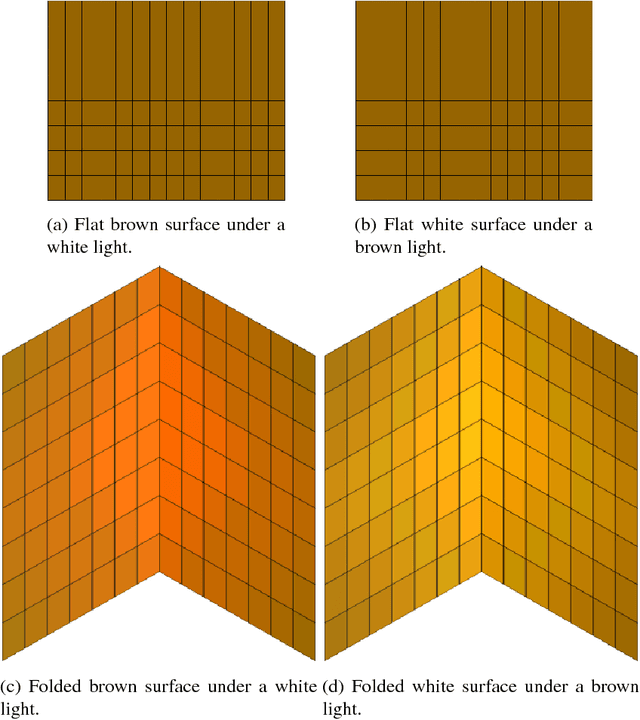
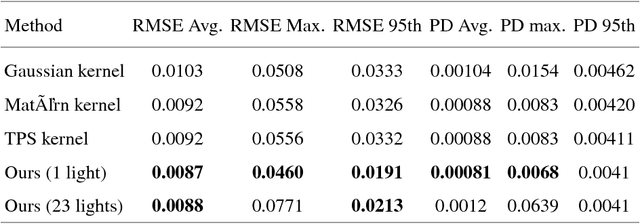
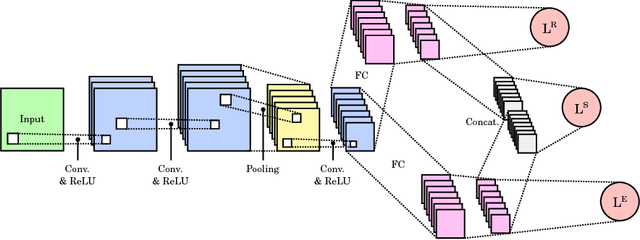
In this work, we propose a CNN-based approach to estimate the spectral reflectance of a surface and the spectral power distribution of the light from a single RGB image of a V-shaped surface. Interreflections happening in a concave surface lead to gradients of RGB values over its area. These gradients carry a lot of information concerning the physical properties of the surface and the illuminant. Our network is trained with only simulated data constructed using a physics-based interreflection model. Coupling interreflection effects with deep learning helps to retrieve the spectral reflectance under an unknown light and to estimate the spectral power distribution of this light as well. In addition, it is more robust to the presence of image noise than the classical approaches. Our results show that the proposed approach outperforms the state of the art learning-based approaches on simulated data. In addition, it gives better results on real data compared to other interreflection-based approaches.