 Add to Chrome
 Add to Firefox
 Add to Edge
StructureGS: Structure-aware Gaussian Splatting for Articulated Object Reconstruction
Jul 29, 2026
Reconstructing articulated objects with multiple movable parts is essential for understanding object structure and enabling physical interaction. However, this reconstruction task poses significant challenges due to the entanglement of geometry, appearance, and motion parameters during optimization. Existing methods rely primarily on photometric supervision, which commonly fails to disentangle these interdependent components, resulting in poor part decomposition with blurred boundaries and geometric artifacts. To address this limitation, we introduce StructureGS, a reconstruction framework for articulated objects that integrates structure-aware guidance into 3D Gaussian Splatting. Our approach leverages oriented bounding boxes of object parts to enforce two key structural properties: spatial coherence, which constrains each part's geometry to remain compact and spatially coherent within its designated region, and structural connectivity, which enforces physically plausible contact relationships between adjacent parts. These properties are realized through structure-aware losses that inject explicit structural constraints into the optimization process. Extensive experiments demonstrate that our method achieves state-of-the-art performance in articulated object reconstruction, producing high-quality results with well-defined part geometries.

Deep Deformable 3D Caricatures with Learned Shape Control
Jul 29, 2022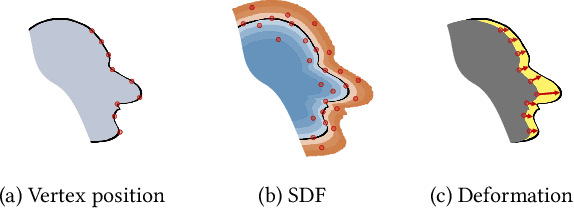
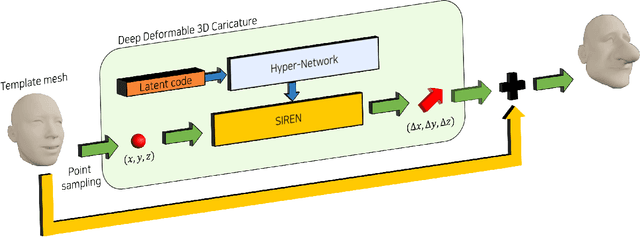
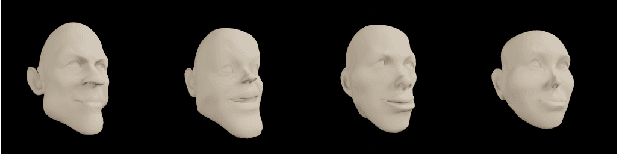
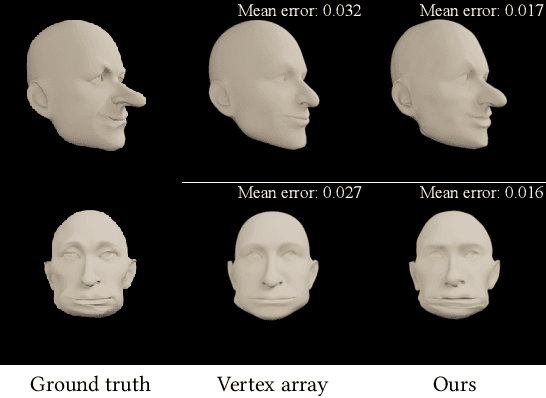
A 3D caricature is an exaggerated 3D depiction of a human face. The goal of this paper is to model the variations of 3D caricatures in a compact parameter space so that we can provide a useful data-driven toolkit for handling 3D caricature deformations. To achieve the goal, we propose an MLP-based framework for building a deformable surface model, which takes a latent code and produces a 3D surface. In the framework, a SIREN MLP models a function that takes a 3D position on a fixed template surface and returns a 3D displacement vector for the input position. We create variations of 3D surfaces by learning a hypernetwork that takes a latent code and produces the parameters of the MLP. Once learned, our deformable model provides a nice editing space for 3D caricatures, supporting label-based semantic editing and point-handle-based deformation, both of which produce highly exaggerated and natural 3D caricature shapes. We also demonstrate other applications of our deformable model, such as automatic 3D caricature creation.
StyleCariGAN: Caricature Generation via StyleGAN Feature Map Modulation
Jul 09, 2021
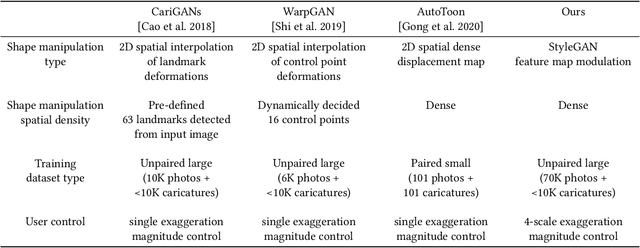

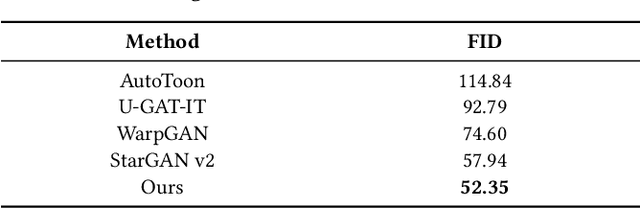
We present a caricature generation framework based on shape and style manipulation using StyleGAN. Our framework, dubbed StyleCariGAN, automatically creates a realistic and detailed caricature from an input photo with optional controls on shape exaggeration degree and color stylization type. The key component of our method is shape exaggeration blocks that are used for modulating coarse layer feature maps of StyleGAN to produce desirable caricature shape exaggerations. We first build a layer-mixed StyleGAN for photo-to-caricature style conversion by swapping fine layers of the StyleGAN for photos to the corresponding layers of the StyleGAN trained to generate caricatures. Given an input photo, the layer-mixed model produces detailed color stylization for a caricature but without shape exaggerations. We then append shape exaggeration blocks to the coarse layers of the layer-mixed model and train the blocks to create shape exaggerations while preserving the characteristic appearances of the input. Experimental results show that our StyleCariGAN generates realistic and detailed caricatures compared to the current state-of-the-art methods. We demonstrate StyleCariGAN also supports other StyleGAN-based image manipulations, such as facial expression control.
* Accepted to SIGGRAPH 2021. For supplementary material, see http://cg.postech.ac.kr/papers/2021_StyleCariGAN_supp.zip