 Add to Chrome
 Add to Firefox
 Add to Edge
Long Live Fine-Tuning: Task-Specific Transformers Outperform Zero-Shot LLMs for Misinformation Response Classification on Reddit
Jun 02, 2026
As large language models (LLMs) become default tools for online information verification, an implicit assumption follows them: that scale and general capability are sufficient for nuanced classification of misinformation discourse. We test this assumption directly on 900 Reddit comments spanning three PolitiFact-verified misinformation claims (environment, health, immigration), labelled as belief (propagates the claim), fact-check (corrects it), or other. We compare nine models across three paradigms -- BART-MNLI, three Llama variants, three commercial frontier LLMs (Claude Haiku 4.5, Gemini Flash Lite 2.5, Claude Sonnet 4.6), and fine-tuned DistilBERT and RoBERTa -- under universal and topic-specific label schemas. The assumption does not hold. Fine-tuned RoBERTa reaches 0.62 macro-$F_1$ against a best zero-shot result of 0.50 (Claude Haiku 4.5), at a fraction of the per-query cost; the supervised advantage is concentrated on the belief class, the implicit, affective category every zero-shot model under-detects. Scaling does not help: Llama-3-8B matches Llama-3-70B, and Claude Sonnet 4.6 underperforms the smaller Haiku under generic labels, collapsing belief detection to 0.17 and refusing outright on a subset of comments flagged as sensitive. This is a safety-alignment artefact, not a capacity limit. Label schema and topic jointly shape zero-shot performance, with the same model varying by more than 0.13 macro-$F_1$ across topics under matched labels. In a verification context, where missing belief is the costlier error, task-specific fine-tuning remains the more reliable choice despite the proliferation of large generative models.

Misinformation is not about Bad Facts: An Analysis of the Production and Consumption of Fringe Content
Mar 13, 2024What if misinformation is not an information problem at all? Our findings suggest that online fringe ideologies spread through the use of content that is consensus-based and "factually correct". We found that Australian news publishers with both moderate and far-right political leanings contain comparable levels of information completeness and quality; and furthermore, that far-right Twitter users often share from moderate sources. However, a stark difference emerges when we consider two additional factors: 1) the narrow topic selection of articles by far-right users, suggesting that they cherrypick only news articles that engage with specific topics of their concern, and 2) the difference between moderate and far-right publishers when we examine the writing style of their articles. Furthermore, we can even identify users prone to sharing misinformation based on their communication style. These findings have important implications for countering online misinformation, as they highlight the powerful role that users' personal bias towards specific topics, and publishers' writing styles, have in amplifying fringe ideologies online.
A Conjoint Application of Data Mining Techniques for Analysis of Global Terrorist Attacks -- Prevention and Prediction for Combating Terrorism
Jan 19, 2019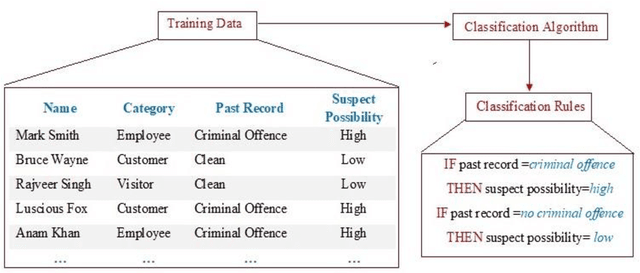
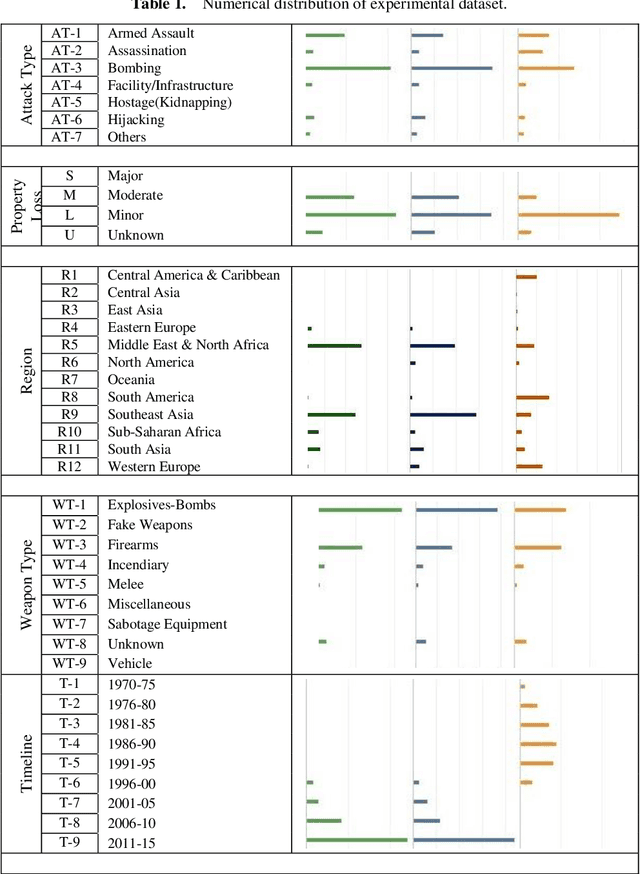
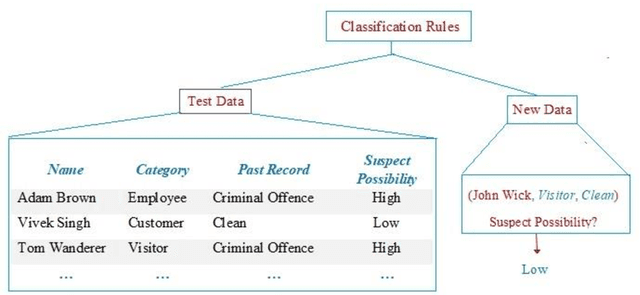
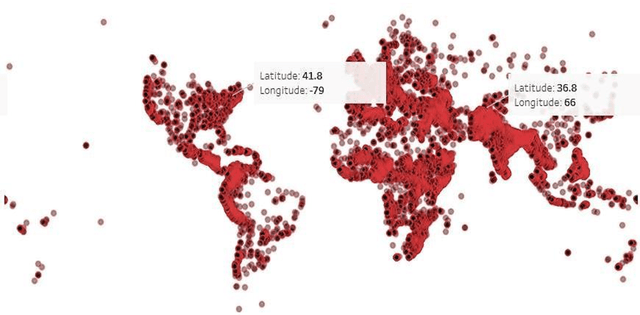
Terrorism has become one of the most tedious problems to deal with and a prominent threat to mankind. To enhance counter-terrorism, several research works are developing efficient and precise systems, data mining is not an exception. Immense data is floating in our lives, though the scarce availability of authentic terrorist attack data in the public domain makes it complicated to fight terrorism. This manuscript focuses on data mining classification techniques and discusses the role of United Nations in counter-terrorism. It analyzes the performance of classifiers such as Lazy Tree, Multilayer Perceptron, Multiclass and Na\"ive Bayes classifiers for observing the trends for terrorist attacks around the world. The database for experiment purpose is created from different public and open access sources for years 1970-2015 comprising of 156,772 reported attacks causing massive losses of lives and property. This work enumerates the losses occurred, trends in attack frequency and places more prone to it, by considering the attack responsibilities taken as evaluation class.
Self-adaptive node-based PCA encodings
Jun 16, 2017In this paper we propose an algorithm, Simple Hebbian PCA, and prove that it is able to calculate the principal component analysis (PCA) in a distributed fashion across nodes. It simplifies existing network structures by removing intralayer weights, essentially cutting the number of weights that need to be trained in half.