 Add to Chrome
 Add to Firefox
 Add to Edge
Modular and Multi-Path-Aware Offline Benchmarking for Mobile GUI Agents
Dec 14, 2025
Mobile GUI Agents, AI agents capable of interacting with mobile applications on behalf of users, have the potential to transform human computer interaction. However, current evaluation practices for GUI agents face two fundamental limitations. First, they either rely on single path offline benchmarks or online live benchmarks. Offline benchmarks using static, single path annotated datasets unfairly penalize valid alternative actions, while online benchmarks suffer from poor scalability and reproducibility due to the dynamic and unpredictable nature of live evaluation. Second, existing benchmarks treat agents as monolithic black boxes, overlooking the contributions of individual components, which often leads to unfair comparisons or obscures key performance bottlenecks. To address these limitations, we present MobiBench, the first modular and multi path aware offline benchmarking framework for mobile GUI agents that enables high fidelity, scalable, and reproducible evaluation entirely in offline settings. Our experiments demonstrate that MobiBench achieves 94.72 percent agreement with human evaluators, on par with carefully engineered online benchmarks, while preserving the scalability and reproducibility of static offline benchmarks. Furthermore, our comprehensive module level analysis uncovers several key insights, including a systematic evaluation of diverse techniques used in mobile GUI agents, optimal module configurations across model scales, the inherent limitations of current LFMs, and actionable guidelines for designing more capable and cost efficient mobile agents.

MetaMix: Meta-state Precision Searcher for Mixed-precision Activation Quantization
Nov 12, 2023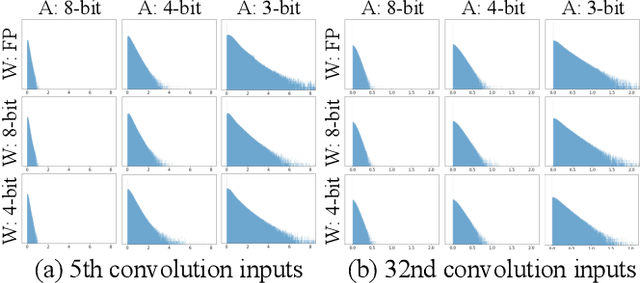


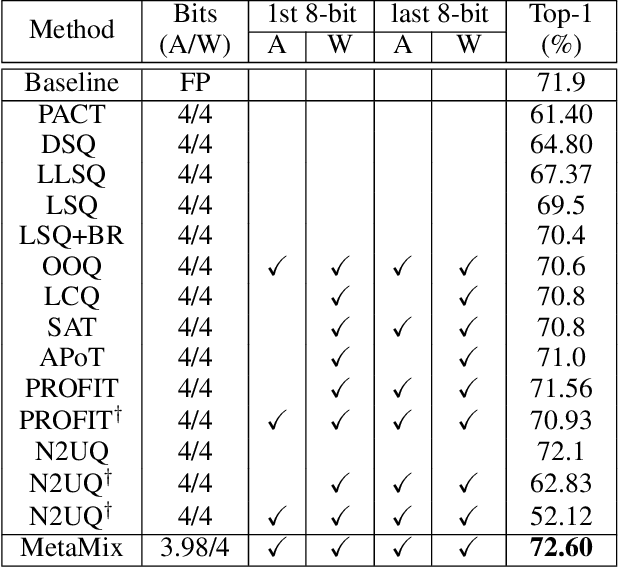
Mixed-precision quantization of efficient networks often suffer from activation instability encountered in the exploration of bit selections. To address this problem, we propose a novel method called MetaMix which consists of bit selection and weight training phases. The bit selection phase iterates two steps, (1) the mixed-precision-aware weight update, and (2) the bit-search training with the fixed mixed-precision-aware weights, both of which combined reduce activation instability in mixed-precision quantization and contribute to fast and high-quality bit selection. The weight training phase exploits the weights and step sizes trained in the bit selection phase and fine-tunes them thereby offering fast training. Our experiments with efficient and hard-to-quantize networks, i.e., MobileNet v2 and v3, and ResNet-18 on ImageNet show that our proposed method pushes the boundary of mixed-precision quantization, in terms of accuracy vs. operations, by outperforming both mixed- and single-precision SOTA methods.
JaxPruner: A concise library for sparsity research
May 02, 2023


This paper introduces JaxPruner, an open-source JAX-based pruning and sparse training library for machine learning research. JaxPruner aims to accelerate research on sparse neural networks by providing concise implementations of popular pruning and sparse training algorithms with minimal memory and latency overhead. Algorithms implemented in JaxPruner use a common API and work seamlessly with the popular optimization library Optax, which, in turn, enables easy integration with existing JAX based libraries. We demonstrate this ease of integration by providing examples in four different codebases: Scenic, t5x, Dopamine and FedJAX and provide baseline experiments on popular benchmarks.