 Add to Chrome
 Add to Firefox
 Add to Edge
Pose6DAug: Physically Plausible Multi-view Object Swapping for Robot Data Augmentation
Jun 18, 2026
Vision-language-action (VLA) policies have shown strong potential for general-purpose manipulation, yet they often fail on novel, out-of-distribution objects whose appearance or geometry deviates from the training distribution. The standard remedy is to collect multi-view teleoperation data for every failure case, but this scales poorly in both cost and time. We introduce Pose6DAug, a failure-driven data augmentation framework that turns a policy's own successful episodes into targeted demonstrations for its failure modes, without any new data collection. Our key insight is that each successful episode already encodes a physically valid action trajectory together with calibrated multi-view observations. By swapping only the manipulated object while preserving this trajectory, we obtain new and physically grounded demonstrations. However, naive 2D video editing breaks multi-view consistency and physical plausibility, particularly under heavy occlusion and egocentric viewpoints. Our method instead operates directly in 3D, anchoring the target object with an explicit mesh driven by a temporally coherent 6D pose trajectory, ensuring geometrically consistent renderings across all camera views. Fine-tuning a VLA on data augmented by our method improves success rates by 16.5% relative to the state-of-the-art baseline on novel objects, while preserving in-distribution performance. These results show that multi-view and physically consistent augmentation is a practical path to scalable VLA generalization.

Collaborative LLM Inference via Planning for Efficient Reasoning
Jun 13, 2025
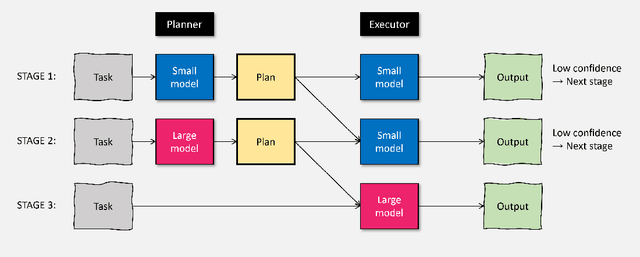
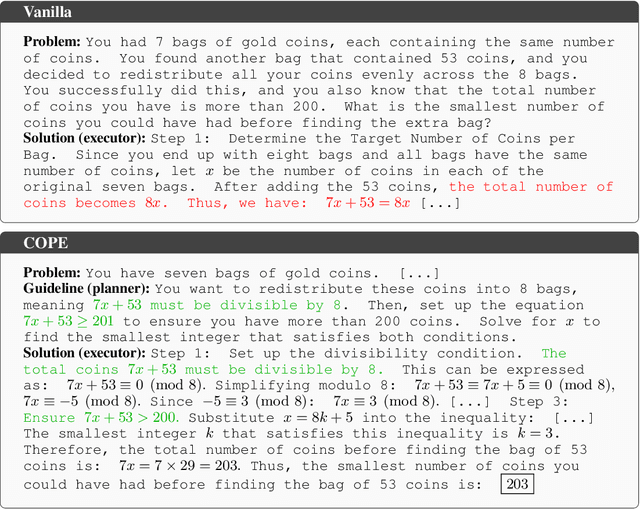
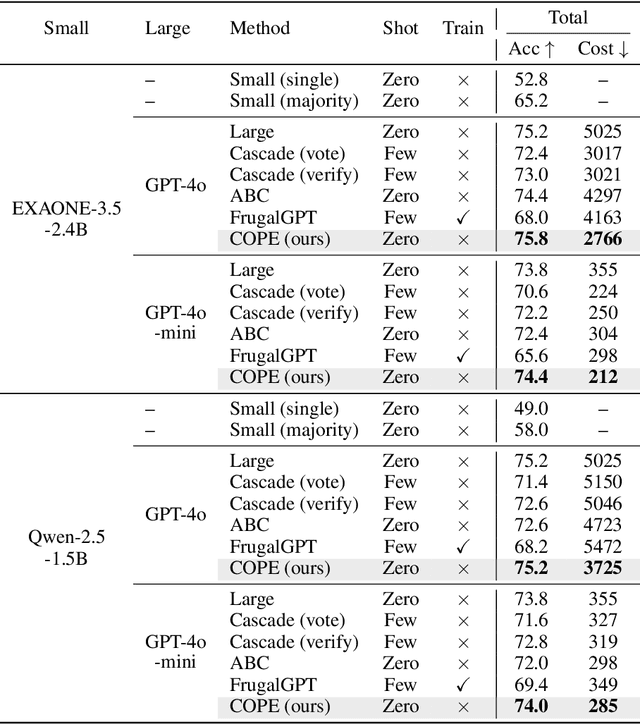
Large language models (LLMs) excel at complex reasoning tasks, but those with strong capabilities (e.g., whose numbers of parameters are larger than 100B) are often accessible only through paid APIs, making them too costly for applications of frequent use. In contrast, smaller open-sourced LLMs (e.g., whose numbers of parameters are less than 3B) are freely available and easy to deploy locally (e.g., under a single GPU having 8G VRAM), but lack suff icient reasoning ability. This trade-off raises a natural question: can small (free) and large (costly) models collaborate at test time to combine their strengths? We propose a test-time collaboration framework in which a planner model first generates a plan, defined as a distilled and high-level abstraction of the problem. This plan serves as a lightweight intermediate that guides a reasoner model, which generates a complete solution. Small and large models take turns acting as planner and reasoner, exchanging plans in a multi-round cascade to collaboratively solve complex tasks. Our method achieves accuracy comparable to strong proprietary models alone, while significantly reducing reliance on paid inference. These results highlight planning as an effective prior for orchestrating cost-aware, cross-model inference under real-world deployment constraints.