 Add to Chrome
 Add to Firefox
 Add to Edge
SpokenUS: A Spoken User Simulator for Task-Oriented Dialogue
Mar 17, 2026
Robust task-oriented spoken dialogue agents require exposure to the full diversity of how people interact through speech. Building spoken user simulators that address this requires large-scale spoken task-oriented dialogue (TOD) data encompassing spoken user behaviors, yet existing datasets are limited in scale and domain coverage, with no systematic pipeline for augmenting them. To address this, we introduce \textbf{SpokenTOD}, a spoken TOD dataset of 52,390 dialogues and 1,034 hours of speech augmented with four spoken user behaviors -- cross-turn slots, barge-in, disfluency, and emotional prosody -- across diverse speakers and domains. Building on SpokenTOD, we present \textbf{SpokenUS}, a spoken user simulator grounded in TOD with a dedicated architecture for barge-in. SpokenUS achieves comparable goal coverage to significantly larger models while substantially outperforming all baselines in Human MOS, disclosing slot values gradually across the dialogue as humans do rather than front-loading them. Further analysis confirms that SpokenUS's spoken behaviors pose meaningful challenges to downstream agents, making it a practical tool for training and evaluating more robust spoken dialogue systems.

SpeakerSleuth: Evaluating Large Audio-Language Models as Judges for Multi-turn Speaker Consistency
Jan 07, 2026Large Audio-Language Models (LALMs) as judges have emerged as a prominent approach for evaluating speech generation quality, yet their ability to assess speaker consistency across multi-turn conversations remains unexplored. We present SpeakerSleuth, a benchmark evaluating whether LALMs can reliably judge speaker consistency in multi-turn dialogues through three tasks reflecting real-world requirements. We construct 1,818 human-verified evaluation instances across four diverse datasets spanning synthetic and real speech, with controlled acoustic difficulty. Evaluating nine widely-used LALMs, we find that models struggle to reliably detect acoustic inconsistencies. For instance, given audio samples of the same speaker's turns, some models overpredict inconsistency, whereas others are overly lenient. Models further struggle to identify the exact turns that are problematic. When other interlocutors' turns are provided together, performance degrades dramatically as models prioritize textual coherence over acoustic cues, failing to detect even obvious gender switches for a speaker. On the other hand, models perform substantially better in choosing the audio that best matches the speaker among several acoustic variants, demonstrating inherent acoustic discrimination capabilities. These findings expose a significant bias in LALMs: they tend to prioritize text over acoustics, revealing fundamental modality imbalances that need to be addressed to build reliable audio-language judges.
Quantifying Data Contamination in Psychometric Evaluations of LLMs
Oct 08, 2025Recent studies apply psychometric questionnaires to Large Language Models (LLMs) to assess high-level psychological constructs such as values, personality, moral foundations, and dark traits. Although prior work has raised concerns about possible data contamination from psychometric inventories, which may threaten the reliability of such evaluations, there has been no systematic attempt to quantify the extent of this contamination. To address this gap, we propose a framework to systematically measure data contamination in psychometric evaluations of LLMs, evaluating three aspects: (1) item memorization, (2) evaluation memorization, and (3) target score matching. Applying this framework to 21 models from major families and four widely used psychometric inventories, we provide evidence that popular inventories such as the Big Five Inventory (BFI-44) and Portrait Values Questionnaire (PVQ-40) exhibit strong contamination, where models not only memorize items but can also adjust their responses to achieve specific target scores.
Don't Adapt Small Language Models for Tools; Adapt Tool Schemas to the Models
Oct 08, 2025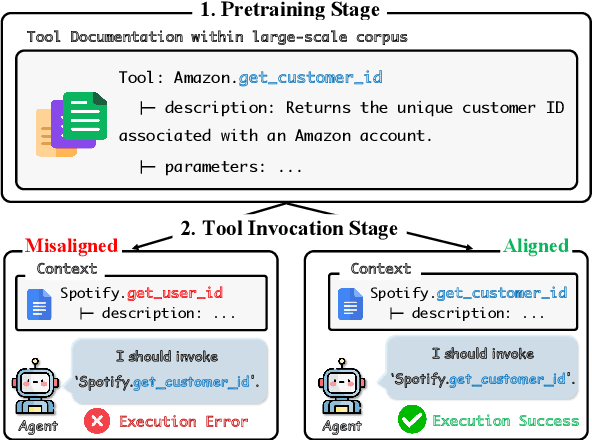
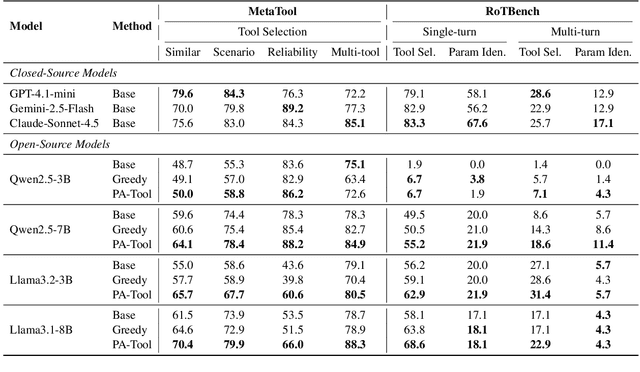
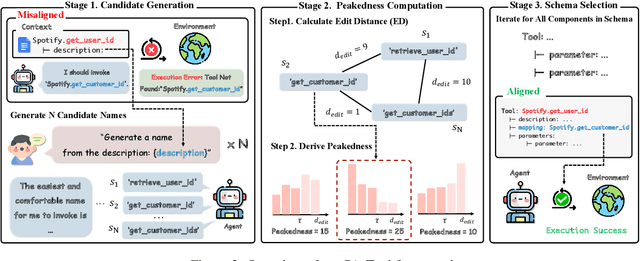
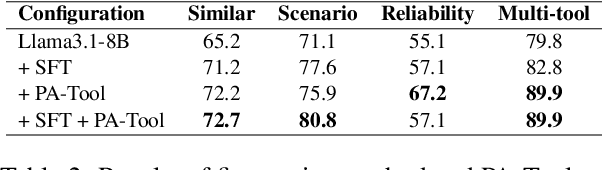
Small language models (SLMs) offer significant computational advantages for tool-augmented AI systems, yet they struggle with tool-use tasks, particularly in selecting appropriate tools and identifying correct parameters. A common failure mode is schema misalignment: models hallucinate plausible but non-existent tool names that reflect naming conventions internalized during pretraining but absent from the provided tool schema. Rather than forcing models to adapt to arbitrary schemas, we propose adapting schemas to align with models' pretrained knowledge. We introduce PA-Tool (Pretraining-Aligned Tool Schema Generation), a training-free method that leverages peakedness-a signal from contamination detection indicating pretraining familiarity-to automatically rename tool components. By generating multiple candidates and selecting those with highest output concentration across samples, PA-Tool identifies pretrain-aligned naming patterns. Experiments on MetaTool and RoTBench show improvements of up to 17% points, with schema misalignment errors reduced by 80%. PA-Tool enables small models to approach state-of-the-art performance while maintaining computational efficiency for adaptation to new tools without retraining. Our work demonstrates that schema-level interventions can unlock the tool-use potential of resource-efficient models by adapting schemas to models rather than models to schemas.