 Add to Chrome
 Add to Firefox
 Add to Edge
Deployment Is Not Destiny: Robot Recomposition in the Field with Unseen Software, Hardware, and Compute Payloads
Aug 11, 2026
The tight coupling of subsystems in most robots, though a natural consequence of their complexity, leads to monolithic designs that are time-consuming and difficult to adapt after initial deployment. To address this challenge, we present a framework and supporting abstractions for recomposition during runtime that enable robots to quickly integrate previously unseen modular software, hardware, and compute payloads. Our approach allows non-expert users to quickly add new capabilities in the field through a true plug-and-play process. Crucially, new resources are not only immediately available to a host robot but are also shared with distributed peers, enabling compute-constrained systems to access powerful new remote capabilities. Our framework reduces reconfiguration time to a matter of minutes with no developer intervention, in stark contrast to the hours of expert effort often required for traditional manual integration. We demonstrate our method in two disaster response scenarios, including radioactive source localization at an operational nuclear reactor facility and a thermal-guided search for people in dark, difficult-to-reach spaces. These demonstrations show how in-field recomposition provides timely, flexible, and accessible adaptation to dynamic requirements, representing a critical step toward creating robots that can quickly evolve alongside the tasks, technologies, and environments they support.

Contract-Grounded Behavior Tree Synthesis via Coding Agents
Jul 13, 2026Synthesizing deployable robot behavior trees (BTs) from natural language (NL) requires grounding to ensure every generated BT references only skills a robot can actually execute. Existing LLM-based BT synthesis approaches often place this grounding responsibility on the prompt author. This makes deployment brittle when the author does not know which skills the robot can execute, how those skills are parameterized, or how the robot runtime software constrains valid BT structure. This paper proposes a contract-grounded BT synthesis architecture in which a coding agent queries a robot-side Model Context Protocol (MCP) server to retrieve an explicit contract consisting of a skill library, permitted BT operators, and optional BT composition templates, before synthesizing a BT for validation and execution. In our framework, non-expert operators issue NL commands without knowledge of robot implementation details, while a robot runtime validation gate enforces correctness before execution. We evaluate two LLMs, a closed model (Sonnet 4.6) and a smaller open-source model (Gemma4:31b), across 110 simulated tasks in PyRoboSim and 14 tasks on a physical Husarion Panther robot. Results show that contract grounding enables near-perfect BT validation and high task success, that BT composition templates substantially recover success on reactive control-flow tasks for the smaller model, and that the architecture transfers to physical hardware running a Nav2 stack opaque to both operator and agent.
Limited Linguistic Diversity in Embodied AI Datasets
Jan 06, 2026Language plays a critical role in Vision-Language-Action (VLA) models, yet the linguistic characteristics of the datasets used to train and evaluate these systems remain poorly documented. In this work, we present a systematic dataset audit of several widely used VLA corpora, aiming to characterize what kinds of instructions these datasets actually contain and how much linguistic variety they provide. We quantify instruction language along complementary dimensions-including lexical variety, duplication and overlap, semantic similarity, and syntactic complexity. Our analysis shows that many datasets rely on highly repetitive, template-like commands with limited structural variation, yielding a narrow distribution of instruction forms. We position these findings as descriptive documentation of the language signal available in current VLA training and evaluation data, intended to support more detailed dataset reporting, more principled dataset selection, and targeted curation or augmentation strategies that broaden language coverage.
Temporal and Semantic Evaluation Metrics for Foundation Models in Post-Hoc Analysis of Robotic Sub-tasks
Mar 25, 2024Recent works in Task and Motion Planning (TAMP) show that training control policies on language-supervised robot trajectories with quality labeled data markedly improves agent task success rates. However, the scarcity of such data presents a significant hurdle to extending these methods to general use cases. To address this concern, we present an automated framework to decompose trajectory data into temporally bounded and natural language-based descriptive sub-tasks by leveraging recent prompting strategies for Foundation Models (FMs) including both Large Language Models (LLMs) and Vision Language Models (VLMs). Our framework provides both time-based and language-based descriptions for lower-level sub-tasks that comprise full trajectories. To rigorously evaluate the quality of our automatic labeling framework, we contribute an algorithm SIMILARITY to produce two novel metrics, temporal similarity and semantic similarity. The metrics measure the temporal alignment and semantic fidelity of language descriptions between two sub-task decompositions, namely an FM sub-task decomposition prediction and a ground-truth sub-task decomposition. We present scores for temporal similarity and semantic similarity above 90%, compared to 30% of a randomized baseline, for multiple robotic environments, demonstrating the effectiveness of our proposed framework. Our results enable building diverse, large-scale, language-supervised datasets for improved robotic TAMP.
Cost-effective Machine Learning Inference Offload for Edge Computing
Dec 07, 2020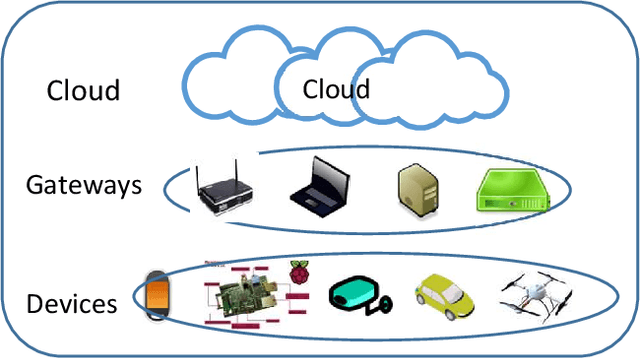
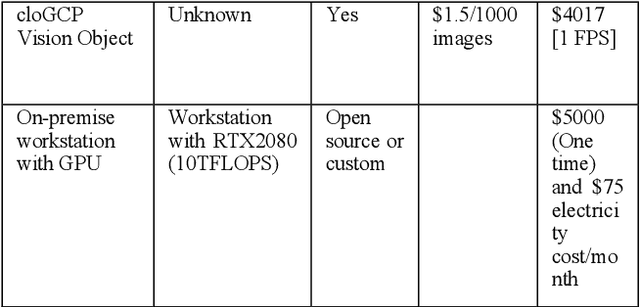
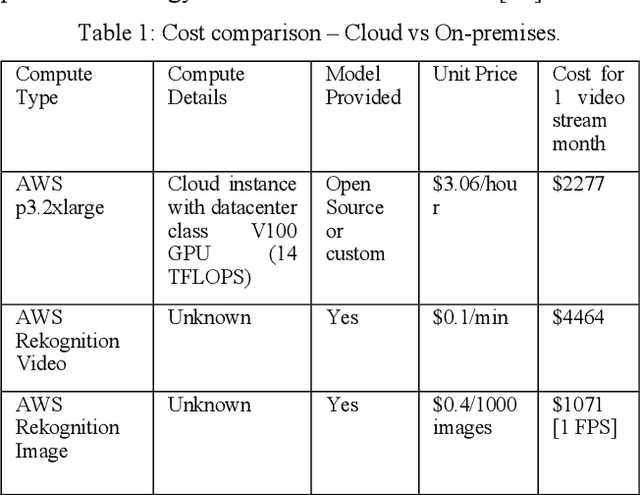
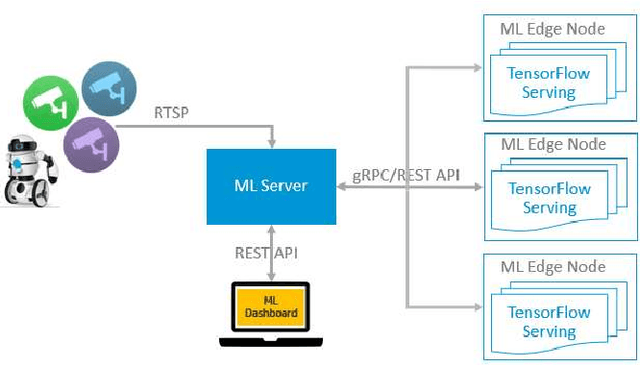
Computing at the edge is increasingly important since a massive amount of data is generated. This poses challenges in transporting all that data to the remote data centers and cloud, where they can be processed and analyzed. On the other hand, harnessing the edge data is essential for offering data-driven and machine learning-based applications, if the challenges, such as device capabilities, connectivity, and heterogeneity can be mitigated. Machine learning applications are very compute-intensive and require processing of large amount of data. However, edge devices are often resources-constrained, in terms of compute resources, power, storage, and network connectivity. Hence, limiting their potential to run efficiently and accurately state-of-the art deep neural network (DNN) models, which are becoming larger and more complex. This paper proposes a novel offloading mechanism by leveraging installed-base on-premises (edge) computational resources. The proposed mechanism allows the edge devices to offload heavy and compute-intensive workloads to edge nodes instead of using remote cloud. Our offloading mechanism has been prototyped and tested with state-of-the art person and object detection DNN models for mobile robots and video surveillance applications. The performance shows a significant gain compared to cloud-based offloading strategies in terms of accuracy and latency.