 Add to Chrome
 Add to Firefox
 Add to Edge
The Evaluation Cost of Task Specialization in Evolutionary Multi-Robot Systems
Jun 23, 2026
Task specialization can improve the efficiency of multi-robot systems (MRSs). Previous works have investigated the emergence of task-specialist robot controllers through evolutionary optimization and have argued that task specialization is more likely to evolve when subtask behaviors are readily available as building blocks. However, the available evaluation budget must be distributed across all subtasks, whereas a single generalist behavior can exploit the entire budget for its own optimization. We present a cost-benefit analysis of evolving task-specialist versus generalist behaviors in a foraging scenario here. In a physics-based robotics simulator, we study the total evaluation budget required to evolve task-specialist behaviors that outperform generalist behaviors across MRS sizes. We show that with increasing MRS size, a lower total evaluation budget is sufficient to evolve specialists that outperform generalists.

On the Cost of Evolving Task Specialization in Multi-Robot Systems
Mar 10, 2026Task specialization can lead to simpler robot behaviors and higher efficiency in multi-robot systems. Previous works have shown the emergence of task specialization during evolutionary optimization, focusing on feasibility rather than costs. In this study, we take first steps toward a cost-benefit analysis of task specialization in robot swarms using a foraging scenario. We evolve artificial neural networks as generalist behaviors for the entire task and as task-specialist behaviors for subtasks within a limited evaluation budget. We show that generalist behaviors can be successfully optimized while the evolved task-specialist controllers fail to cooperate efficiently, resulting in worse performance than the generalists. Consequently, task specialization does not necessarily improve efficiency when optimization budget is limited.
How Swarms Differ: Challenges in Collective Behaviour Comparison
Feb 13, 2026Collective behaviours often need to be expressed through numerical features, e.g., for classification or imitation learning. This problem is often addressed by proposing an ad-hoc feature set for a particular swarm behaviour context, usually without further consideration of the solution's resilience outside of the conceived context. Yet, the development of automatic methods to design swarm behaviours is dependent on the ability to measure quantitatively the similarity of swarm behaviours. Hence, we investigate the impact of feature sets for collective behaviours. We select swarm feature sets and similarity measures from prior swarm robotics works, which mainly considered a narrow behavioural context and assess their robustness. We demonstrate that the interplay of feature set and similarity measure makes some combinations more suitable to distinguish groups of similar behaviours. We also propose a self-organised map-based approach to identify regions of the feature space where behaviours cannot be easily distinguished.
Do We Run Large-scale Multi-Robot Systems on the Edge? More Evidence for Two-Phase Performance in System Size Scaling
Oct 18, 2023With increasing numbers of mobile robots arriving in real-world applications, more robots coexist in the same space, interact, and possibly collaborate. Methods to provide such systems with system size scalability are known, for example, from swarm robotics. Example strategies are self-organizing behavior, a strict decentralized approach, and limiting the robot-robot communication. Despite applying such strategies, any multi-robot system breaks above a certain critical system size (i.e., number of robots) as too many robots share a resource (e.g., space, communication channel). We provide additional evidence based on simulations, that at these critical system sizes, the system performance separates into two phases: nearly optimal and minimal performance. We speculate that in real-world applications that are configured for optimal system size, the supposedly high-performing system may actually live on borrowed time as it is on a transient to breakdown. We provide two modeling options (based on queueing theory and a population model) that may help to support this reasoning.
Show me what you want: Inverse reinforcement learning to automatically design robot swarms by demonstration
Jan 17, 2023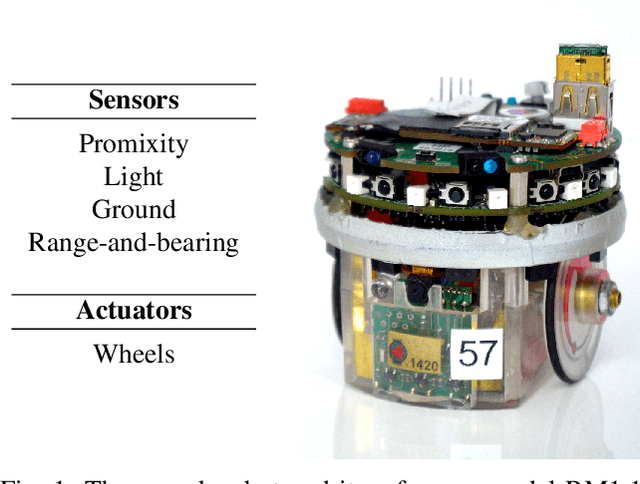
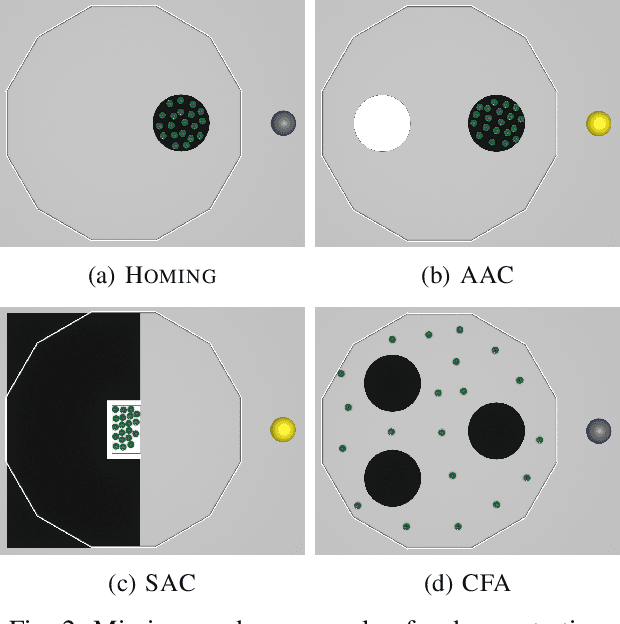
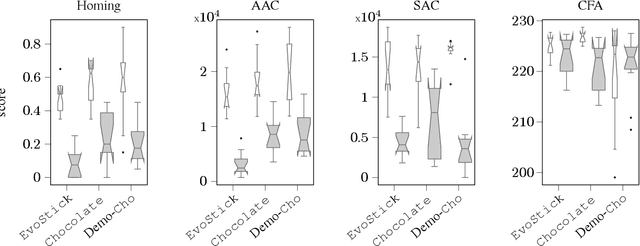
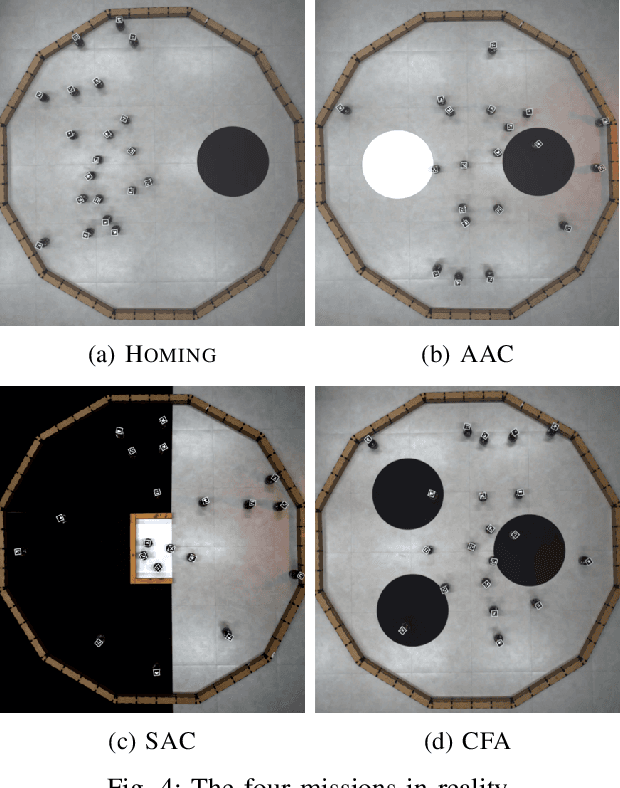
Automatic design is a promising approach to generating control software for robot swarms. So far, automatic design has relied on mission-specific objective functions to specify the desired collective behavior. In this paper, we explore the possibility to specify the desired collective behavior via demonstrations. We develop Demo-Cho, an automatic design method that combines inverse reinforcement learning with automatic modular design of control software for robot swarms. We show that, only on the basis of demonstrations and without the need to be provided with an explicit objective function, Demo-Cho successfully generated control software to perform four missions. We present results obtained in simulation and with physical robots.