 Add to Chrome
 Add to Firefox
 Add to Edge
Epistemic Filtering and Collective Hallucination: A Jury Theorem for Confidence-Calibrated Agents
Feb 25, 2026
We investigate the collective accuracy of heterogeneous agents who learn to estimate their own reliability over time and selectively abstain from voting. While classical epistemic voting results, such as the \textit{Condorcet Jury Theorem} (CJT), assume fixed participation, real-world aggregation often benefits from allowing agents to say ``I don't know.'' We propose a probabilistic framework where agents engage in a \textit{calibration} phase, updating beliefs about their own fixed competence, before facing a final confidence gate that determines whether to vote or abstain. We derive a non-asymptotic lower bound on the group's success probability and prove that this \textit{selective participation} generalizes the asymptotic guarantees of the CJT to a sequential, confidence-gated setting. Empirically, we validate these bounds via Monte Carlo simulations. While our results are general, we discuss their potential application to AI safety, outlining how this framework can mitigate \textit{hallucinations} in collective LLM decision-making.

Constructive Interpolation and Concept-Based Beth Definability for Description Logics via Sequents
Apr 24, 2024


We introduce a constructive method applicable to a large number of description logics (DLs) for establishing the concept-based Beth definability property (CBP) based on sequent systems. Using the highly expressive DL RIQ as a case study, we introduce novel sequent calculi for RIQ-ontologies and show how certain interpolants can be computed from sequent calculus proofs, which permit the extraction of explicit definitions of implicitly definable concepts. To the best of our knowledge, this is the first sequent-based approach to computing interpolants and definitions within the context of DLs, as well as the first proof that RIQ enjoys the CBP. Moreover, due to the modularity of our sequent systems, our results hold for any restriction of RIQ, and are applicable to other DLs by suitable modifications.
Uniform and Modular Sequent Systems for Description Logics
Jun 17, 2022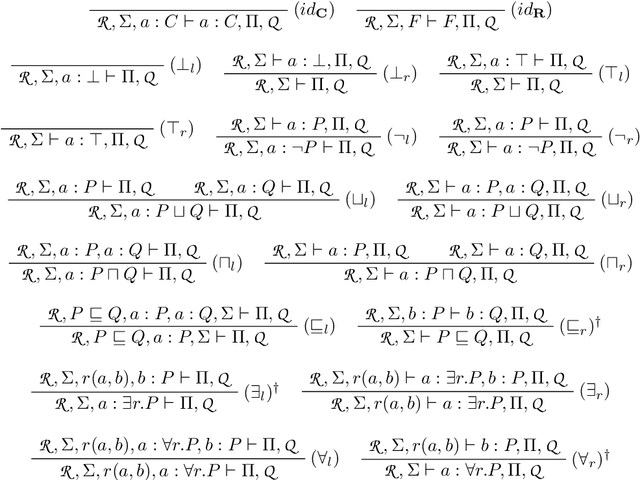

We introduce a framework that allows for the construction of sequent systems for expressive description logics extending ALC. Our framework not only covers a wide array of common description logics, but also allows for sequent systems to be obtained for extensions of description logics with special formulae that we call "role relational axioms." All sequent systems are sound, complete, and possess favorable properties such as height-preserving admissibility of common structural rules and height-preserving invertibility of rules.