 Add to Chrome
 Add to Firefox
 Add to Edge
Chain of Flow: A Foundational Generative Framework for ECG-to-4D Cardiac Digital Twins
Feb 26, 2026
A clinically actionable Cardiac Digital Twin (CDT) should reconstruct individualised cardiac anatomy and physiology, update its internal state from multimodal signals, and enable a broad range of downstream simulations beyond isolated tasks. However, existing CDT frameworks remain limited to task-specific predictors rather than building a patient-specific, manipulable virtual heart. In this work, we introduce Chain of Flow (COF), a foundational ECG-driven generative framework that reconstructs full 4D cardiac structure and motion from a single cardiac cycle. The method integrates cine-CMR and 12-lead ECG during training to learn a unified representation of cardiac geometry, electrophysiology, and motion dynamics. We evaluate Chain of Flow on diverse cohorts and demonstrate accurate recovery of cardiac anatomy, chamber-wise function, and dynamic motion patterns. The reconstructed 4D hearts further support downstream CDT tasks such as volumetry, regional function analysis, and virtual cine synthesis. By enabling full 4D organ reconstruction directly from ECG, COF transforms cardiac digital twins from narrow predictive models into fully generative, patient-specific virtual hearts. Code will be released after review.

Deep Learning-based Automated Aortic Area and Distensibility Assessment: The Multi-Ethnic Study of Atherosclerosis
Mar 03, 2021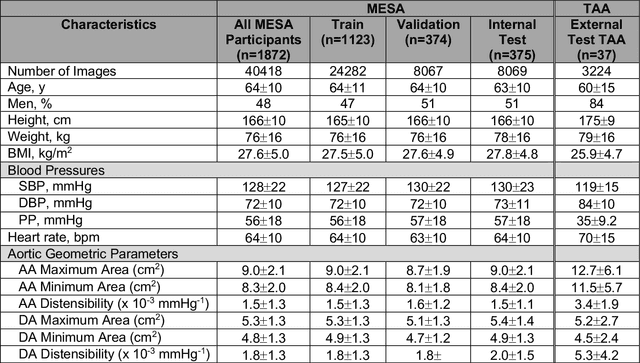
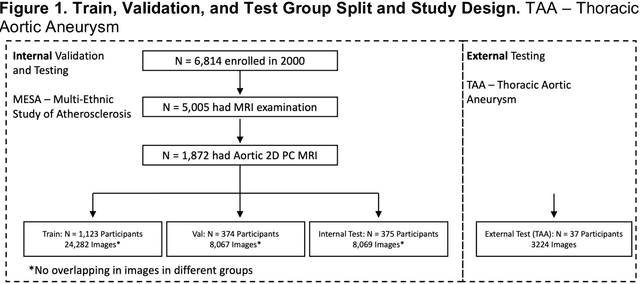
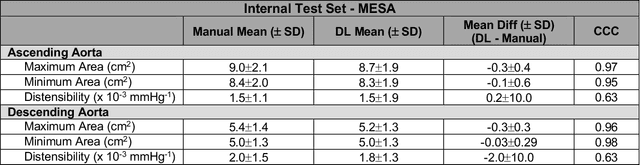
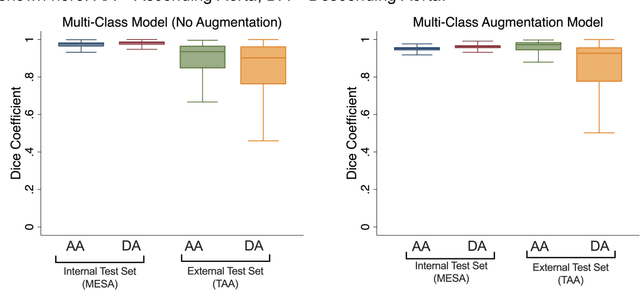
This study applies convolutional neural network (CNN)-based automatic segmentation and distensibility measurement of the ascending and descending aorta from 2D phase-contrast cine magnetic resonance imaging (PC-cine MRI) within the large MESA cohort with subsequent assessment on an external cohort of thoracic aortic aneurysm (TAA) patients. 2D PC-cine MRI images of the ascending and descending aorta at the pulmonary artery bifurcation from the MESA study were included. Train, validation, and internal test sets consisted of 1123 studies (24282 images), 374 studies (8067 images), and 375 studies (8069 images), respectively. An external test set of TAAs consisted of 37 studies (3224 images). A U-Net based CNN was constructed, and performance was evaluated utilizing dice coefficient (for segmentation) and concordance correlation coefficients (CCC) of aortic geometric parameters by comparing to manual segmentation and parameter estimation. Dice coefficients for aorta segmentation were 97.6% (CI: 97.5%-97.6%) and 93.6% (84.6%-96.7%) on the internal and external test of TAAs, respectively. CCC for comparison of manual and CNN maximum and minimum ascending aortic areas were 0.97 and 0.95, respectively, on the internal test set and 0.997 and 0.995, respectively, for the external test. CCCs for maximum and minimum descending aortic areas were 0.96 and 0. 98, respectively, on the internal test set and 0.93 and 0.93, respectively, on the external test set. We successfully developed and validated a U-Net based ascending and descending aortic segmentation and distensibility quantification model in a large multi-ethnic database and in an external cohort of TAA patients.