 Add to Chrome
 Add to Firefox
 Add to Edge
Token Distribution versus Data Volume: Domain Balancing in Multi-Domain Meeting Summarisation
Aug 16, 2026
Jointly fine-tuning an LLM on meeting-summarisation corpora of widely varying size raises a question that prior work leaves confounded: when a domain-balanced training mixture helps, is the gain due to the distribution of tokens across domains, or merely to the volume of data seen? We disentangle these factors by constructing balanced and natural (native-proportional) token mixtures at matched token budgets (2-32M) over five English meeting corpora, fine-tuning Mistral-7B with QLoRA, and evaluating per domain. Balancing redistributes quality, improving the data-scarce minority domains at a low cost to the data-rich ones. The trade favours balancing whenever the minority domains matter: their share under proportional allocation is fixed at 1-2% regardless of budget, so matching balanced quality on those domains requires far more total data. We further find that pruning low-value transcript lines removes ~15% of tokens from the conversational corpora at no measurable cost, and that balancing by tokens is not the same as balancing by examples. A two-annotator study of 741 judge-labelled facts validates our fact-level evaluation. Together these results give practitioners a basis for deciding when to balance an imbalanced multi-domain mixture, and on what unit.

Artificial Intelligence for Collective Intelligence: A National-Scale Research Strategy
Nov 09, 2024


Advances in artificial intelligence (AI) have great potential to help address societal challenges that are both collective in nature and present at national or trans-national scale. Pressing challenges in healthcare, finance, infrastructure and sustainability, for instance, might all be productively addressed by leveraging and amplifying AI for national-scale collective intelligence. The development and deployment of this kind of AI faces distinctive challenges, both technical and socio-technical. Here, a research strategy for mobilising inter-disciplinary research to address these challenges is detailed and some of the key issues that must be faced are outlined.
A Fusion Approach for Efficient Human Skin Detection
Oct 14, 2014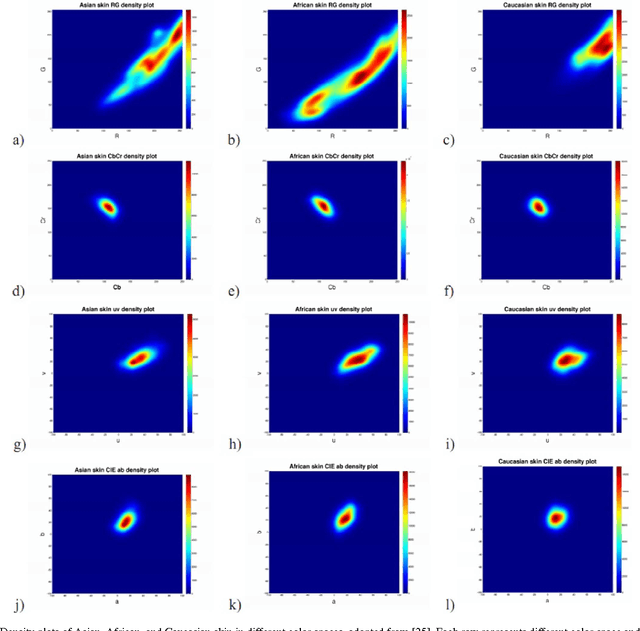
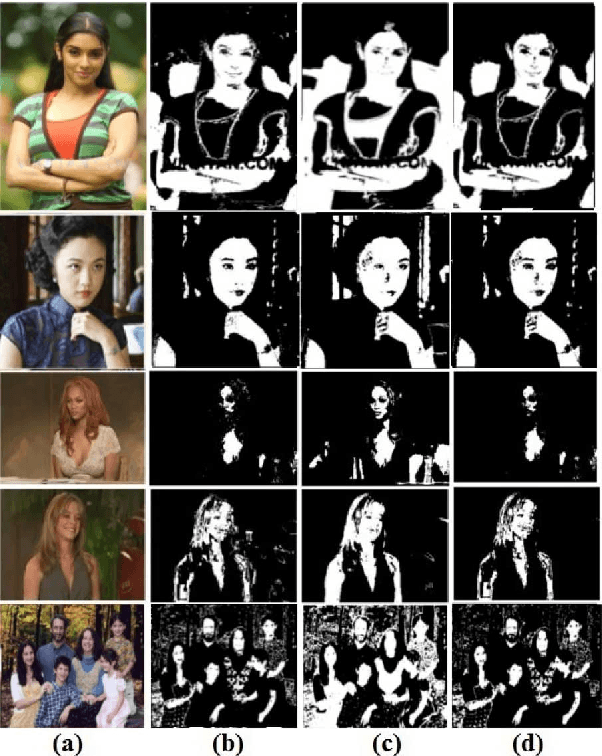
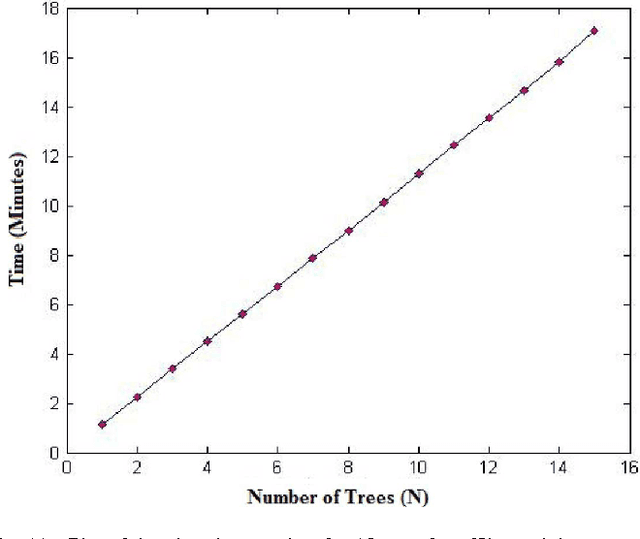

A reliable human skin detection method that is adaptable to different human skin colours and illu- mination conditions is essential for better human skin segmentation. Even though different human skin colour detection solutions have been successfully applied, they are prone to false skin detection and are not able to cope with the variety of human skin colours across different ethnic. Moreover, existing methods require high computational cost. In this paper, we propose a novel human skin de- tection approach that combines a smoothed 2D histogram and Gaussian model, for automatic human skin detection in colour image(s). In our approach an eye detector is used to refine the skin model for a specific person. The proposed approach reduces computational costs as no training is required; and it improves the accuracy of skin detection despite wide variation in ethnicity and illumination. To the best of our knowledge, this is the first method to employ fusion strategy for this purpose. Qualitative and quantitative results on three standard public datasets and a comparison with state-of-the-art methods have shown the effectiveness and robustness of the proposed approach.
* Accepted in IEEE Transactions on Industrial Informatics, vol. 8(1), pp. 138-147, new skin detection + ground truth (Pratheepan) dataset