 Add to Chrome
 Add to Firefox
 Add to Edge
AxisGuide: Grounding Robot Action Coordinate System in RGB Observations for Robust Visuomotor Manipulation
Jun 04, 2026
Visuomotor manipulation policies trained via large-scale behavior cloning have achieved strong semantic scene understanding, yet often fail to reliably execute correct low-level actions under distribution shifts. For example, even in a simple pickup task with identical scene layouts, camera viewpoints, and illumination, performance can degrade substantially when the object is placed at unseen locations. We argue that this gap arises from insufficient action understanding, namely the inability to interpret the robot's base-frame action coordinate system in image space. To address this issue, we introduce AxisGuide, a lightweight guidance method that bridges semantic scene understanding and action-coordinate interpretation. Using camera parameters and end-effector poses, AxisGuide renders the robot base-frame axes in each camera view and augments RGB observations with a small set of cue channels that explicitly visualize the meaning of the +x, +y, and +z motions in image space. Extensive evaluations in both the LIBERO simulation and real-world environments demonstrate that AxisGuide yields substantial performance gains and improved generalization, highlighting the effectiveness of explicit action-coordinate cues for learning reliable and transferable generalist visuomotor policies.

Finetuning Pre-trained Model with Limited Data for LiDAR-based 3D Object Detection by Bridging Domain Gaps
Oct 02, 2024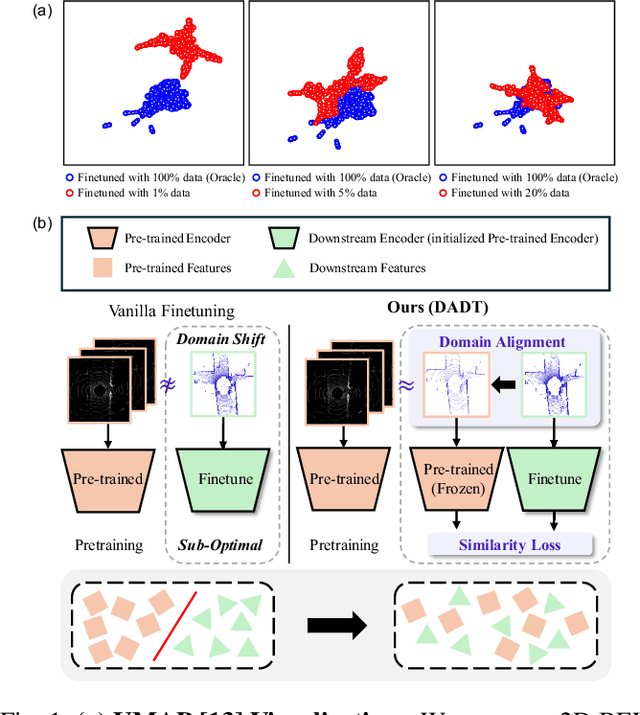

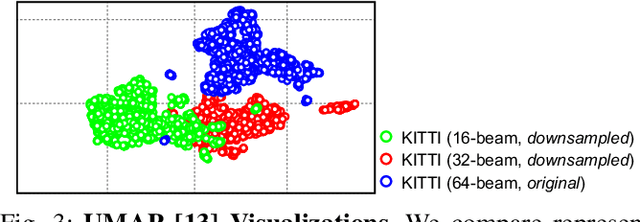
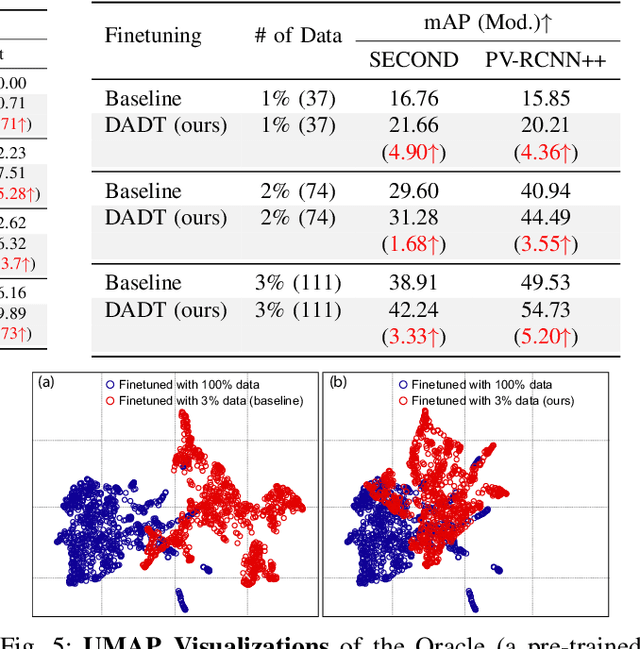
LiDAR-based 3D object detectors have been largely utilized in various applications, including autonomous vehicles or mobile robots. However, LiDAR-based detectors often fail to adapt well to target domains with different sensor configurations (e.g., types of sensors, spatial resolution, or FOVs) and location shifts. Collecting and annotating datasets in a new setup is commonly required to reduce such gaps, but it is often expensive and time-consuming. Recent studies suggest that pre-trained backbones can be learned in a self-supervised manner with large-scale unlabeled LiDAR frames. However, despite their expressive representations, they remain challenging to generalize well without substantial amounts of data from the target domain. Thus, we propose a novel method, called Domain Adaptive Distill-Tuning (DADT), to adapt a pre-trained model with limited target data (approximately 100 LiDAR frames), retaining its representation power and preventing it from overfitting. Specifically, we use regularizers to align object-level and context-level representations between the pre-trained and finetuned models in a teacher-student architecture. Our experiments with driving benchmarks, i.e., Waymo Open dataset and KITTI, confirm that our method effectively finetunes a pre-trained model, achieving significant gains in accuracy.