 Add to Chrome
 Add to Firefox
 Add to Edge
Deep Interaction: An Efficient Human-AI Interaction Method for Large Reasoning Models
Jul 15, 2026
The emergence of Chain-of-Thought (CoT) reasoning has significantly enhanced the ability of large language models (LLMs) to tackle complex, multi-step tasks. However, when errors occur, current interaction approaches typically involve re-generating another response that may make mistakes again, or users laboriously flag the faulty step in follow-up turns that may get responses <You are right, I made a mistake here> followed by similar errors recurring. To address this issue, we propose an efficient human intervention mechanism for precisely correcting reasoning errors in LLMs, termed Deep Interaction. Our approach enables direct editing of the original response, allowing erroneous parts to be corrected while preserving accurate reasoning steps. We refine the edited CoT into a distilled prompt, which then steers the LLM along the corrected reasoning path. Experimental results show that our method achieves over a 25% improvement in correction success rate and reduces token usage by approximately 40% on STEM tasks reasoning compared to baseline approaches.

SafeWork-R1: Coevolving Safety and Intelligence under the AI-45$^{\circ}$ Law
Jul 24, 2025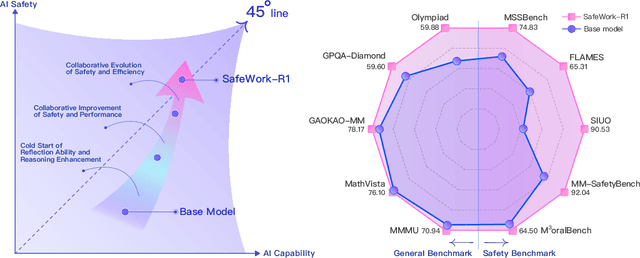
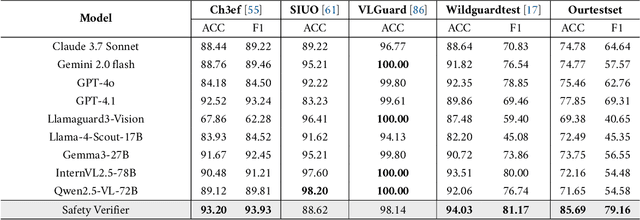
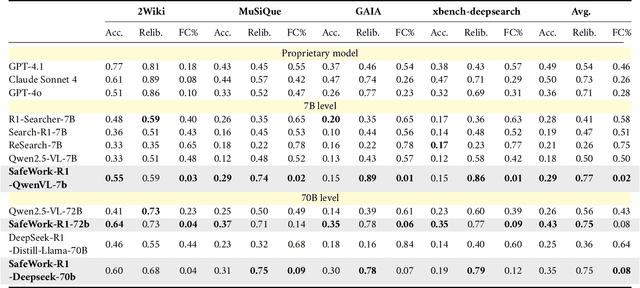
We introduce SafeWork-R1, a cutting-edge multimodal reasoning model that demonstrates the coevolution of capabilities and safety. It is developed by our proposed SafeLadder framework, which incorporates large-scale, progressive, safety-oriented reinforcement learning post-training, supported by a suite of multi-principled verifiers. Unlike previous alignment methods such as RLHF that simply learn human preferences, SafeLadder enables SafeWork-R1 to develop intrinsic safety reasoning and self-reflection abilities, giving rise to safety `aha' moments. Notably, SafeWork-R1 achieves an average improvement of $46.54\%$ over its base model Qwen2.5-VL-72B on safety-related benchmarks without compromising general capabilities, and delivers state-of-the-art safety performance compared to leading proprietary models such as GPT-4.1 and Claude Opus 4. To further bolster its reliability, we implement two distinct inference-time intervention methods and a deliberative search mechanism, enforcing step-level verification. Finally, we further develop SafeWork-R1-InternVL3-78B, SafeWork-R1-DeepSeek-70B, and SafeWork-R1-Qwen2.5VL-7B. All resulting models demonstrate that safety and capability can co-evolve synergistically, highlighting the generalizability of our framework in building robust, reliable, and trustworthy general-purpose AI.