 Add to Chrome
 Add to Firefox
 Add to Edge
Less is more: Not all samples are effective for evaluation
Dec 22, 2025
The versatility of Large Language Models (LLMs) in vertical domains has spurred the development of numerous specialized evaluation benchmarks. However, these benchmarks often suffer from significant semantic redundancy and impose high computational costs during evaluation. Existing compression methods, such as tinyBenchmarks depend critically on correctness labels from multiple historical models evaluated on the full test set, making them inapplicable in cold-start scenarios, such as the introduction of a new task, domain, or model with no prior evaluation history. To address this limitation, we propose a history-free test set compression framework that requires no prior model performance data. Our method begins by fine-tuning a base LLM on a small amount of domain-specific data to internalize task-relevant semantics. It then generates high-level semantic embeddings for all original test samples using only their raw textual content. In this domain-adapted embedding space, we perform task-aware clustering and introduce a novel dataset X-ray mechanism that analyzes cluster geometry to dynamically calibrate the compression intensity based on the intrinsic redundancy of the benchmark. Experiments on professional-domain dataset, notably a large-scale 3GPP communications benchmark, demonstrate that our approach effectively identifies and removes redundant samples, reducing evaluation cost by over 90% while preserving high fidelity to the full benchmark.

DHRL-FNMR: An Intelligent Multicast Routing Approach Based on Deep Hierarchical Reinforcement Learning in SDN
May 30, 2023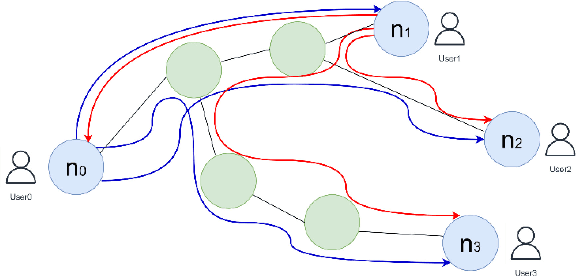
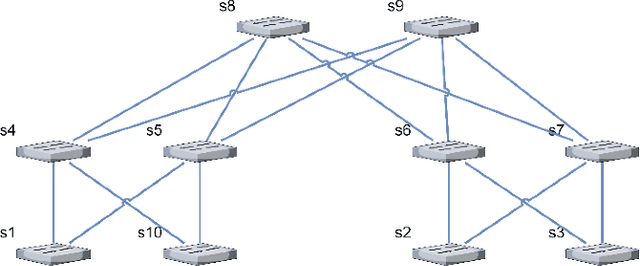
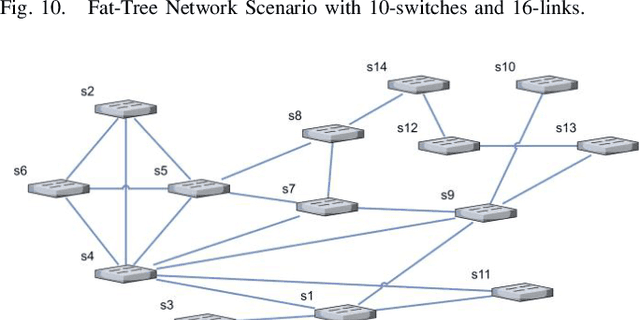
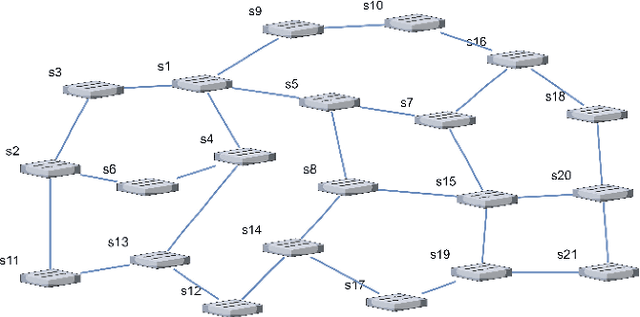
The optimal multicast tree problem in the Software-Defined Networking (SDN) multicast routing is an NP-hard combinatorial optimization problem. Although existing SDN intelligent solution methods, which are based on deep reinforcement learning, can dynamically adapt to complex network link state changes, these methods are plagued by problems such as redundant branches, large action space, and slow agent convergence. In this paper, an SDN intelligent multicast routing algorithm based on deep hierarchical reinforcement learning is proposed to circumvent the aforementioned problems. First, the multicast tree construction problem is decomposed into two sub-problems: the fork node selection problem and the construction of the optimal path from the fork node to the destination node. Second, based on the information characteristics of SDN global network perception, the multicast tree state matrix, link bandwidth matrix, link delay matrix, link packet loss rate matrix, and sub-goal matrix are designed as the state space of intrinsic and meta controllers. Then, in order to mitigate the excessive action space, our approach constructs different action spaces at the upper and lower levels. The meta-controller generates an action space using network nodes to select the fork node, and the intrinsic controller uses the adjacent edges of the current node as its action space, thus implementing four different action selection strategies in the construction of the multicast tree. To facilitate the intelligent agent in constructing the optimal multicast tree with greater speed, we developed alternative reward strategies that distinguish between single-step node actions and multi-step actions towards multiple destination nodes.
An Intelligent SDWN Routing Algorithm Based on Network Situational Awareness and Deep Reinforcement Learning
May 12, 2023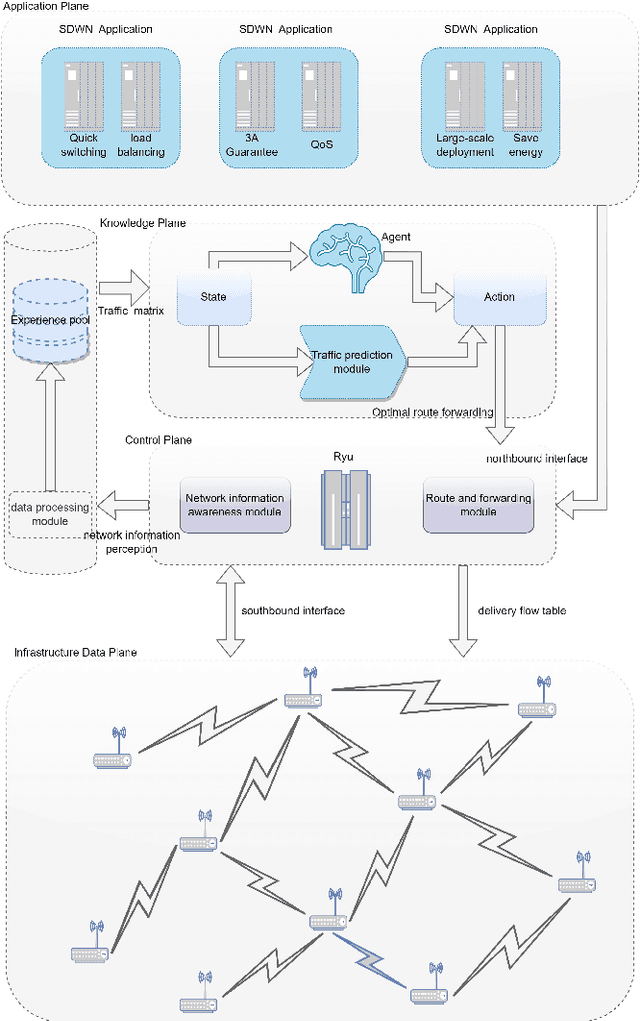
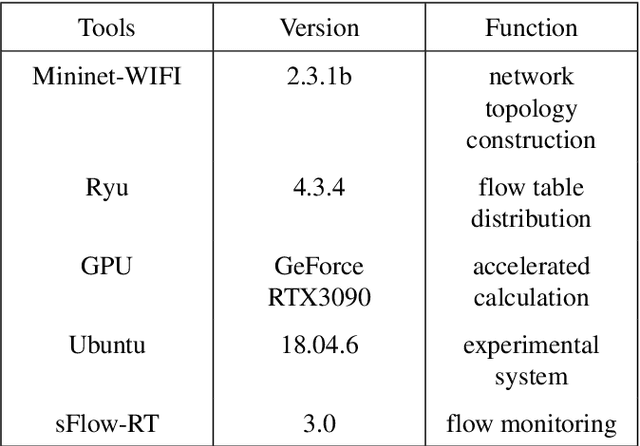
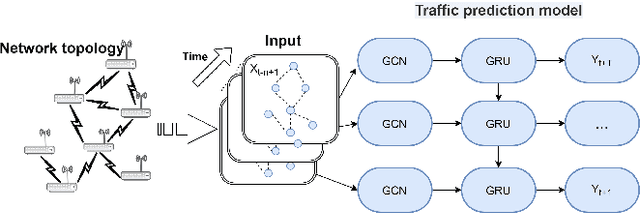
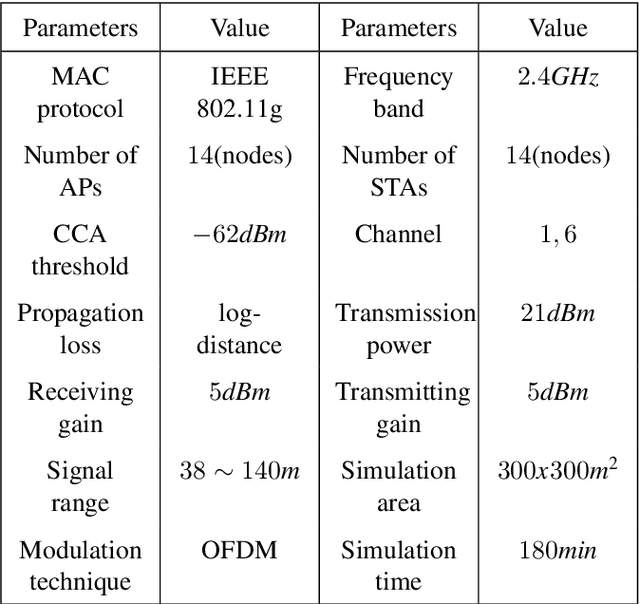
Due to the highly dynamic changes in wireless network topologies, efficiently obtaining network status information and flexibly forwarding data to improve communication quality of service are important challenges. This article introduces an intelligent routing algorithm (DRL-PPONSA) based on proximal policy optimization deep reinforcement learning with network situational awareness under a software-defined wireless networking architecture. First, a specific data plane is designed for network topology construction and data forwarding. The control plane collects network traffic information, sends flow tables, and uses a GCN-GRU prediction mechanism to perceive future traffic change trends to achieve network situational awareness. Second, a DRL-based data forwarding mechanism is designed in the knowledge plane. The predicted network traffic matrix and topology information matrix are treated as the environment for DRL agents, while next-hop adjacent nodes are treated as executable actions. Accordingly, action selection strategies are designed for different network conditions to achieve more intelligent, flexible, and efficient routing control. The reward function is designed using network link information and various reward and penalty mechanisms. Additionally, importance sampling and gradient clipping techniques are employed during gradient updating to enhance convergence speed and stability. Experimental results show that DRL-PPONSA outperforms traditional routing methods in network throughput, delay, packet loss rate, and wireless node distance. Compared to value-function-based Dueling DQN routing, the convergence speed is significantly improved, and the convergence effect is more stable. Simultaneously, its consumption of hardware storage space is reduced, and efficient routing decisions can be made in real-time using the current network state information.