 Add to Chrome
 Add to Firefox
 Add to Edge
MAGIC: Multi-Step Advantage-Gated Causal Influence for Multi-agent Reinforcement Learning
May 03, 2026
A key challenge in multi-agent reinforcement learning (MARL) lies in designing learning signals that effectively promote coordination among agents. Designing such signals necessitates the ability to quantify the true, long-term causal influence between agents. To address this, we introduce Multi-step Advantage-Gated Interventional Causal MARL (MAGIC), a framework that extracts multi-step causal influences between agents and selectively converts them into intrinsic rewards. MAGIC uses causal intervention with conditional mutual information to quantify long-horizon agent influence, and introduces an advantage-based gating mechanism to ensure exploration is directed toward beneficial, goal-aligned behaviors. Experiments across multiple standard MARL benchmarks and task families, including MPE and SMAC/SMACv2, demonstrate that MAGIC outperforms state-of-the-art methods by a significant margin, achieving an improvement of at least 10.1% in the main evaluation metric.

Guiding Multi-agent Multi-task Reinforcement Learning by a Hierarchical Framework with Logical Reward Shaping
Nov 02, 2024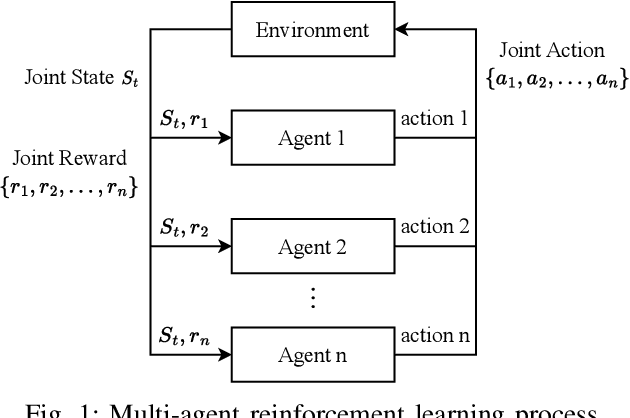
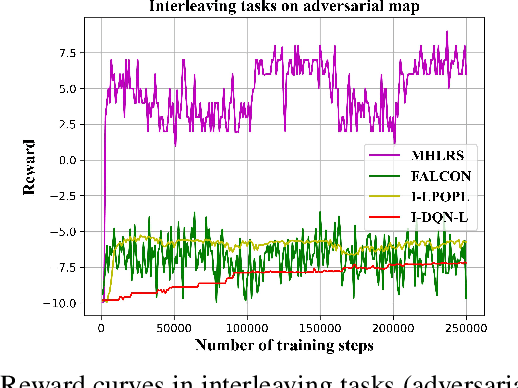
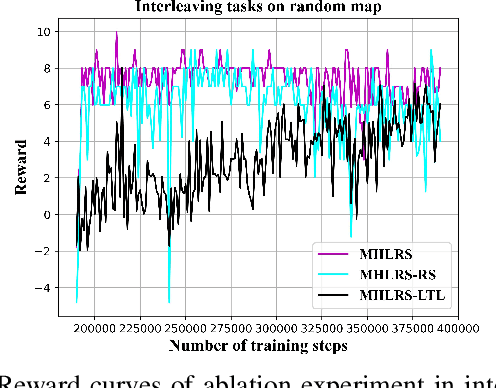
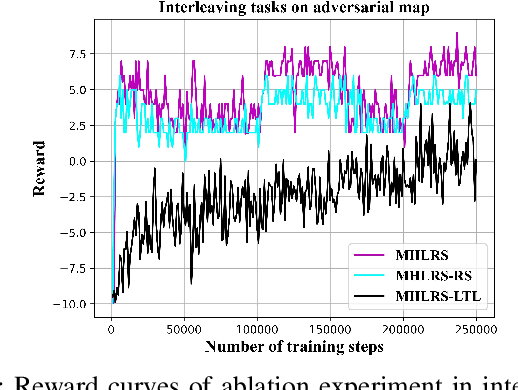
Multi-agent hierarchical reinforcement learning (MAHRL) has been studied as an effective means to solve intelligent decision problems in complex and large-scale environments. However, most current MAHRL algorithms follow the traditional way of using reward functions in reinforcement learning, which limits their use to a single task. This study aims to design a multi-agent cooperative algorithm with logic reward shaping (LRS), which uses a more flexible way of setting the rewards, allowing for the effective completion of multi-tasks. LRS uses Linear Temporal Logic (LTL) to express the internal logic relation of subtasks within a complex task. Then, it evaluates whether the subformulae of the LTL expressions are satisfied based on a designed reward structure. This helps agents to learn to effectively complete tasks by adhering to the LTL expressions, thus enhancing the interpretability and credibility of their decisions. To enhance coordination and cooperation among multiple agents, a value iteration technique is designed to evaluate the actions taken by each agent. Based on this evaluation, a reward function is shaped for coordination, which enables each agent to evaluate its status and complete the remaining subtasks through experiential learning. Experiments have been conducted on various types of tasks in the Minecraft-like environment. The results demonstrate that the proposed algorithm can improve the performance of multi-agents when learning to complete multi-tasks.