 Add to Chrome
 Add to Firefox
 Add to Edge
U-HNO: A U-shaped Hybrid Neural Operator with Sparse-Point Adaptive Routing for Non-stationary PDE Dynamics
May 13, 2026
Solutions to many partial differential equations (PDEs) display coexisting smooth global transport and localized sharp features within a single trajectory: shock fronts, thin interfaces, and concentrated high-frequency content sit on top of slowly varying backgrounds. This poses a challenge for neural operators: Fourier-based architectures mix nonlocal interactions efficiently but tend to under-resolve localized non-smooth features, whereas spatially local architectures recover fine detail at the cost of long-range propagation and rollout stability. Existing hybrid operators paper over this tension with a fixed, spatially uniform fusion that forces the same trade-off everywhere. We propose U-HNO, a U-shaped hybrid neural operator whose central design is Sparse-Point Adaptive Routing (SPAR): at every spatial location, a per-pixel hard mask selects whether the global Fourier branch or the local multi-scale Gaussian branch should dominate, and the sparsity ratio is a function of the local contrast of the routing signal, so smooth and shock-aligned regions receive different mixtures of global and local computation. SPAR is embedded in a hierarchical encoder-bottleneck-decoder backbone with skip connections so that the dual branches and the gate operate at every resolution. Training combines pointwise supervision with a finite-difference H^1 gradient term and a band-wise spectral consistency regularizer. Across benchmarks spanning 1D Burgers, Kuramoto-Sivashinsky, KdV, 2D advection, Allen-Cahn, Navier-Stokes, Darcy flow, and 3D transonic compressible Navier-Stokes from PDEBench, U-HNO achieves state-of-the-art rollout accuracy on the majority of tasks in both relative L^2 and H^1 metrics, with the largest gains on problems dominated by sharp localized features. Ablations show that removing any single component substantially degrades rollout error.

Contextual Weisfeiler-Lehman Graph Kernel For Malware Detection
Jun 21, 2016
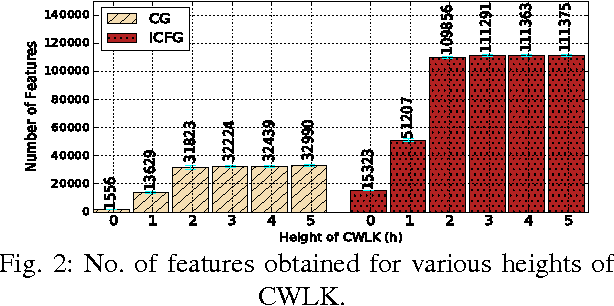
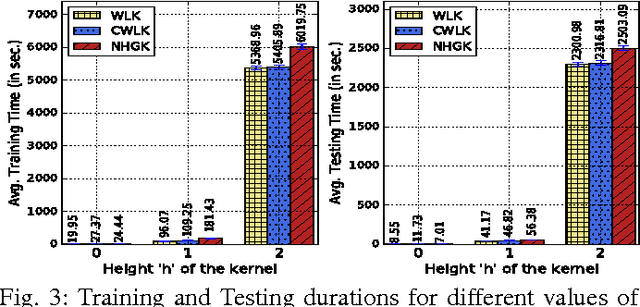
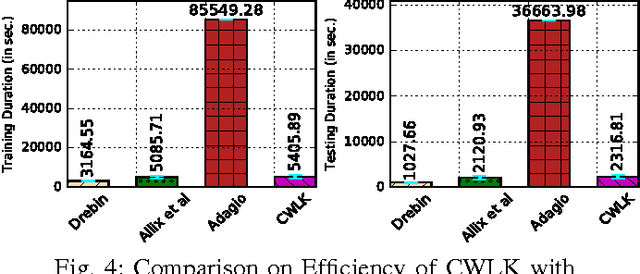
In this paper, we propose a novel graph kernel specifically to address a challenging problem in the field of cyber-security, namely, malware detection. Previous research has revealed the following: (1) Graph representations of programs are ideally suited for malware detection as they are robust against several attacks, (2) Besides capturing topological neighbourhoods (i.e., structural information) from these graphs it is important to capture the context under which the neighbourhoods are reachable to accurately detect malicious neighbourhoods. We observe that state-of-the-art graph kernels, such as Weisfeiler-Lehman kernel (WLK) capture the structural information well but fail to capture contextual information. To address this, we develop the Contextual Weisfeiler-Lehman kernel (CWLK) which is capable of capturing both these types of information. We show that for the malware detection problem, CWLK is more expressive and hence more accurate than WLK while maintaining comparable efficiency. Through our large-scale experiments with more than 50,000 real-world Android apps, we demonstrate that CWLK outperforms two state-of-the-art graph kernels (including WLK) and three malware detection techniques by more than 5.27% and 4.87% F-measure, respectively, while maintaining high efficiency. This high accuracy and efficiency make CWLK suitable for large-scale real-world malware detection.