 Add to Chrome
 Add to Firefox
 Add to Edge
Generative AI Advertising as a Problem of Trustworthy Commercial Intervention
May 18, 2026
Major deployed generative AI advertising systems preserve a visible boundary between commercial content and AI-generated responses. Yet empirical research shows that ads woven directly into large language model (LLM) outputs often go undetected by users. We argue that generative AI fundamentally changes advertising: rather than placing products into discrete slots, it enables interventions on the generative process itself, which induce commercial influence through less observable channels. This reframes generative AI advertising as a problem of trustworthy intervention rather than content placement. We introduce a taxonomy organized by influence tier, corresponding to interventions on progressively more latent variables: product mentions, information framing, behavioral redirection, and long-term preference shaping; and show how these tiers instantiate across modalities and system architectures, including retrieval-augmented generation and agentic pipelines where upstream decisions can sharply constrain downstream outcomes. Both major deployed systems and designed mechanisms concentrate on the most observable and easiest-to-govern tier, while the forms of commercial influence most consequential for user autonomy remain poorly understood and lack frameworks for detection, measurement, or disclosure. The central challenge is whether commercial influence in generative systems can be made trustworthy, i.e., attributable, measurable, contestable, and aligned with user welfare.

Counterfactual LLM-based Framework for Measuring Rhetorical Style
Dec 22, 2025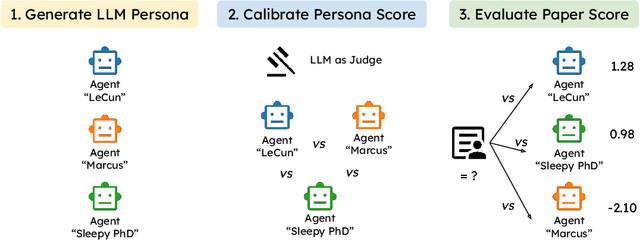
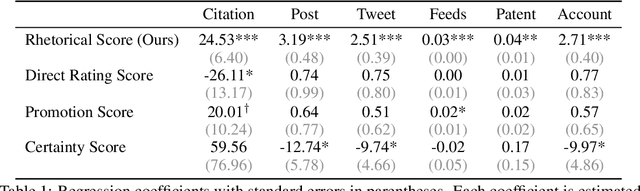
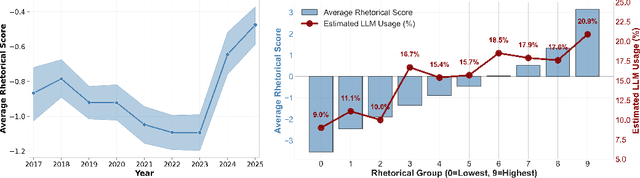
The rise of AI has fueled growing concerns about ``hype'' in machine learning papers, yet a reliable way to quantify rhetorical style independently of substantive content has remained elusive. Because bold language can stem from either strong empirical results or mere rhetorical style, it is often difficult to distinguish between the two. To disentangle rhetorical style from substantive content, we introduce a counterfactual, LLM-based framework: multiple LLM rhetorical personas generate counterfactual writings from the same substantive content, an LLM judge compares them through pairwise evaluations, and the outcomes are aggregated using a Bradley--Terry model. Applying this method to 8,485 ICLR submissions sampled from 2017 to 2025, we generate more than 250,000 counterfactual writings and provide a large-scale quantification of rhetorical style in ML papers. We find that visionary framing significantly predicts downstream attention, including citations and media attention, even after controlling for peer-review evaluations. We also observe a sharp rise in rhetorical strength after 2023, and provide empirical evidence showing that this increase is largely driven by the adoption of LLM-based writing assistance. The reliability of our framework is validated by its robustness to the choice of personas and the high correlation between LLM judgments and human annotations. Our work demonstrates that LLMs can serve as instruments to measure and improve scientific evaluation.