 Add to Chrome
 Add to Firefox
 Add to Edge
Curvature-Adaptive Consistency Flow Matching: Autonomous Trajectory Optimization via Reinforcement Learning
Jun 21, 2026
Consistency distillation has significantly accelerated the inference of diffusion models. In this work, we reveal an intriguing asymmetry: while Logit-Normal sampling priors are highly efficacious for standard iterative generation, consistency distillation exhibits a distinctly different difficulty profile (e.g., U-shaped). We identify that the primary optimization bottlenecks reside at the boundary stages (initialization or final refinement) rather than the intermediate steps. To address the limitations of static sampling in accommodating evolving learning requirements, we propose Curvature-Adaptive Consistency Flow Matching (CACFM). By formulating distillation as a dynamic decision process, CACFM employs a lightweight Reinforcement Learning agent to actively probe Probability Flow ODE trajectories, automatically constructing an efficiency-oriented curriculum that prioritizes critical regions without manual scheduling. Integrated with a novel Flow Distribution Matching Distillation (DMD) objective, our approach achieves new state-of-the-art results on large-scale models such as FLUX and SDXL. It effectively mitigates structural deformities and preserves high-frequency details in extreme few-step regimes, achieving unprecedented visual fidelity.

mm-Wave Radar Hand Shape Classification Using Deformable Transformers
Oct 24, 2022A novel, real-time, mm-Wave radar-based static hand shape classification algorithm and implementation are proposed. The method finds several applications in low cost and privacy sensitive touchless control technology using 60 Ghz radar as the sensor input. As opposed to prior Range-Doppler image based 2D classification solutions, our method converts raw radar data to 3D sparse cartesian point clouds.The demonstrated 3D radar neural network model using deformable transformers significantly surpasses the performance results set by prior methods which either utilize custom signal processing or apply generic convolutional techniques on Range-Doppler FFT images. Experiments are performed on an internally collected dataset using an off-the-shelf radar sensor.
Asymptotic Analysis of Sampling Estimators for Randomized Numerical Linear Algebra Algorithms
Feb 24, 2020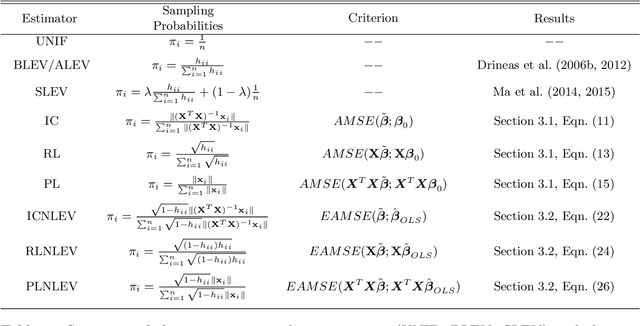
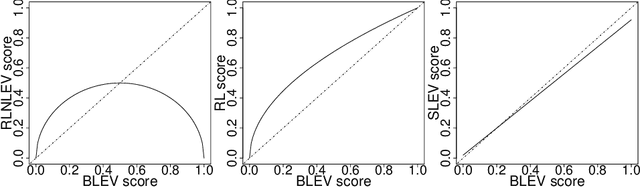
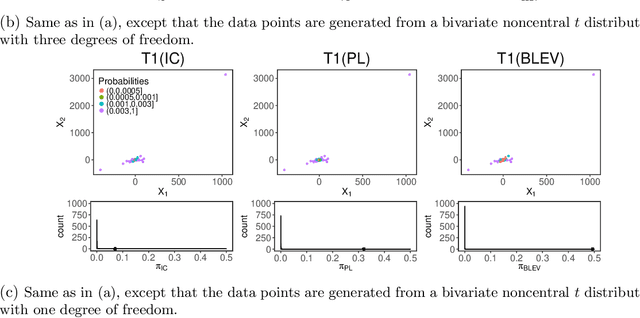
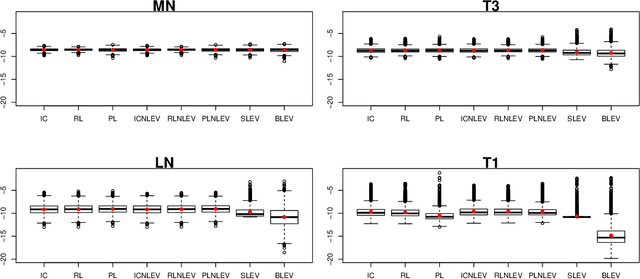
The statistical analysis of Randomized Numerical Linear Algebra (RandNLA) algorithms within the past few years has mostly focused on their performance as point estimators. However, this is insufficient for conducting statistical inference, e.g., constructing confidence intervals and hypothesis testing, since the distribution of the estimator is lacking. In this article, we develop an asymptotic analysis to derive the distribution of RandNLA sampling estimators for the least-squares problem. In particular, we derive the asymptotic distribution of a general sampling estimator with arbitrary sampling probabilities. The analysis is conducted in two complementary settings, i.e., when the objective of interest is to approximate the full sample estimator or is to infer the underlying ground truth model parameters. For each setting, we show that the sampling estimator is asymptotically normally distributed under mild regularity conditions. Moreover, the sampling estimator is asymptotically unbiased in both settings. Based on our asymptotic analysis, we use two criteria, the Asymptotic Mean Squared Error (AMSE) and the Expected Asymptotic Mean Squared Error (EAMSE), to identify optimal sampling probabilities. Several of these optimal sampling probability distributions are new to the literature, e.g., the root leverage sampling estimator and the predictor length sampling estimator. Our theoretical results clarify the role of leverage in the sampling process, and our empirical results demonstrate improvements over existing methods.
Communication-Efficient Distributed Estimator for Generalized Linear Models with a Diverging Number of Covariates
Jan 17, 2020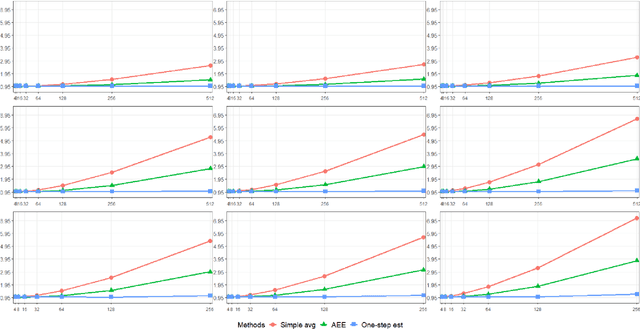
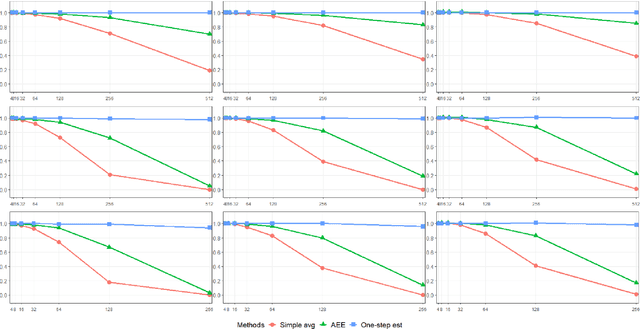
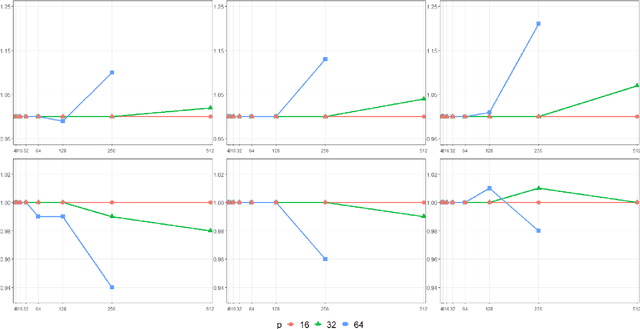
Distributed statistical inference has recently attracted immense attention. Herein, we study the asymptotic efficiency of the maximum likelihood estimator (MLE), the one-step MLE, and the aggregated estimating equation estimator for generalized linear models with a diverging number of covariates. Then a novel method is proposed to obtain an asymptotically efficient estimator for large-scale distributed data by two rounds of communication between local machines and the central server. The assumption on the number of machines in this paper is more relaxed and thus practical for real-world applications. Simulations and a case study demonstrate the satisfactory finite-sample performance of the proposed estimators.