 Add to Chrome
 Add to Firefox
 Add to Edge
Heterogeneous AAV Logistics Task Allocation: A Reinforcement Learning Enhanced Overlapping Coalition Formation Game Approach
May 26, 2026
In dynamic urban logistics, the stochastic emergence of time-sensitive tasks poses a significant optimality challenge for heterogeneous AAVs logistics task allocation. To address this problem, a reinforcement learning enhanced overlapping coalition formation game approach is proposed. A dynamic task allocation model is established, where global optimality is mathematically quantified by a generalized logistics cost coupling service quality and resource consumption. To deal with the time-varying task sets induced by stochastic order arrivals, a transformer-based soft actor-critic network is designed. By leveraging multi-head self-attention to encode variable-length logistics states and capture task-wise spatiotemporal dependencies, the learned policy adaptively guides coalition updates, replacing heuristic rules in the overlapping coalition formation game. On this basis, heterogeneous AAVs can form more efficient overlapping coalitions for dynamic logistics tasks. The resulting coalition formation process is proven to constitute an exact potential game, which guarantees convergence to a Nash-stable equilibrium within a finite number of iterations. Numerical simulations demonstrate that the proposed algorithm effectively improves the optimality of task allocation under the generalized logistics cost criterion. In a scenario with 32 AAVs and 80 tasks, our algorithm achieves a 39.76% cost reduction compared with the heuristic OCF baseline. Indoor flight experiments further validate its practicality.

TRUST-Planner: Topology-guided Robust Trajectory Planner for AAVs with Uncertain Obstacle Spatial-temporal Avoidance
Aug 20, 2025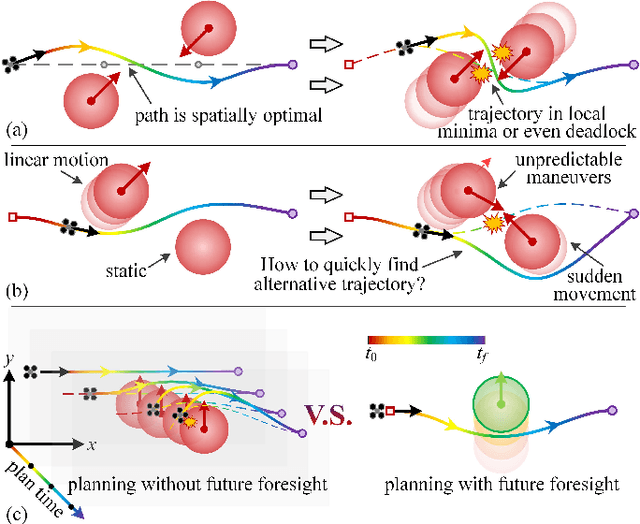
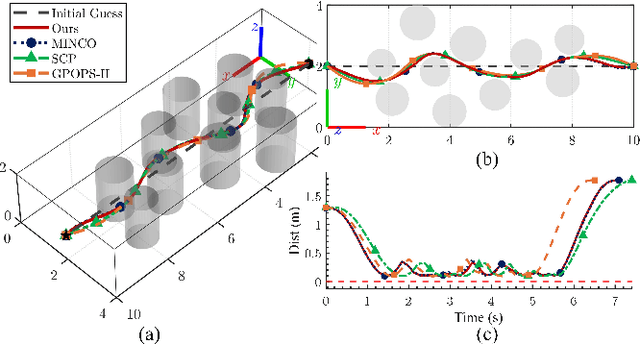
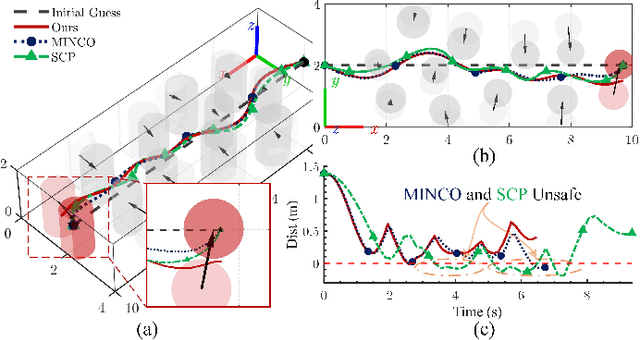
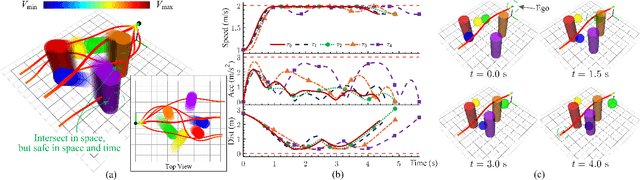
Despite extensive developments in motion planning of autonomous aerial vehicles (AAVs), existing frameworks faces the challenges of local minima and deadlock in complex dynamic environments, leading to increased collision risks. To address these challenges, we present TRUST-Planner, a topology-guided hierarchical planning framework for robust spatial-temporal obstacle avoidance. In the frontend, a dynamic enhanced visible probabilistic roadmap (DEV-PRM) is proposed to rapidly explore topological paths for global guidance. The backend utilizes a uniform terminal-free minimum control polynomial (UTF-MINCO) and dynamic distance field (DDF) to enable efficient predictive obstacle avoidance and fast parallel computation. Furthermore, an incremental multi-branch trajectory management framework is introduced to enable spatio-temporal topological decision-making, while efficiently leveraging historical information to reduce replanning time. Simulation results show that TRUST-Planner outperforms baseline competitors, achieving a 96\% success rate and millisecond-level computation efficiency in tested complex environments. Real-world experiments further validate the feasibility and practicality of the proposed method.
Differential Flatness-based Fast Trajectory Planning for Fixed-wing Unmanned Aerial Vehicles
Dec 02, 2024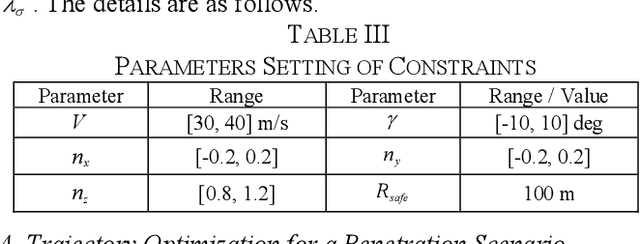
Due to the strong nonlinearity and nonholonomic dynamics, despite that various general trajectory optimization methods have been presented, few of them can guarantee efficient compu-tation and physical feasibility for relatively complicated fixed-wing UAV dynamics. Aiming at this issue, this paper investigates a differential flatness-based trajectory optimization method for fixed-wing UAVs (DFTO-FW), which transcribes the trajectory optimization into a lightweight, unconstrained, gradient-analytical optimization with linear time complexity in each itera-tion to achieve fast trajectory generation. Through differential flat characteristics analysis and polynomial parameterization, the customized trajectory representation is presented, which implies the equality constraints to avoid the heavy computational burdens of solving complex dynamics. Through the design of integral performance costs and deduction of analytical gradients, the original trajectory optimization is transcribed into an uncon-strained, gradient-analytical optimization with linear time com-plexity to further improve efficiency. The simulation experi-ments illustrate the superior efficiency of the DFTO-FW, which takes sub-second CPU time against other competitors by orders of magnitude to generate fixed-wing UAV trajectories in ran-domly generated obstacle environments.