 Add to Chrome
 Add to Firefox
 Add to Edge
Momentum Streams for Optimizer-Inspired Transformers
May 23, 2026
The residual update of a pre-norm Transformer layer admits an interpretation as one step of a first-order optimizer acting on a surrogate token energy, wherein the attention and MLP sublayers function as gradient oracles. Based on this observation, we build a family of optimizer-inspired Transformers (triple-momentum, Adam/AdamW, Muon, SOAP) and compare them under matched compute. In our main pretraining experiment, the triple-momentum TMMFormer achieves the lowest validation loss, outperforming the vanilla Transformer and prior architectural variants. A controlled ablation and supporting theory show that momentum, not preconditioning, is the main source of the gain. We further show that TMMFormer and other momentum-based designs reach flatter minima than the vanilla Transformer, which leads to less forgetting and better generalization.

Understanding and Mitigating Premature Confidence for Better LLM Reasoning
May 23, 2026Long chains of thought (CoT) from current language models frequently contain logical gaps and unjustified leaps, limiting the gains from additional test-time compute. Improving reasoning quality directly would require process reward models, but the step-level annotations needed to train them are expensive and scarce. We find such a signal in how the model's confidence evolves during reasoning: premature confidence, the tendency to commit to an answer early and use the remaining tokens to rationalize it, strongly predicts flawed reasoning across tasks and model scales. We exploit this in progressive confidence shaping, a reinforcement learning objective that trains models to update their confidence as they reason rather than commit early -- rewarding gradual confidence growth and penalizing early commitment, with no external labels or reward models. The method improves accuracy and reasoning quality from 1.5B to 8B parameters across arithmetic (Countdown), math (DAPO, AIME), and science (ScienceQA): on Countdown, accuracy improves 3.2x (+42.0pp) and flawed reasoning drops 48pp; on AIME, Pass@64 improves 6.6pp. Consistent with this mechanism, the method also improves faithfulness: on a safety benchmark, our models more transparently surface misleading content in their reasoning traces rather than concealing it. Controlled experiments reveal that the problem and its remedy scale together: premature confidence grows with model size and task difficulty, and so do the gains from addressing it.
Taming the Curses of Multiagency in Robust Markov Games with Large State Space through Linear Function Approximation
May 04, 2026Multi-agent reinforcement learning (MARL) holds great potential but faces robustness challenges due to environmental uncertainty. To address this, distributionally robust Markov games (RMGs) optimize worst-case performance when the environment deviates from the nominal model within a uncertainty set. Beyond robustness, an equally urgent goal for MARL is data efficiency -- sampling from vast state and action spaces that grow exponentially with the number of agents potentially leads to the curse of multiagency. However, current provably data-efficient algorithms for RMGs are limited to tabular settings with finite state and action spaces, which are only computationally manageable for small-scale problems, leaving RMGs with large-scale (or infinite) state spaces largely unexplored. The only existing work beyond tabular settings focuses on linear function approximation (LFA) for a restrictive class of RMGs using vanish minimal value assumption and still suffers from sample complexity with the curse of multiagency. In this work, we focuses on general RMGs with LFA. For uncertainty sets defined by total variation distance, we develop provably data-efficient algorithms that break the curse of multiagency in both the generative model setting and a newly proposed online interactive setting. To our knowledge, our results are the first to break the curse of multiagency of sample complexity for RMGs with large (possibly infinite) state spaces, regardless of the uncertainty set construction.
Towards Solving the Gilbert-Pollak Conjecture via Large Language Models
Jan 29, 2026The Gilbert-Pollak Conjecture \citep{gilbert1968steiner}, also known as the Steiner Ratio Conjecture, states that for any finite point set in the Euclidean plane, the Steiner minimum tree has length at least $\sqrt{3}/2 \approx 0.866$ times that of the Euclidean minimum spanning tree (the Steiner ratio). A sequence of improvements through the 1980s culminated in a lower bound of $0.824$, with no substantial progress reported over the past three decades. Recent advances in LLMs have demonstrated strong performance on contest-level mathematical problems, yet their potential for addressing open, research-level questions remains largely unexplored. In this work, we present a novel AI system for obtaining tighter lower bounds on the Steiner ratio. Rather than directly prompting LLMs to solve the conjecture, we task them with generating rule-constrained geometric lemmas implemented as executable code. These lemmas are then used to construct a collection of specialized functions, which we call verification functions, that yield theoretically certified lower bounds of the Steiner ratio. Through progressive lemma refinement driven by reflection, the system establishes a new certified lower bound of 0.8559 for the Steiner ratio. The entire research effort involves only thousands of LLM calls, demonstrating the strong potential of LLM-based systems for advanced mathematical research.
Can We Break the Curse of Multiagency in Robust Multi-Agent Reinforcement Learning?
Sep 30, 2024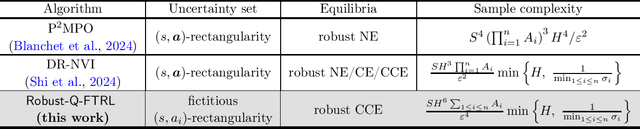
Standard multi-agent reinforcement learning (MARL) algorithms are vulnerable to sim-to-real gaps. To address this, distributionally robust Markov games (RMGs) have been proposed to enhance robustness in MARL by optimizing the worst-case performance when game dynamics shift within a prescribed uncertainty set. Solving RMGs remains under-explored, from problem formulation to the development of sample-efficient algorithms. A notorious yet open challenge is if RMGs can escape the curse of multiagency, where the sample complexity scales exponentially with the number of agents. In this work, we propose a natural class of RMGs where the uncertainty set of each agent is shaped by both the environment and other agents' strategies in a best-response manner. We first establish the well-posedness of these RMGs by proving the existence of game-theoretic solutions such as robust Nash equilibria and coarse correlated equilibria (CCE). Assuming access to a generative model, we then introduce a sample-efficient algorithm for learning the CCE whose sample complexity scales polynomially with all relevant parameters. To the best of our knowledge, this is the first algorithm to break the curse of multiagency for RMGs.
Beyond Weisfeiler-Lehman: A Quantitative Framework for GNN Expressiveness
Jan 16, 2024


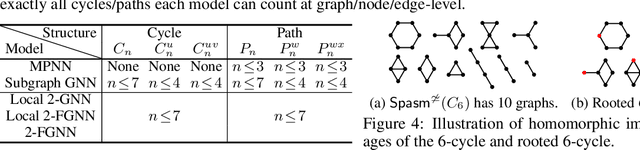
Designing expressive Graph Neural Networks (GNNs) is a fundamental topic in the graph learning community. So far, GNN expressiveness has been primarily assessed via the Weisfeiler-Lehman (WL) hierarchy. However, such an expressivity measure has notable limitations: it is inherently coarse, qualitative, and may not well reflect practical requirements (e.g., the ability to encode substructures). In this paper, we introduce a unified framework for quantitatively studying the expressiveness of GNN architectures, addressing all the above limitations. Specifically, we identify a fundamental expressivity measure termed homomorphism expressivity, which quantifies the ability of GNN models to count graphs under homomorphism. Homomorphism expressivity offers a complete and practical assessment tool: the completeness enables direct expressivity comparisons between GNN models, while the practicality allows for understanding concrete GNN abilities such as subgraph counting. By examining four classes of prominent GNNs as case studies, we derive simple, unified, and elegant descriptions of their homomorphism expressivity for both invariant and equivariant settings. Our results provide novel insights into a series of previous work, unify the landscape of different subareas in the community, and settle several open questions. Empirically, extensive experiments on both synthetic and real-world tasks verify our theory, showing that the practical performance of GNN models aligns well with the proposed metric.