 Add to Chrome
 Add to Firefox
 Add to Edge
Frequency and Edge-Guided Segment Anything Model for Remote Sensing Image Semantic Segmentation
Aug 15, 2026
Remote sensing image semantic segmentation (RSISS) has attracted significant attention due to the growing demand for fine-grained land cover information. The Segment Anything Model (SAM), proposed as a foundation vision model, offers strong segmentation performance and generalization capabilities for RSISS tasks. However, existing SAM-based approaches face two limitations: (1) Insufficient adaptation of SAM's features to the diverse characteristics of land cover types. (2) Semantic ambiguity at object boundaries, which hinders accurate delineation. To address these limitations, we propose Frequency and Edge-guided SAM (FE-SAM), a scalable and efficient framework for RSISS. Specifically, we introduce a Frequency-Modulated Adapter (FMA) that adaptively decomposes and modulates frequency-domain features based on the input data. It selectively enhances informative high- and low-frequency components corresponding to different land cover types. Furthermore, to improve SAM's ability to capture fine-grained details, we design EGRefiner, which integrates multi-scale edge-enhanced information extracted from the input image. Extensive experiments on three benchmark datasets demonstrate that FE-SAM outperforms state-of-the-art methods. The source codes are available at: https://github.com/oucailab/FE-SAM.

RAUNE-Net: A Residual and Attention-Driven Underwater Image Enhancement Method
Nov 01, 2023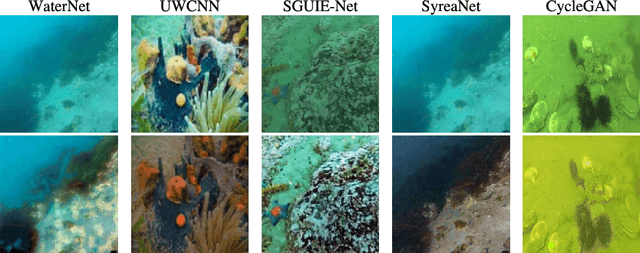
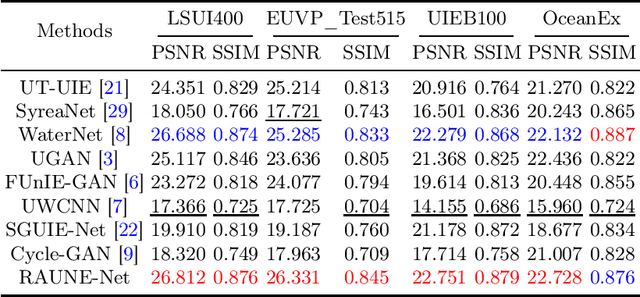
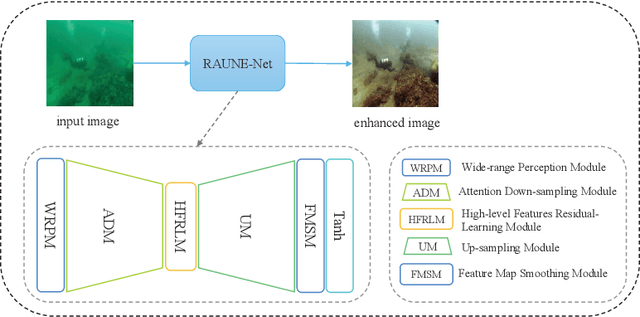
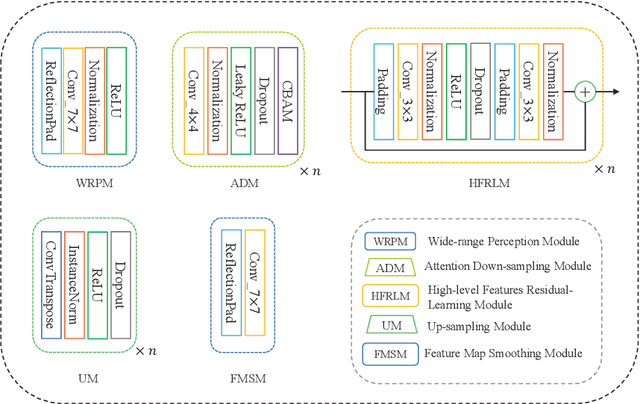
Underwater image enhancement (UIE) poses challenges due to distinctive properties of the underwater environment, including low contrast, high turbidity, visual blurriness, and color distortion. In recent years, the application of deep learning has quietly revolutionized various areas of scientific research, including UIE. However, existing deep learning-based UIE methods generally suffer from issues of weak robustness and limited adaptability. In this paper, inspired by residual and attention mechanisms, we propose a more reliable and reasonable UIE network called RAUNE-Net by employing residual learning of high-level features at the network's bottle-neck and two aspects of attention manipulations in the down-sampling procedure. Furthermore, we collect and create two datasets specifically designed for evaluating UIE methods, which contains different types of underwater distortions and degradations. The experimental validation demonstrates that our method obtains promising objective performance and consistent visual results across various real-world underwater images compared to other eight UIE methods. Our example code and datasets are publicly available at https://github.com/fansuregrin/RAUNE-Net.