 Add to Chrome
 Add to Firefox
 Add to Edge
Multiple Hypothesis Flow Estimation for Video Frame Interpolation under Matching Ambiguity
Aug 07, 2026
Many flow-based video frame interpolation (VFI) methods synthesize an intermediate frame by estimating optical flow fields, warping the two input frames, and blending the warped observations. These latent flow fields are typically learned through image-level reconstruction supervision without direct flow annotations. In ambiguous regions containing repetitive or stochastic textures, rotating symmetric structures, or fast motion with blur, the matching evidence for a single query may contain multiple comparable and spatially separated peaks. Although the ground-truth intermediate frame provides indirect supervision, it may not uniquely identify the latent correspondence in ambiguous regions.When several locations provide multiple plausible matches, a single-flow estimator can retain only one displacement and discard the remaining candidates. If the selected match is incorrect or inconsistent with those of neighboring pixels, warping samples content from mismatched locations, producing ghosting, structural distortion, or blur.To address this limitation, we propose a multiple hypothesis flow estimation framework that preserves top-K candidate correspondences and selects one per location through a reliability-guided router. Each hypothesis is initialized from a coarse matching anchor and refined separately through anchor-centered local attention. Frame synthesis is thus conditioned on one selected flow-appearance hypothesis rather than a soft combination of candidate motions.Experiments on the proposed MA-HD benchmark and public VFI benchmarks show that our method achieves the best LPIPS and DISTS among the compared methods.

Zero-shot Autonomous Microscopy for Scalable and Intelligent Characterization of 2D Materials
Apr 14, 2025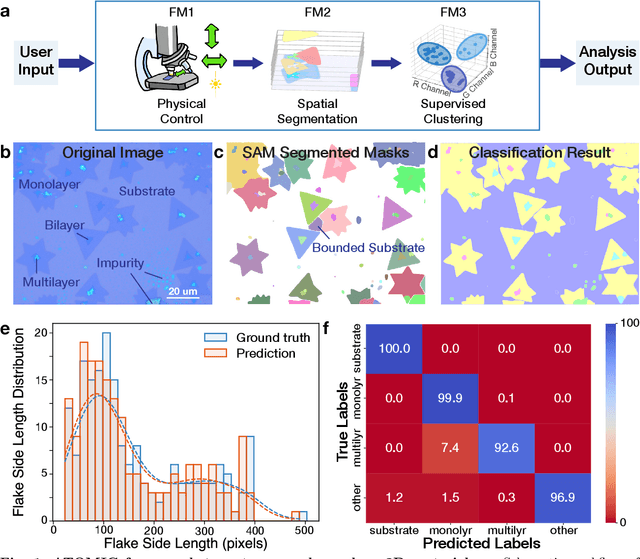
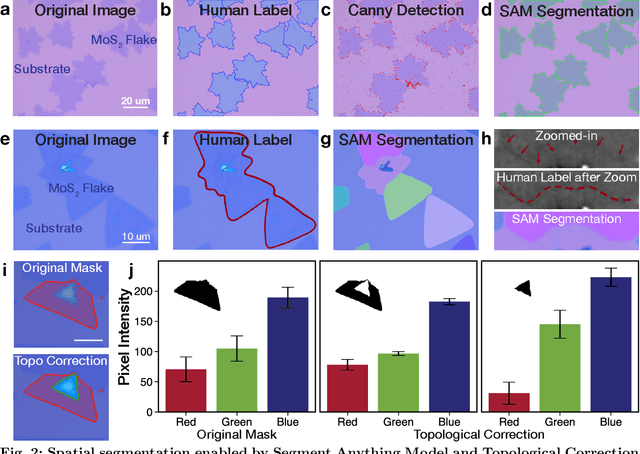
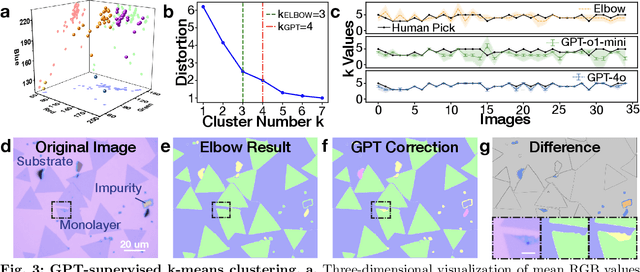
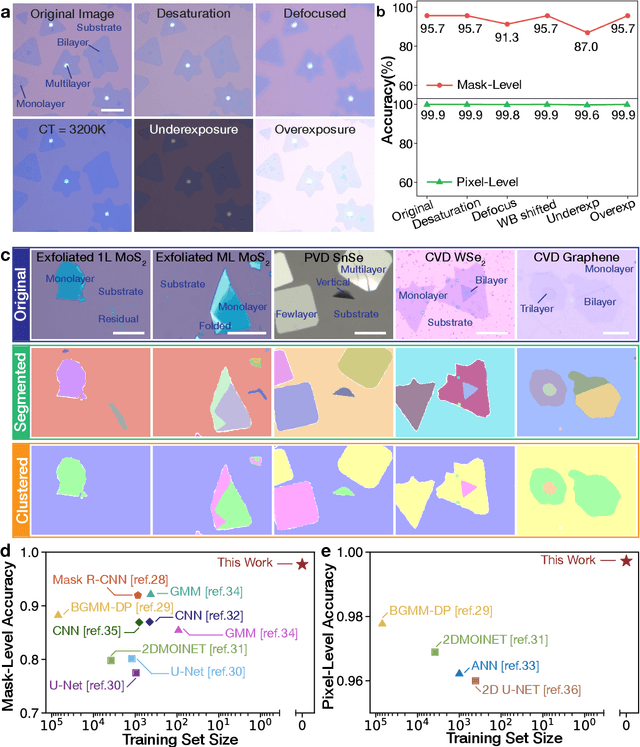
Characterization of atomic-scale materials traditionally requires human experts with months to years of specialized training. Even for trained human operators, accurate and reliable characterization remains challenging when examining newly discovered materials such as two-dimensional (2D) structures. This bottleneck drives demand for fully autonomous experimentation systems capable of comprehending research objectives without requiring large training datasets. In this work, we present ATOMIC (Autonomous Technology for Optical Microscopy & Intelligent Characterization), an end-to-end framework that integrates foundation models to enable fully autonomous, zero-shot characterization of 2D materials. Our system integrates the vision foundation model (i.e., Segment Anything Model), large language models (i.e., ChatGPT), unsupervised clustering, and topological analysis to automate microscope control, sample scanning, image segmentation, and intelligent analysis through prompt engineering, eliminating the need for additional training. When analyzing typical MoS2 samples, our approach achieves 99.7% segmentation accuracy for single layer identification, which is equivalent to that of human experts. In addition, the integrated model is able to detect grain boundary slits that are challenging to identify with human eyes. Furthermore, the system retains robust accuracy despite variable conditions including defocus, color temperature fluctuations, and exposure variations. It is applicable to a broad spectrum of common 2D materials-including graphene, MoS2, WSe2, SnSe-regardless of whether they were fabricated via chemical vapor deposition or mechanical exfoliation. This work represents the implementation of foundation models to achieve autonomous analysis, establishing a scalable and data-efficient characterization paradigm that fundamentally transforms the approach to nanoscale materials research.