 Add to Chrome
 Add to Firefox
 Add to Edge
PlanRAG-Audio: Planning and Retrieval Augmented Generation for Long-form Audio Understanding
May 19, 2026
Long-form audio understanding poses significant challenges for large audio language models (LALMs) due to the extreme length of audio sequences and the need to reason over heterogeneous acoustic cues distributed over time, such as speech content, speaker identity, emotion, and sound events. To address these challenges, we propose \textbf{PlanRAG-Audio}, a planning-based retrieval-augmented generation framework for scalable long-form audio understanding. Rather than having audio LALMs process entire recordings directly, PlanRAG-Audio explicitly plans which modalities and temporal spans are required for a given query, and retrieves only query-relevant information from a structured text and audio database. This retrieval planning enables effective reasoning over complex, cross-domain audio queries while substantially reducing the input length passed to the large language models. Experiments across a wide range of speech/audio retrieval demonstrate that PlanRAG-Audio improves reasoning accuracy and stabilizes performance as audio duration increases by decoupling inference cost from raw audio length.

A Cross-direction Task Decoupling Network for Small Logo Detection
May 04, 2023
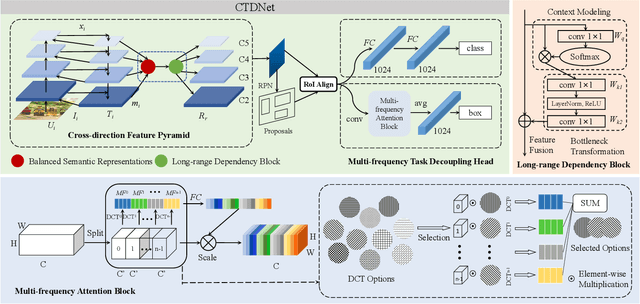


Logo detection plays an integral role in many applications. However, handling small logos is still difficult since they occupy too few pixels in the image, which burdens the extraction of discriminative features. The aggregation of small logos also brings a great challenge to the classification and localization of logos. To solve these problems, we creatively propose Cross-direction Task Decoupling Network (CTDNet) for small logo detection. We first introduce Cross-direction Feature Pyramid (CFP) to realize cross-direction feature fusion by adopting horizontal transmission and vertical transmission. In addition, Multi-frequency Task Decoupling Head (MTDH) decouples the classification and localization tasks into two branches. A multi frequency attention convolution branch is designed to achieve more accurate regression by combining discrete cosine transform and convolution creatively. Comprehensive experiments on four logo datasets demonstrate the effectiveness and efficiency of the proposed method.