 Add to Chrome
 Add to Firefox
 Add to Edge
LUCID: Learned Undersampling-Adaptive Consistency-Guided Inference with Deterministic Flow Matching for Sparse-View CT Reconstruction
Jun 15, 2026
Sparse-view CT reduces radiation dose and scanning time by acquiring fewer projection views, but angular undersampling makes reconstruction severely ill-posed, causing streak artifacts, structural blurring, and loss of fine details. Existing supervised methods are often tied to specific sampling settings, whereas generative methods may introduce anatomically inconsistent hallucination-like structures under severe undersampling. We propose Lucid, a sparsity-adaptive, consistency-guided reconstruction framework based on a Flow Matching generative prior for sparse-view CT. Lucid is trained only on high-quality CT images to learn a continuous transport between a Gaussian distribution and the high-quality CT image distribution, independent of view sampling. During inference, the sampling sparsity level is explicitly incorporated to adapt the generative trajectory of a single pretrained model. Specifically, Lucid constructs a degradation-matched initial state by sparsity-weighted fusion of the sparse-view FBP image and Gaussian noise, performs sparsity-modulated Flow Matching updates, and applies projection-domain data-consistency correction after each prior update. Experiments under multiple sparse-view settings show that Lucid achieves stable reconstruction performance across different sampling densities, improves image quality and structural fidelity, and reduces the risk of hallucination-like structures in generative sparse-view CT reconstruction.

Beyond Fixed Inference: Quantitative Flow Matching for Adaptive Image Denoising
Apr 02, 2026Diffusion and flow-based generative models have shown strong potential for image restoration. However, image denoising under unknown and varying noise conditions remains challenging, because the learned vector fields may become inconsistent across different noise levels, leading to degraded restoration quality under mismatch between training and inference. To address this issue, we propose a quantitative flow matching framework for adaptive image denoising. The method first estimates the input noise level from local pixel statistics, and then uses this quantitative estimate to adapt the inference trajectory, including the starting point, the number of integration steps, and the step-size schedule. In this way, the denoising process is better aligned with the actual corruption level of each input, reducing unnecessary computation for lightly corrupted images while providing sufficient refinement for heavily degraded ones. By coupling quantitative noise estimation with noise-adaptive flow inference, the proposed method improves both restoration accuracy and inference efficiency. Extensive experiments on natural, medical, and microscopy images demonstrate its robustness and strong generalization across diverse noise levels and imaging conditions.
A Comprehensive Scatter Correction Model for Micro-Focus Dual-Source Imaging Systems: Combining Ambient, Cross, and Forward Scatter
Mar 18, 2025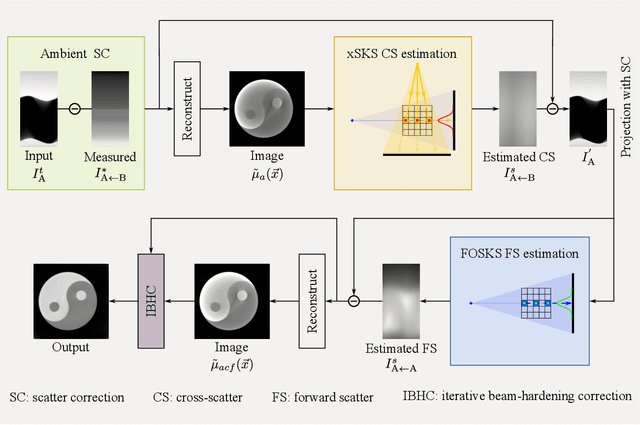
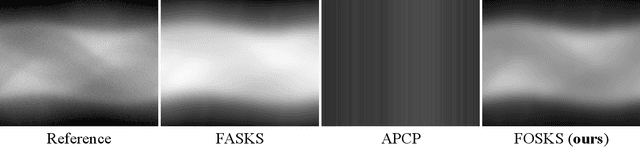
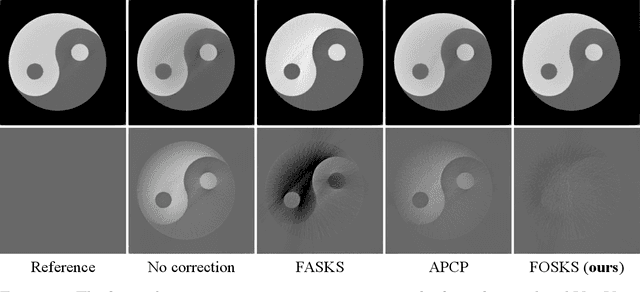
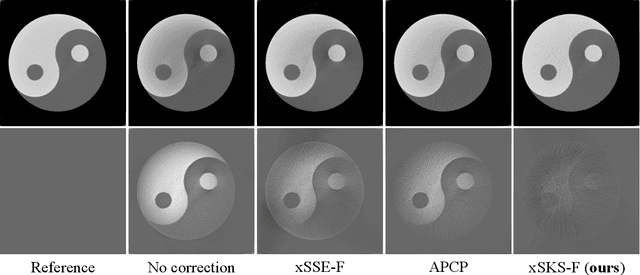
Compared to single-source imaging systems, dual-source imaging systems equipped with two cross-distributed scanning beams significantly enhance temporal resolution and capture more comprehensive object scanning information. Nevertheless, the interaction between the two scanning beams introduces more complex scatter signals into the acquired projection data. Existing methods typically model these scatter signals as the sum of cross-scatter and forward scatter, with cross-scatter estimation limited to single-scatter along primary paths. Through experimental measurements on our selfdeveloped micro-focus dual-source imaging system, we observed that the peak ratio of hardware-induced ambient scatter to single-source projection intensity can even exceed 60%, a factor often overlooked in conventional models. To address this limitation, we propose a more comprehensive model that decomposes the total scatter signals into three distinct components: ambient scatter, cross-scatter, and forward scatter. Furthermore, we introduce a cross-scatter kernel superposition (xSKS) module to enhance the accuracy of cross-scatter estimation by modeling both single and multiple crossscatter events along non-primary paths. Additionally, we employ a fast object-adaptive scatter kernel superposition (FOSKS) module for efficient forward scatter estimation. In Monte Carlo (MC) simulation experiments performed on a custom-designed waterbone phantom, our model demonstrated remarkable superiority, achieving a scatter-toprimary-weighted mean absolute percentage error (SPMAPE) of 1.32%, significantly lower than the 12.99% attained by the state-of-the-art method. Physical experiments further validate the superior performance of our model in correcting scatter artifacts.