 Add to Chrome
 Add to Firefox
 Add to Edge
Improving the decoding performance of CA-polar codes
Dec 11, 2025
We investigate the use of modern code-agnostic decoders to convert CA-SCL from an incomplete decoder to a complete one. When CA-SCL fails to identify a codeword that passes the CRC check, we apply a code-agnostic decoder that identifies a codeword that satisfies the CRC. We establish that this approach gives gains of up to 0.2 dB in block error rate for CA-Polar codes from the 5G New Radio standard. If, instead, the message had been encoded in a systematic CA-polar code, the gain improves to 0.2 ~ 1dB. Leveraging recent developments in blockwise soft output, we additionally establish that it is possible to control the undetected error rate even when using the CRC for error correction.

Enhanced GCD through ORBGRAND-AI: Exploiting Partial and Total Correlation in Noise
Nov 10, 2025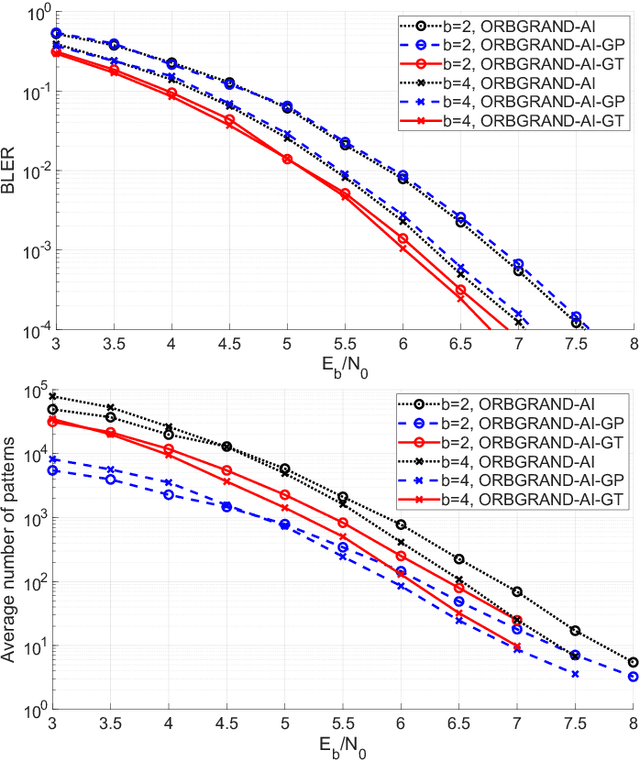
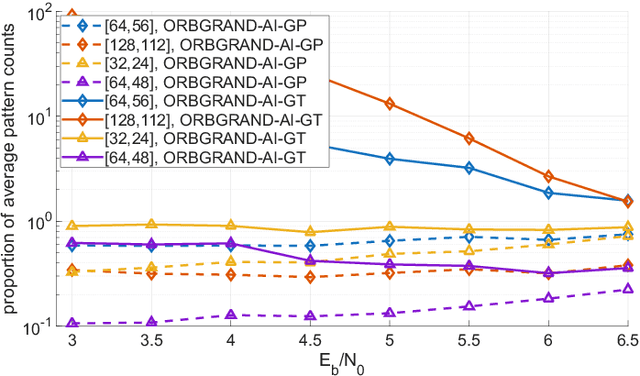
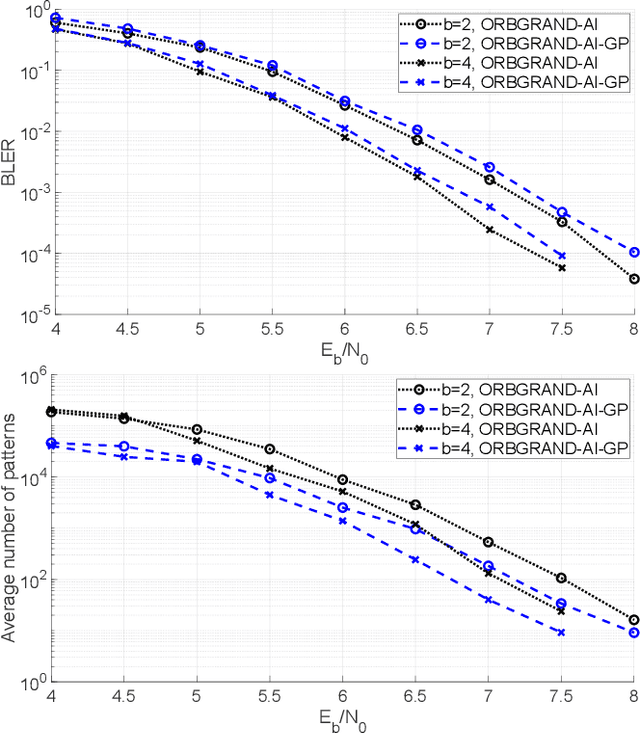
There have been significant advances in recent years in the development of forward error correction decoders that can decode codes of any structure, including practical realizations in synthesized circuits and taped out chips. While essentially all soft-decision decoders assume that bits have been impacted independently on the channel, for one of these new approaches it has been established that channel dependencies can be exploited to achieve superior decoding accuracy, resulting in Ordered Reliability Bits Guessing Random Additive Noise Decoding Approximate Independence (ORBGRAND-AI). Building on that capability, here we consider the integration of ORBGRAND-AI as a pattern generator for Guessing Codeword Decoding (GCD). We first establish that a direct approach delivers mildly degraded block error rate (BLER) but with reduced number of queried patterns when compared to ORBGRAND-AI. We then show that with a more nuanced approach it is possible to leverage total correlation to deliver an additional BLER improvement of around 0.75 dB while retaining reduced query numbers.