 Add to Chrome
 Add to Firefox
 Add to Edge
Extreme dynamic symmetry enables omnidirectional and multifunctional robots
May 28, 2026
Symmetry is a central organizing principle in natural systems, yet its use as a unifying design strategy in robotics has largely remained limited to geometric form. We show that symmetry can instead be leveraged at the level of dynamic actuation capability. We introduce dynamic symmetry, the uniformity of a robot's attainable center-of-mass accelerations, and formalize it through a measure coined as dynamic isotropy. Across more than 1000 simulated morphologies, we found that higher dynamic symmetry consistently improved trajectory tracking, task success, robustness, resiliency, and energy efficiency, with the benefits becoming most pronounced as dynamic isotropy approached its theoretical limit. To study this regime systematically, we developed Argus, a family of spherical robots designed to explore the effects of increasing dynamic symmetry. Members of the Argus family vary in their actuation geometry and dynamic symmetry level while sharing a common architectural principle: radially oriented linear actuators that directly shape the robot's center-of-mass dynamics. Among them, we built a physical 20-leg Argus variant that achieved near-extreme dynamic isotropy and demonstrated orientation-invariant locomotion, agile traversal of cluttered and deformable terrain, rapid self-stabilization, and resilience to partial actuator failures. Its distributed sensing further enabled omnidirectional perception and object interaction during continuous motion. These results show that designing robots for symmetry not only in morphology but also in their attainable dynamics provides a powerful and general pathway toward agility, robustness, and multifunctionality in uncertain terrestrial and extraterrestrial environments.
* Published in Science Robotics (2026). Our project website is at:https://generalroboticslab.com/Argus

Global and Local Confidence Based Fraud Detection Graph Neural Network
Jul 24, 2024This paper presents the Global and Local Confidence Graph Neural Network (GLC-GNN), an innovative approach to graph-based anomaly detection that addresses the challenges of heterophily and camouflage in fraudulent activities. By introducing a prototype to encapsulate the global features of a graph and calculating a Global Confidence (GC) value for each node, GLC-GNN effectively distinguishes between benign and fraudulent nodes. The model leverages GC to generate attention values for message aggregation, enhancing its ability to capture both homophily and heterophily. Through extensive experiments on four open datasets, GLC-GNN demonstrates superior performance over state-of-the-art models in accuracy and convergence speed, while maintaining a compact model size and expedited training process. The integration of global and local confidence measures in GLC-GNN offers a robust solution for detecting anomalies in graphs, with significant implications for fraud detection across diverse domains.
Text2Robot: Evolutionary Robot Design from Text Descriptions
Jun 28, 2024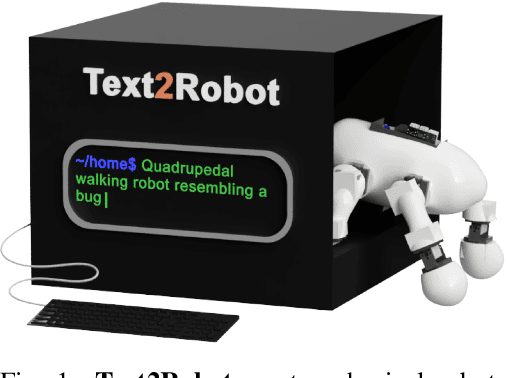
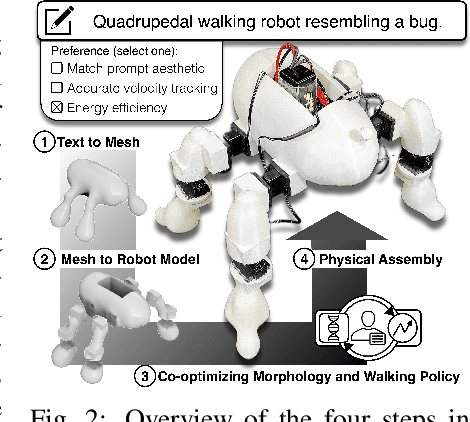
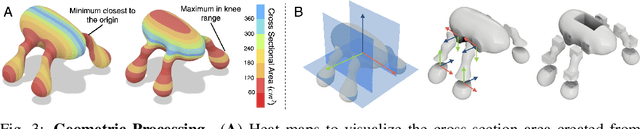
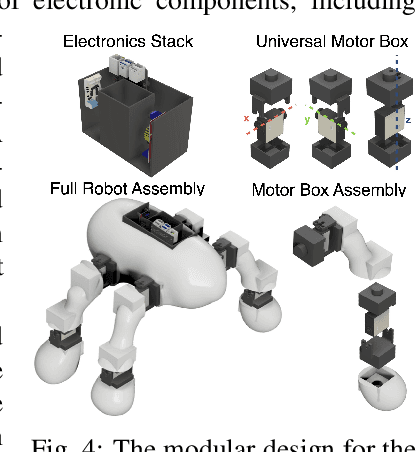
Robot design has traditionally been costly and labor-intensive. Despite advancements in automated processes, it remains challenging to navigate a vast design space while producing physically manufacturable robots. We introduce Text2Robot, a framework that converts user text specifications and performance preferences into physical quadrupedal robots. Within minutes, Text2Robot can use text-to-3D models to provide strong initializations of diverse morphologies. Within a day, our geometric processing algorithms and body-control co-optimization produce a walking robot by explicitly considering real-world electronics and manufacturability. Text2Robot enables rapid prototyping and opens new opportunities for robot design with generative models.
SonicSense: Object Perception from In-Hand Acoustic Vibration
Jun 25, 2024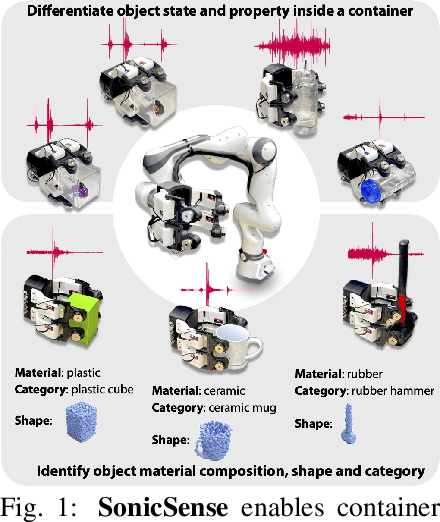
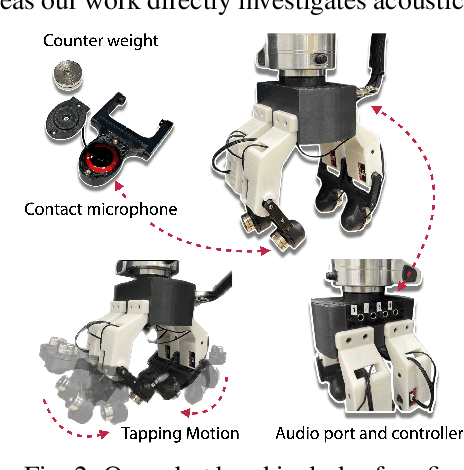
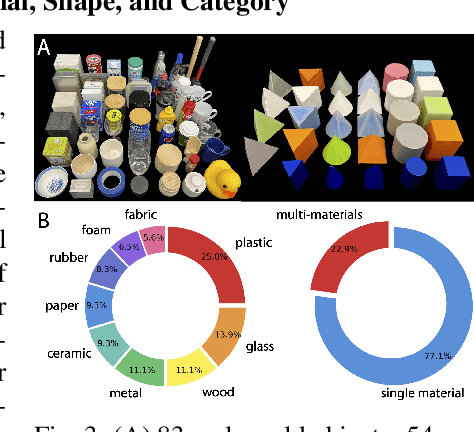
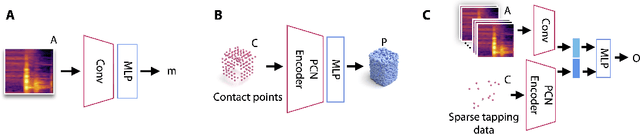
We introduce SonicSense, a holistic design of hardware and software to enable rich robot object perception through in-hand acoustic vibration sensing. While previous studies have shown promising results with acoustic sensing for object perception, current solutions are constrained to a handful of objects with simple geometries and homogeneous materials, single-finger sensing, and mixing training and testing on the same objects. SonicSense enables container inventory status differentiation, heterogeneous material prediction, 3D shape reconstruction, and object re-identification from a diverse set of 83 real-world objects. Our system employs a simple but effective heuristic exploration policy to interact with the objects as well as end-to-end learning-based algorithms to fuse vibration signals to infer object properties. Our framework underscores the significance of in-hand acoustic vibration sensing in advancing robot tactile perception.