 Add to Chrome
 Add to Firefox
 Add to Edge
Radiology Report Generation for Low-Quality X-Ray Images
Apr 11, 2026
Vision-Language Models (VLMs) have significantly advanced automated Radiology Report Generation (RRG). However, existing methods implicitly assume high-quality inputs, overlooking the noise and artifacts prevalent in real-world clinical environments. Consequently, current models exhibit severe performance degradation when processing suboptimal images. To bridge this gap, we propose a robust report generation framework explicitly designed for image quality variations. We first introduce an Automated Quality Assessment Agent (AQAA) to identify low-quality samples within the MIMIC-CXR dataset and establish the Low-quality Radiology Report Generation (LRRG) benchmark. To tackle degradation-induced shifts, we propose a novel Dual-loop Training Strategy leveraging bi-level optimization and gradient consistency. This approach ensures the model learns quality-agnostic diagnostic features by aligning gradient directions across varying quality regimes. Extensive experiments demonstrate that our approach effectively mitigates model performance degradation caused by image quality deterioration. The code and data will be released upon acceptance.

Integrating Response Time and Attention Duration in Bayesian Preference Learning for Multiple Criteria Decision Aiding
Apr 21, 2025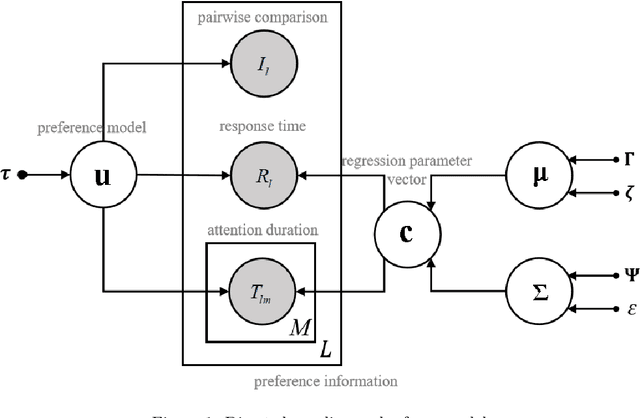
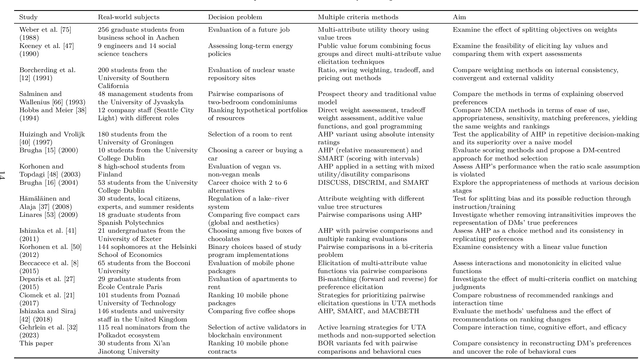
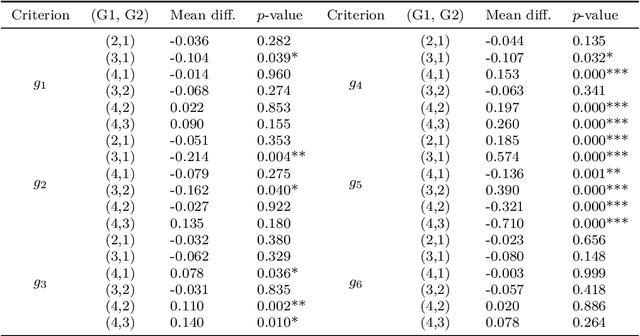

We introduce a multiple criteria Bayesian preference learning framework incorporating behavioral cues for decision aiding. The framework integrates pairwise comparisons, response time, and attention duration to deepen insights into decision-making processes. The approach employs an additive value function model and utilizes a Bayesian framework to derive the posterior distribution of potential ranking models by defining the likelihood of observed preference data and specifying a prior on the preference structure. This distribution highlights each model's ability to reconstruct Decision-Makers' holistic pairwise comparisons. By leveraging both response time as a proxy for cognitive effort and alternative discriminability as well as attention duration as an indicator of criterion importance, the proposed model surpasses traditional methods by uncovering richer behavioral patterns. We report the results of a laboratory experiment on mobile phone contract selection involving 30 real subjects using a dedicated application with time-, eye-, and mouse-tracking components. We validate the novel method's ability to reconstruct complete preferences. The detailed ablation studies reveal time- and attention-related behavioral patterns, confirming that integrating comprehensive data leads to developing models that better align with the DM's actual preferences.