 Add to Chrome
 Add to Firefox
 Add to Edge
LDDR: Linear-DPP-Based Dynamic-Resolution Frame Sampling for Video MLLMs
May 12, 2026
Video understanding in multimodal large language models requires selecting informative frames from long, redundant videos under limited visual-token budgets. Existing methods often rely on uniform sampling, point-wise relevance scoring, chunk-wise selection, or agentic exploration, which either miss global dependencies or introduce substantial overhead. We propose LDDR (Linear DPP-Based Dynamic Resolution), a training-free, plug-and-play, and budget-aware video frame sampling framework. LDDR performs query-aware Determinantal Point Process (DPP) frame selection in a task-conditioned feature space, achieving a 3x runtime speedup over standard DPP baselines. It further introduces a Group DPP importance metric to guide frame retention and dynamic resolution allocation, assigning more tokens to informative, non-redundant frames while downscaling or pruning less useful ones. Across four video benchmarks spanning short-, medium-, and long-range videos, LDDR consistently outperforms the next-best baselines, achieving gains of 2.5 points under budget-constrained settings and 1.6 points in high-budget scenarios. These improvements are consistently observed across multiple MLLM backbones, including both open- and closed-source models. Qualitative analysis confirms that relevant frames are selected and allocated a higher budget, facilitating improved video understanding.

Exploring What Why and How: A Multifaceted Benchmark for Causation Understanding of Video Anomaly
Dec 10, 2024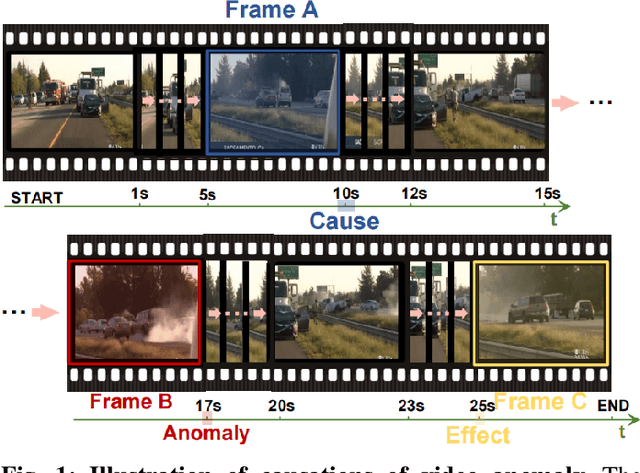

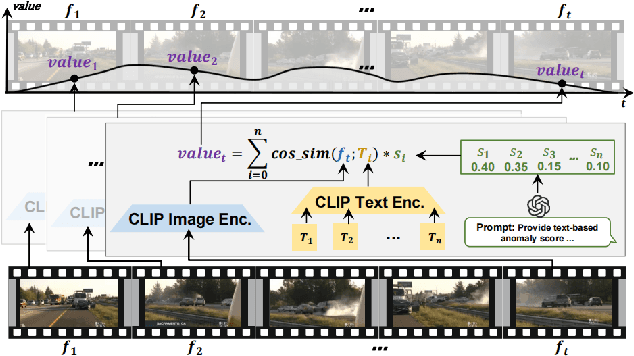

Recent advancements in video anomaly understanding (VAU) have opened the door to groundbreaking applications in various fields, such as traffic monitoring and industrial automation. While the current benchmarks in VAU predominantly emphasize the detection and localization of anomalies. Here, we endeavor to delve deeper into the practical aspects of VAU by addressing the essential questions: "what anomaly occurred?", "why did it happen?", and "how severe is this abnormal event?". In pursuit of these answers, we introduce a comprehensive benchmark for Exploring the Causation of Video Anomalies (ECVA). Our benchmark is meticulously designed, with each video accompanied by detailed human annotations. Specifically, each instance of our ECVA involves three sets of human annotations to indicate "what", "why" and "how" of an anomaly, including 1) anomaly type, start and end times, and event descriptions, 2) natural language explanations for the cause of an anomaly, and 3) free text reflecting the effect of the abnormality. Building upon this foundation, we propose a novel prompt-based methodology that serves as a baseline for tackling the intricate challenges posed by ECVA. We utilize "hard prompt" to guide the model to focus on the critical parts related to video anomaly segments, and "soft prompt" to establish temporal and spatial relationships within these anomaly segments. Furthermore, we propose AnomEval, a specialized evaluation metric crafted to align closely with human judgment criteria for ECVA. This metric leverages the unique features of the ECVA dataset to provide a more comprehensive and reliable assessment of various video large language models. We demonstrate the efficacy of our approach through rigorous experimental analysis and delineate possible avenues for further investigation into the comprehension of video anomaly causation.