 Add to Chrome
 Add to Firefox
 Add to Edge
LightMoE: Reducing Mixture-of-Experts Redundancy through Expert Replacing
Mar 13, 2026
Mixture-of-Experts (MoE) based Large Language Models (LLMs) have demonstrated impressive performance and computational efficiency. However, their deployment is often constrained by substantial memory demands, primarily due to the need to load numerous expert modules. While existing expert compression techniques like pruning or merging attempt to mitigate this, they often suffer from irreversible knowledge loss or high training overhead. In this paper, we propose a novel expert compression paradigm termed expert replacing, which replaces redundant experts with parameter-efficient modules and recovers their capabilities with low training costs. We find that even a straightforward baseline of this paradigm yields promising performance. Building on this foundation, we introduce LightMoE, a framework that enhances the paradigm by introducing adaptive expert selection, hierarchical expert construction, and an annealed recovery strategy. Experimental results show that LightMoE matches the performance of LoRA fine-tuning at a 30% compression ratio. Even under a more aggressive 50% compression rate, it outperforms existing methods and achieves average performance improvements of 5.6% across five diverse tasks. These findings demonstrate that LightMoE strikes a superior balance among memory efficiency, training efficiency, and model performance.

LGViT: Dynamic Early Exiting for Accelerating Vision Transformer
Aug 01, 2023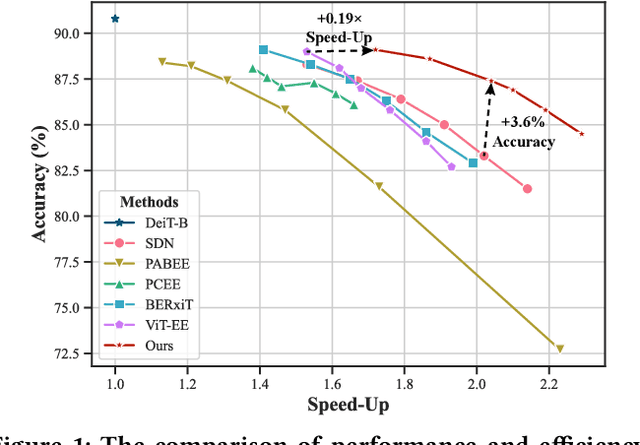
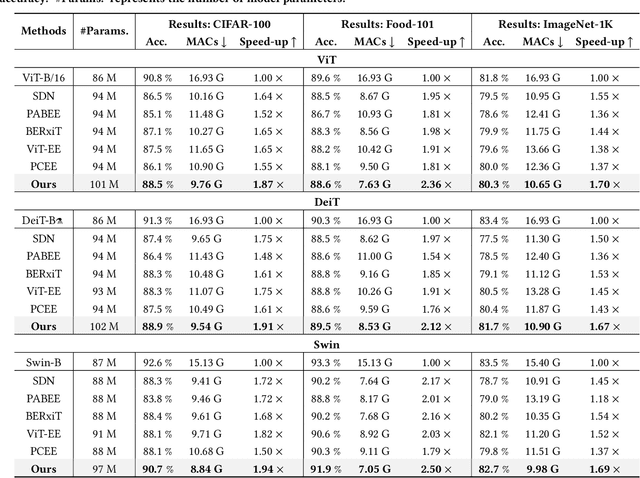
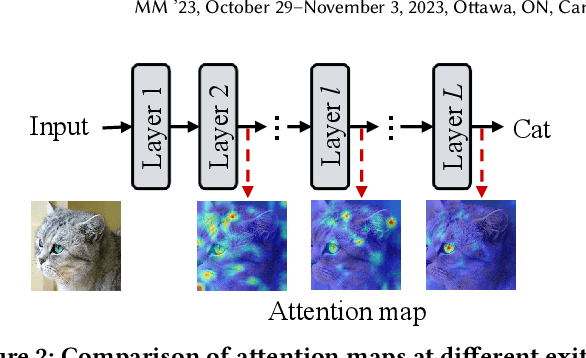
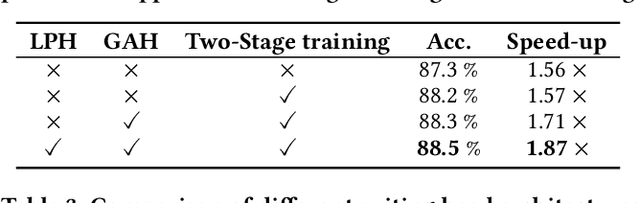
Recently, the efficient deployment and acceleration of powerful vision transformers (ViTs) on resource-limited edge devices for providing multimedia services have become attractive tasks. Although early exiting is a feasible solution for accelerating inference, most works focus on convolutional neural networks (CNNs) and transformer models in natural language processing (NLP).Moreover, the direct application of early exiting methods to ViTs may result in substantial performance degradation. To tackle this challenge, we systematically investigate the efficacy of early exiting in ViTs and point out that the insufficient feature representations in shallow internal classifiers and the limited ability to capture target semantic information in deep internal classifiers restrict the performance of these methods. We then propose an early exiting framework for general ViTs termed LGViT, which incorporates heterogeneous exiting heads, namely, local perception head and global aggregation head, to achieve an efficiency-accuracy trade-off. In particular, we develop a novel two-stage training scheme, including end-to-end training and self-distillation with the backbone frozen to generate early exiting ViTs, which facilitates the fusion of global and local information extracted by the two types of heads. We conduct extensive experiments using three popular ViT backbones on three vision datasets. Results demonstrate that our LGViT can achieve competitive performance with approximately 1.8 $\times$ speed-up.