 Add to Chrome
 Add to Firefox
 Add to Edge
Let Robots Feel Your Touch: Visuo-Tactile Cortical Alignment for Embodied Mirror Resonance
May 14, 2026
Observing touch on another's body can elicit corresponding tactile sensations in the observer, a phenomenon termed mirror touch that supports empathy and social perception. This visuo-tactile resonance is thought to rely on structural correspondence between visual and somatosensory cortices, yet robotic systems lack computational frameworks that instantiate this principle. Here we demonstrate that cortical correspondence can be operationalized to endow robots with mirror touch. We introduce Mirror Touch Net, which imposes semantic, distributional and geometric alignment between visual and tactile representations through multi-level constraints, enabling prediction of millimetre-scale tactile signals across 1,140 taxels on a robotic hand from RGB images. Manifold analysis reveals that these constraints reshape visual representations into geometry consistent with the tactile manifold, reducing the complexity of cross-modal mapping. Extending this alignment framework to cross-domain observations of human hands enables tactile prediction and reflexive responses to observed human touch. Our results link a neural principle of visuo-tactile resonance to robotic perception, providing an explainable route towards anticipatory touch and empathic human-robot interaction. Code is available at https://github.com/fun0515/Mirror-Touch-Net.

Enable Natural Tactile Interaction for Robot Dog based on Large-format Distributed Flexible Pressure Sensors
Mar 14, 2023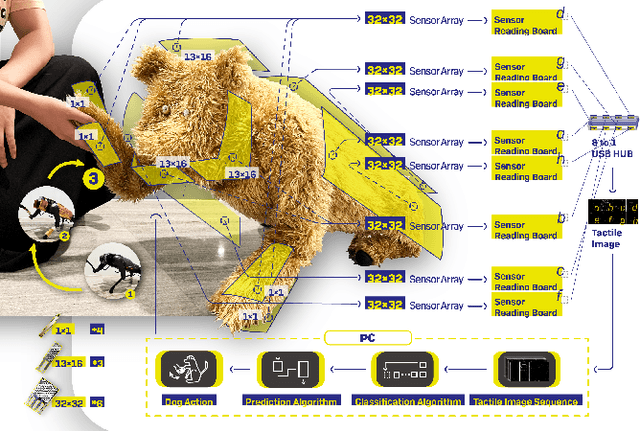


Touch is an important channel for human-robot interaction, while it is challenging for robots to recognize human touch accurately and make appropriate responses. In this paper, we design and implement a set of large-format distributed flexible pressure sensors on a robot dog to enable natural human-robot tactile interaction. Through a heuristic study, we sorted out 81 tactile gestures commonly used when humans interact with real dogs and 44 dog reactions. A gesture classification algorithm based on ResNet is proposed to recognize these 81 human gestures, and the classification accuracy reaches 98.7%. In addition, an action prediction algorithm based on Transformer is proposed to predict dog actions from human gestures, reaching a 1-gram BLEU score of 0.87. Finally, we compare the tactile interaction with the voice interaction during a freedom human-robot-dog interactive playing study. The results show that tactile interaction plays a more significant role in alleviating user anxiety, stimulating user excitement and improving the acceptability of robot dogs.
* 7 pages, 5 figures