 Add to Chrome
 Add to Firefox
 Add to Edge
NetlistBench: Evaluating LLM Reliability in SPICE Netlist Recognition and Manipulation
Aug 12, 2026
Large Language Models (LLMs) are increasingly used in circuit design workflows, yet their reliability on simulator-facing SPICE netlist recognition and manipulation remains poorly understood and is rarely separated from high-level design reasoning. Although netlists are textual, they encode structured circuit objects through topology and parameters. We present \textbf{NetlistBench}, a structure-verified benchmark for SPICE netlist recognition and manipulation. NetlistBench contains 2,342 cases across 24 task families, covering parameter and connectivity recognition and edits, hierarchical operations, equivalence judgment, and long-horizon compound editing. Model outputs are evaluated by a deterministic structure-aware oracle. Across six non-thinking LLMs, performance varies substantially with operation-level structural complexity. Simple local edits reach $96\%$--$100\%$ accuracy, while device addition drops to $41\%$--$83\%$ and equivalence judgment to $49\%$--$90\%$. Enabling reasoning substantially improves weaker models but does not eliminate structure-preservation failures, with performance still degrading sharply as the edit horizon increases. NetlistBench identifies netlist reliability as a distinct bottleneck for trustworthy LLM-based circuit design automation.

LAION-SG: An Enhanced Large-Scale Dataset for Training Complex Image-Text Models with Structural Annotations
Dec 11, 2024
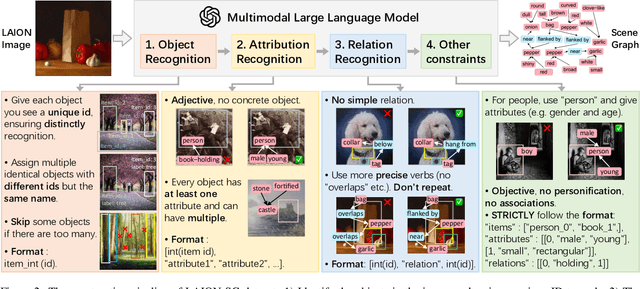
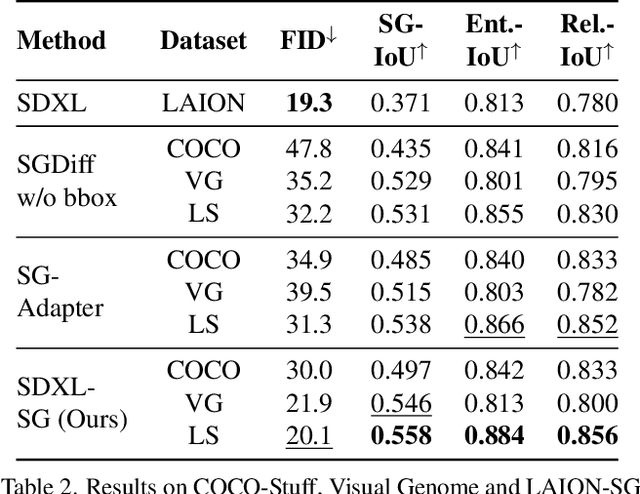
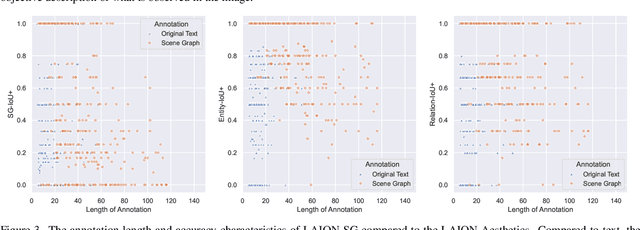
Recent advances in text-to-image (T2I) generation have shown remarkable success in producing high-quality images from text. However, existing T2I models show decayed performance in compositional image generation involving multiple objects and intricate relationships. We attribute this problem to limitations in existing datasets of image-text pairs, which lack precise inter-object relationship annotations with prompts only. To address this problem, we construct LAION-SG, a large-scale dataset with high-quality structural annotations of scene graphs (SG), which precisely describe attributes and relationships of multiple objects, effectively representing the semantic structure in complex scenes. Based on LAION-SG, we train a new foundation model SDXL-SG to incorporate structural annotation information into the generation process. Extensive experiments show advanced models trained on our LAION-SG boast significant performance improvements in complex scene generation over models on existing datasets. We also introduce CompSG-Bench, a benchmark that evaluates models on compositional image generation, establishing a new standard for this domain.